
Setting up residence in a one-room Siberian hut is a victory in the battle against being buried alive by objects. Life in the woods melts the fat away. Unburdened, the airship of life sails higher. Two thousand years ago, the Indo-Sarmatian steppe nomads knew enough to transport their possessions in a small wooden coffer. One's attachment to belongings is in direct proportion to their rarity, and to a Siberian woodsman, a knife and a gun are as precious as any flesh-and-blood companion. An object that has been with us through the ups and downs of life takes on substance and a special aura; the years give it a protective patina. To learn to love each one of our poor patrimony of objects, we have to spend a long time with them. Soon the loving looks directed at the knife, the teapot and the lamp come to embrace their materials and elements: the wood of the spoon, the candle's wax, the flame itself. As the nature of objects reveals itself, I seem to pierce the mysteries of their essence. I love you, bottle; I love you, little jackknife, and you wooden pencil, and you, my cup, and you, teapot steaming away like a ship in distress.
sylvain tesson, the consolations of the forest.
Showing posts with label sustainability. Show all posts
Showing posts with label sustainability. Show all posts
Jan 23, 2016
accumulated time


Jan 11, 2015
Jun 17, 2014
more than enough
the life of affluence and pleasure requires exact discipline and high imagination.
alan watts, does it matter?
Dec 18, 2013
value, counterfeits, authentication, and trust
these statements seem indisputable:
the more valuable a class of objects becomes, the more likely it is that someone will try to counterfeit instances of the class.let us consider the implications of this for bitcoin. the only media of exchange that are systemically immune to authentication-related trust failures (though not immune to local trust failures) are those in which trust in the medium is highly distributed.
the more counterfeiting attempts there are, the more likely it is that good counterfeits will be produced.
the better the counterfeits, the more effortful it will be to authenticate any object.
trust in the value of the class of objects is proportional to the ease with which any instance of the class can be authenticated.
Oct 28, 2013
Apr 30, 2013
observation
In short, men will find out that the men of our days were wrong in first multiplying their needs, and then trying, each man of them, to evade all participation in the means and processes whereby those needs are satisfied; that this kind of division of labour is really only a new and wilful form of arrogant and slothful ignorance, far more injurious to the happiness and contentment of life than the ignorance of the processes of Nature, of what we sometimes call science, which men of the earlier days unwittingly lived in. They will discover, or rediscover rather, that the true secret of happiness lies in the taking a genuine interest in all the details of daily life.on which, also see david pye and t.h. white.
william morris, "the aims of art"
Apr 17, 2013
the oak tree
The final shape of any one particular oak tree is unpredictable ... And a town which is whole, like an oak tree, must be unpredictable also.
The fine details cannot be known ahead of time. We may know, from the pattern language which is shared, what kind of town it will be. But it is impossible to predict its detailed plan: and it is not possible to make it grow according to some plan. It must be unpredictable, so that the individual acts of building can be free to fit themselves to all the local forces which they meet.
The people of a town may know that there is going to be a main pedestrian street, because there is a pattern which tells them so. But, they cannot know just where this main pedestrian street will be, until it is already there. The street will be built up from smaller acts, wherever the opportunity arises. When it is finally made, its form is partly given by the history of happy accidents which let the people build it along with their more private acts. There is no way of knowing, ahead of time, just where these accidents will fall.
This process, exactly like the emergence of any other form of life, alone produces a living order.christopher alexander, the timeless way of building
Apr 11, 2013
a big room, vast
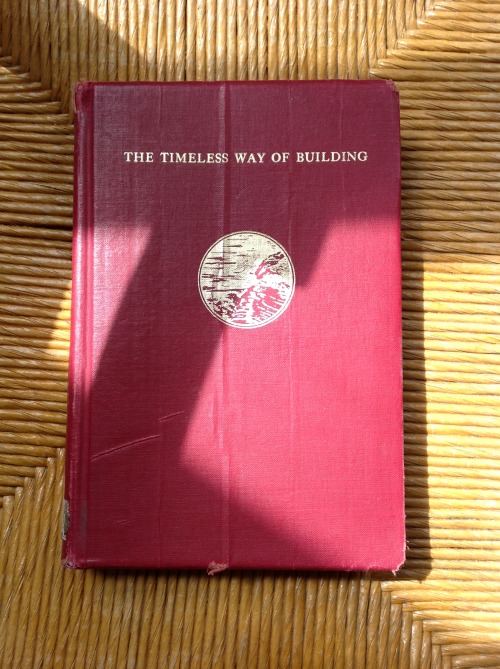
There is one timeless way of building ... But though this method is precise, it cannot be used mechanically. Indeed it turns out, in the end, that what this method does is simply free us from all method ... To purge ourselves of these illusions, to become free of all the artificial images of order which distort the nature that is in us, we must first learn a discipline which teaches us the true relationship between ourselves and our surroundings. Then, once this discipline has done its work, and pricked the bubbles of illusion which we cling to now, we will be ready to give up the discipline, and act as nature does. This is the timeless way of building: learning the discipline—and shedding it.
We have a habit of thinking that the deepest insights, the most mystical, and spiritual insights, are somehow less ordinary than most things—that they are extraordinary. This is only the shallow refuge of the person who does not yet know what he is doing. In fact, the opposite is true: the most mystical, most religious, most wonderful—these are not less ordinary than most things—they are more ordinary than most things. It is because they are so ordinary, indeed, that they strike to the core.christopher alexander, the timeless way of building
Mar 24, 2013
too light winning make the prize light
self-imposed limits on technology make it more likely that human ingenuity will develop an elegant response to its environment. the idea is not new, but it is certainly not en vogue.
Animal-drawn plows varied from country to country and even from one farm to the next. They had to be coordinated with the type of soil, the moisture content, the kind of planting, the draft animals used, and the farmer's own movement. When animals were replaced by mechanical power, plows were simplified, the differences between them became less, and the variations between plows used in some areas disappeared completely. With mechanical power, it was no longer necessary to design each plow individually. General plows were designed to work almost any kind of soil. The farmer was freed from the constraints of his environment. He no longer had to understand his plow in relation to his soil composition.
christopher and charlotte williams, craftsmen of necessity
Mar 9, 2013
drop by drop, it becomes a river
"Renunciation," I said, "even at this late date, can work." "I'd agree with that," said Arkady. "The world, if it has a future, has an ascetic future."
bruce chatwin, the songlines

Mar 4, 2013
going nowhere, seeking no victory
saturday, before dinner at 900 degrees in manchester, NH—a pizza parlor with no similarities to this new york museum of pizza diversity other than the name—we saw japanese swords at the nearby currier museum of art, which also contains a stunningly difficult laminated desk by jere osgood.
The narrow view of natural farming says that it is good for the farmer to apply organic material to the soil and good to raise animals, and that this is the best and most efficient way to put nature to use. To speak in terms of personal practice, this is fine, but with this way alone, the spirit of true natural farming cannot be kept alive. This kind of narrow natural farming is analogous to the school of swordsmanship known as the one-stroke school, which seeks victory through the skillful, yet self-conscious application of technique. Modern industrial farming follows the two-stroke school, which believes that victory can be won by delivering the greatest barrage of swordstrokes. Pure natural farming, by contrast, is the no-stroke school. It goes nowhere and seeks no victory.more fukuoka here. context is important: the pizza would have been better had greatness not been keenly anticipated.
Feb 18, 2013
design vs styling

It seems to me that there was no need for American Airlines to undertake such a change, but many people do not understand the difference between Design and Styling, and believe in change for the sake of change. Design cannot cover the mistakes of bad management, but styling can.vignelli is not infallible, but he is worth thinking about. design is an inextricable part of good management, whether it is the design of an organization or the organization's visual identity. and crucially, styling can cover the mistakes of bad management but not when it is poor styling.
Feb 17, 2013
bits, pieces
this is important.
How we spend our days is, of course, how we spend our lives. What we do with this hour, and that one, is what we are doing. A schedule defends from chaos and whim. It is a net for catching days. It is a scaffolding on which a worker can stand and labor with both hands at sections of time. A schedule is a mock-up of reason and order—willed, faked, and so brought into being; it is a peace and a haven set into the wreck of time; it is a lifeboat on which you find yourself, decades later, still living.more dillard here; more harrison here and here.
annie dillard, the writing life.
It is a somewhat shattering moment when we realize that our lives are made up of the particulars of what we do every day.
jim harrison, "cooking your life" in the raw and the cooked.
Dec 1, 2012
first principles
Before researchers become researchers they should become philosophers. They should consider what the human goal is, what it is that humanity should create ... Modern research divides nature into tiny pieces and conducts tests that conform neither with natural law nor with practical experiences. The results are arranged for the convenience of research, not according to the needs of the farmer. To think that these conclusions can be put to use with invariable success in the farmer's field is a big mistake.
Oct 20, 2012
moral fibre
edge.org interviews daniel lieberman. of particular note:
... there's a reversal of class today. Now, it's only the very wealthy who can afford to be physically active and to eat a good diet, and it's the lower classes, the people in the working classes that cannot afford to actually be physically active. People who are well-off, the one-percenters or maybe the five-percenters of our country, can afford to go to health clubs and take yoga classes and buy organic food. But most Americans today, particularly those who are in the working class, have to work all day long, they have to commute long hours. They don't have time to exercise; they can't afford to buy food that's very healthy. The result is that there's now an interesting reversal that never occurred before in human evolution, which is that the wealthier you are, the healthier you are.and
We love comfort, and people make a lot of money selling us comfort, but I would challenge the notion that comfort is usually good for us.the meditations and the care of the self are two interesting books to think about here, as is the influence of weather on the development of moral fibre.
Oct 19, 2012
low entropy life
what does a low entropy life look like? and is the only way to reduce entropy locally to export it into the enclosing system?
i hope this is more than just a rationalization of lifestyle choices.
Oct 18, 2012
for the time being
it's been a few years since i was up late in snowmass after a day at the woodshop reading annie dillard's for the time being, a many-threaded extended reflection on theodicy and the ways humans are evil to each other. the book ranges considerably into the realm of cultural evolutionary biology, which i've been thinking about of late (robert boyd and peter richerson write compelling about it in a book anyone interested in the evolution of culture should read). she writes:
Cultural evolution happens fast; it accelerates exponentially and, to put it less precisely, explodes. Biological evolution takes time, because it requires biological generations; the unit of reproduction is the mortal and replicating creature. Once the naked ape starts talking, however, "the unit of reproduction becomes" — in the words of anthropologist Gary Clevidence — "the mouth."more from pierre teilhard de chardin (who also plays a supporting role in dan simmons's hyperion cantos, one of my favourite space operas):
Geologists have considered every concentric layer forming the Earth except one: the layer of human thought. [chardin might also have said, and of human history and its impact on the land.] However far we look into the past, we see the waves of the multiple breaking into foam.a recurrent theme: the disparity between religion (which abrogates to itself the experience of holiness) and the experience of holiness itself.
Throughout my whole life, during ever minute of it, the world has been gradually lighting up and blazing before my eyes until it has come to surround me, entirely lit up from within. (chardin)freeman dyson's infinite in all directions (his gifford lectures) captures this same sense of holiness, of sensing the flame behind the form. there is also an element, as the shakers understood, of doing something for the sake of doing it. mother ann lee said "Do all your work as though you had a thousand years to live, and as though you were going to die to-morrow." dillard finds an example from one of the layers of our shared history:
The more I work, the more I see things differently, that is, everything gains in grandeur every day, becomes more and more unknown, more and more beautiful. The closer I come, the grander it is, the more remote it is. (giacometti)
Solutrean artisans knapped astonishing yellow blades in the shape of long, narrow pointed leaves. The longest Solutrean blade is fourteen inches long, four inches at its beam, and only one-quarter inch thick. Their intricate technique is overshot flaking; it is, according to Douglas Preston, "primarily an intellectual process" ... Hold one of these chert knives to the sky. It passes light. It shines dull, waxy gold — brown in the center, and yellow toward the edges as it clears. At each conchoidal fractured edge all the way around the double-ogive form, at each cove in the continental stone, the blade thins from translucency to transparency. You see your skin, and the sky. At its very edge the blade dissolves into the universe at large. It ends imperceptibly at an atom. Each of these delicate, absurd objects takes hundreds of separate blows to fashion. At each stroke and at each pressure flake, the brittle chert might — and, by the record, very often did — snap. The maker knew he was likely to lose many hours breath-holding work at a tap. The maker worked in extreme cold. He knew no one would ever use the virtuoso blades. He protected them, and his decendants saved them intact, for their perfection. To any human on earth, the sight of one of them means: someone thought of making, and made, this difficult, impossible, beautiful thing.looking beyond trappings and outward signs is the key. chardin is the originator of the virtual sacrament, first as a soldier in the second world war, and then later as an archaeologist in china:
Since once more, my Lord, not now in the forest of the Aisne but in the steppes of Asia, I have neither bread, nor wine, nor altar, I shall rise beyond symbols to the pure majesty of the real, and I shall offer you, I your priest, on the altar of the whole earth, the toil and sorrow of the world.it comes back to a particular type of love for the world:
We love in all we seek. The hidden shows up in too-plain sight. It lives captive on the face of the obvious — the people, events, and things of the day — to which we as sophisticated children have long since become oblivious. What a hideout: Holiness lies spread and borne over the surface of time and stuff like colour. What to do? There is only matter, Teilhard said; there is only spirit, the Kabbalists and Gnostics said. These are essentially identical views. Each impels and individual soul to undertake to divinize, transform, and complete the world, to — as these thinkers say quite as if there were both matter and spirit — "subject a little more matter to spirit," to "lift up the fallen and to free the imprisoned," to"work for the redemption of the world," to "extract spiritual power without letting any of it be lost," to "help the holy spiritual substance to accomplish itself in that section of creation in which we are living," to "mend the shattered unity of the divine worlds," to "force the gates of the spirit, and cry, 'Let me come by.'" When one of his Hasids complained of God's hiddenness, Rabbi Pinhas said, "It ceases to be a hiding if you know it is hiding." But it does not cease to hide, not ever, not under any circumstance, for anyone.on this, also see: a marvellous stage; wheatcakes; and the expanding self.
Aug 23, 2012
freedom and constraints
freedom is often misunderstood as the absence of constraints on your action. this is not the case: freedom is your ability to voluntarily choose the constraints on action and then to voluntarily submit to these constraints.
a useful consideration when designing products, services, organizations, careers, lives.
also see: kodawari, the key speech; mindful eating; equilibrium maintenance; the groundwork on the metaphysics of morals; the mad farmer liberation front; a just balance.
Jun 29, 2012
an equivocal and cautious age
But megalomania can be a useful counterbalance to our own equivocal and cautious age. Judd, whose work looks better as time goes by, reminds us via his Marfa empire what it is to care unreservedly, even maniacally, about art, which he regarded as synonymous with life, not peripheral to it.this is what i saw in marfa two years ago (even more).
michael kimmelman, "the last great art of the 20th century"
May 29, 2012
the essence of origami
I'm not trying to make a photograph, I'm trying to capture the essence, the impression of something. Some subjects I come back to over and over—cicadas, simple birds. I can do them in a different way and get ever closer to my mind's-eye image of what they ought to look like. You wouldn't think that origami could be reduced to equations, but some parts of it can. But the artistic aspect will never be captured in equations.on which, also see arthur ganson, robert irwin, and the unknown craftsman.
robert j. lang, "into the fold."
Subscribe to:
Posts (Atom)