
Setting up residence in a one-room Siberian hut is a victory in the battle against being buried alive by objects. Life in the woods melts the fat away. Unburdened, the airship of life sails higher. Two thousand years ago, the Indo-Sarmatian steppe nomads knew enough to transport their possessions in a small wooden coffer. One's attachment to belongings is in direct proportion to their rarity, and to a Siberian woodsman, a knife and a gun are as precious as any flesh-and-blood companion. An object that has been with us through the ups and downs of life takes on substance and a special aura; the years give it a protective patina. To learn to love each one of our poor patrimony of objects, we have to spend a long time with them. Soon the loving looks directed at the knife, the teapot and the lamp come to embrace their materials and elements: the wood of the spoon, the candle's wax, the flame itself. As the nature of objects reveals itself, I seem to pierce the mysteries of their essence. I love you, bottle; I love you, little jackknife, and you wooden pencil, and you, my cup, and you, teapot steaming away like a ship in distress.
sylvain tesson, the consolations of the forest.
Showing posts with label the good life. Show all posts
Showing posts with label the good life. Show all posts
Jan 23, 2016
accumulated time


Jun 17, 2014
more than enough
the life of affluence and pleasure requires exact discipline and high imagination.
alan watts, does it matter?
Apr 3, 2014
thorn hedge
To sit in the sun and read Columella on how to plant a thorn hedge is a pleasure I had to teach myself. No, I was teaching myself something else, and the thorn hedge came, wisely, to take its place. They're longer lasting than stone walls and have an ecology all their own. Birds nest in them and snails use them for a world. Hedgehogs, rabbits, snakes, spiders. Brier rose, dog thorn. There are some in England still standing from Roman times.
"the hunter gracchus," guy davenport
Mar 15, 2014
citrus

Everything, Jos was saying to Pascal, Sebastian, and Franklin, can be done well. The art of eating an orange, watch. We want all the juice, jo? The long blade of your pocketknife, whetted truly sharp, with which we make a triangle of three neat jabs in the navel of this big golden orange picked by a Spanish girl with one breast jundying the other. Lift out the tetrahedral plug so sculpted. Suck. Mash carefully and suck again. Now we slice the orange into quarters, sawing sweetly with the blade, so there's no bleeding of juice. Like so, O puppy tails. One for each of us. Nibble and pull: a mouthful of tangy cool fleshy toothsome orange. And Sebastian has squirted his all down his jammies, the world being as yet imperfect. Eat a bit of the peel along with the pulp: not as great as tangerine peel, as preferred by God and several of the archangels, but still one of the best tastes in the world. Seeds and the stringier gristle into the trash basket. Swallow the seeds and they'll grow an orange tree out of your ear. People who don't know how to eat an orange, like people who don't have the patience and cunning to pick all the meat out of a walnut, who don't eat peaches and apples skin and all, do not have immortal souls.
guy davenport, "wo es war, soll ich werden," in the death of picasso
In the morning, in the soft sultry chamber, sit in the window peeling tangerines, three or four. Peel them gently; do not bruise them, as you watch soldiers pour past and past the corner and over the canal to the watched Rhine. Separate each plump little pregnant crescent. If you find the Kiss, the secret section, save it for Al.
Listen to the chambermaid thumping up the pillows, and murmur encouragement to her thick Alsatian tales of l'interieur. That is Paris, the interior, Paris or anywhere west of Strasbourg or maybe the Vosges. While she mutters of seduction and French bicyclists who ride more than wheels, tear delicately from the soft pile of sections each velvet string. You know those white pulpy strings that hold tangerines into their skins? Tear them off. Be careful.
Take yesterday's paper (when we were in Strasbourg L'Ami du Peuple was best, because when it got hot the ink stayed on it) and spread it on top of the radiator. The maid has gone, of course—it might be hard to ignore her belligerent Alsatian glare of astonishment.
After you have put the pieces of tangerine on the paper on the hot radiator, it is best to forget about them. Al comes home, you go to a long noon dinner in the brown dining room, afterwards maybe you have a little nip of quetsch from the bottle on the armoire. Finally he goes. Of course you are sorry, but—
On the radiator the sections of tangerine have grown even plumper, hot and full. You carry them to the window, pull it open, and leave them for a few minutes on the packed snow of the sill. They are ready.
All afternoon you can sit, then, looking down on the corner. Afternoon papers are delivered to the kiosk. Children come home from school just as three lovely whores mince smartly into the pension's chic tearoom. A basketful of Dutch tulips stations itself by the tram-stop, ready to tempt tired clerks at six o'clock. Finally the soldiers stump back from the Rhine. It is dark.
The sections of tangerine are gone, and I cannot tell you why they are so magical. Perhaps it is that little shell, thin as one layer of enamel on a Chinese bowl, that crackles so tinily, so ultimately under your teeth. Or the rush of cold pulp just after it. Or the perfume. I cannot tell.
m.f.k. fisher, "borderland" in serve it forth.
Oranges were once the fruit of the gods, to whom they were the golden apples of the Hesperides, which were stolen by Hercules. Then, in successive declensions, oranges became the fruit of emperors and kings, of the upper prelacy, of the aristocracy, and, by the eighteenth century, of the rich bourgeoisie. Another hundred years went by before they came within reach of the middle classes, and not until early in this century did they at last become a fruit of the community.
john mcphee, oranges.
Mar 10, 2014
hymn to the banal
Languor
Billy Collins
I have come back to the couch—
hands behind my head,
legs crossed at the ankles—
To resume my lifelong study
of the ceiling and its river-like crack,
its memory of a water stain,
The touch of civilization
in the rounded steps of the molding,
and the lick of time in the flaking plaster.
To move would only ruffle
the calm surface of the morning,
and disturb shadows of leaves in the windows.
And to throw open a door
would startle the fish in the pond,
maybe frighten a few birds from a hedge.
Better to stay here,
to occupy the still room of thought,
to listen to the dog breathing on the floor,
better to count my lucky coins,
or redesign my family coat of arms—
remove the plow and hive, shoo away the bee.
Aug 31, 2013
understanding not control
I believe that the best pots are made by potters who have learned to understand rather than to control their materials and techniques.much like going nowhere and seeking no victory.
jack doherty [and also here]
Apr 30, 2013
observation
In short, men will find out that the men of our days were wrong in first multiplying their needs, and then trying, each man of them, to evade all participation in the means and processes whereby those needs are satisfied; that this kind of division of labour is really only a new and wilful form of arrogant and slothful ignorance, far more injurious to the happiness and contentment of life than the ignorance of the processes of Nature, of what we sometimes call science, which men of the earlier days unwittingly lived in. They will discover, or rediscover rather, that the true secret of happiness lies in the taking a genuine interest in all the details of daily life.on which, also see david pye and t.h. white.
william morris, "the aims of art"
Apr 11, 2013
a big room, vast
There is one timeless way of building ... But though this method is precise, it cannot be used mechanically. Indeed it turns out, in the end, that what this method does is simply free us from all method ... To purge ourselves of these illusions, to become free of all the artificial images of order which distort the nature that is in us, we must first learn a discipline which teaches us the true relationship between ourselves and our surroundings. Then, once this discipline has done its work, and pricked the bubbles of illusion which we cling to now, we will be ready to give up the discipline, and act as nature does. This is the timeless way of building: learning the discipline—and shedding it.
We have a habit of thinking that the deepest insights, the most mystical, and spiritual insights, are somehow less ordinary than most things—that they are extraordinary. This is only the shallow refuge of the person who does not yet know what he is doing. In fact, the opposite is true: the most mystical, most religious, most wonderful—these are not less ordinary than most things—they are more ordinary than most things. It is because they are so ordinary, indeed, that they strike to the core.christopher alexander, the timeless way of building

Mar 24, 2013
too light winning make the prize light
self-imposed limits on technology make it more likely that human ingenuity will develop an elegant response to its environment. the idea is not new, but it is certainly not en vogue.
Animal-drawn plows varied from country to country and even from one farm to the next. They had to be coordinated with the type of soil, the moisture content, the kind of planting, the draft animals used, and the farmer's own movement. When animals were replaced by mechanical power, plows were simplified, the differences between them became less, and the variations between plows used in some areas disappeared completely. With mechanical power, it was no longer necessary to design each plow individually. General plows were designed to work almost any kind of soil. The farmer was freed from the constraints of his environment. He no longer had to understand his plow in relation to his soil composition.
christopher and charlotte williams, craftsmen of necessity
Mar 13, 2013
bedtime reading
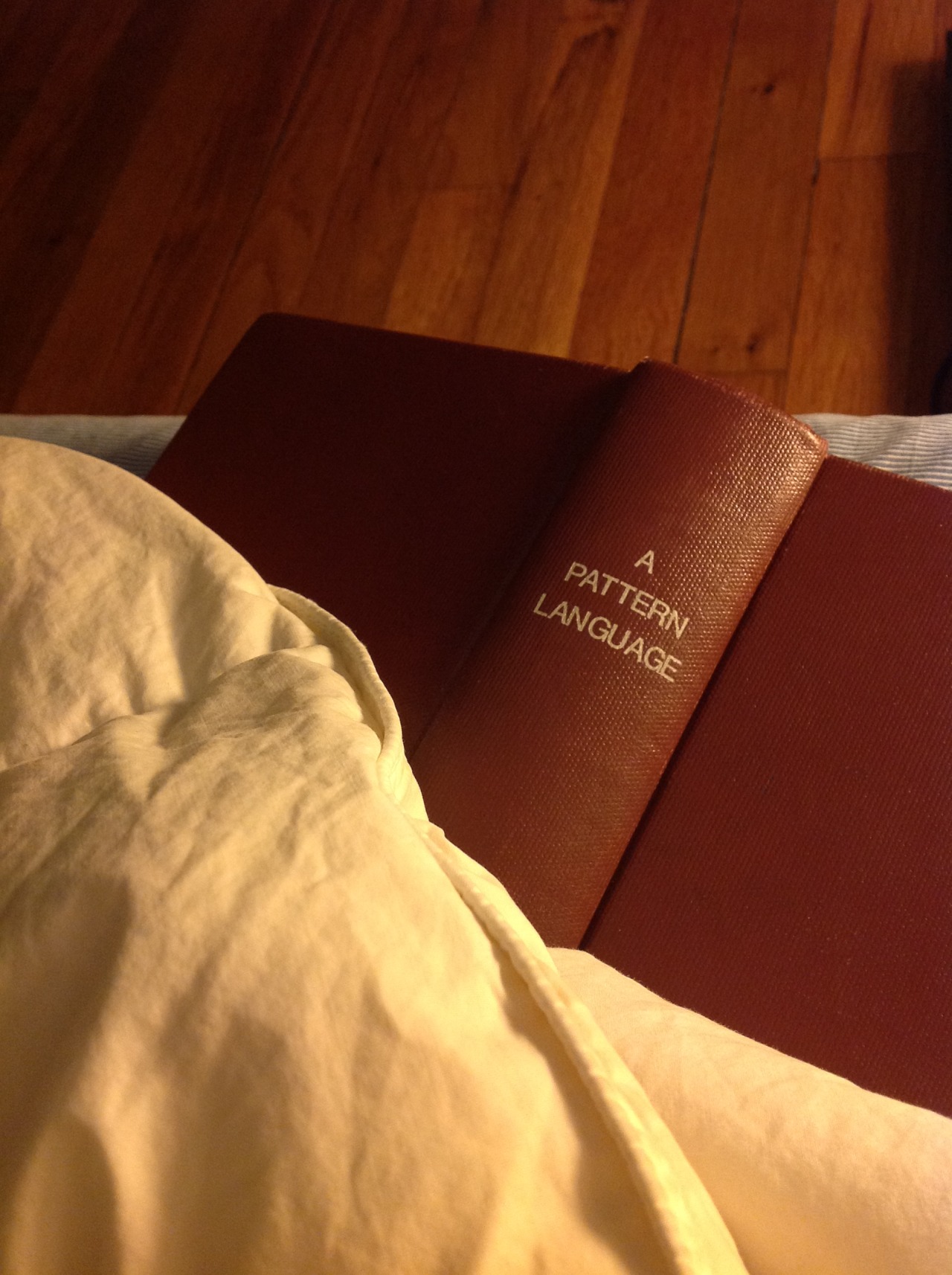
worthwhile, and the opening pages about pattern should be required reading for organizational behaviorists.
... no pattern is an isolated entity. Each pattern can exist in the world only to the extent that is supported by other patterns: the larger patterns in which it is embedded, the patterns of the same size that surround it, and the smaller patterns which are embedded in it. This is a fundamental view of the world. It says that when you build a thing you cannot merely build that thing in isolation, but must also repair the world around it, and within it, so that the larger world at that one place becomes more coherent, and more whole ...
christopher alexander and collaborators; a pattern language
the island
interviewer: What would you like to tell people?
andrei tarkovsky: I don’t know … I think I’d like to say only that they should learn to be alone and try to spend as much time as possible by themselves. I think one of the faults of young people today is that they try to come together around events that are noisy, almost aggressive at times. This desire to be together in order to not feel alone is an unfortunate symptom, in my opinion. Every person needs to learn from childhood how to spend time with oneself. That doesn’t mean he should be lonely, but that he shouldn’t grow bored with himself because people who grow bored in their own company seem to me in danger, from a self-esteem point of view.
[from the increasingly tiresome but still frequently interesting brainpickings, to whom i say: "concision is a virtue."]
Mar 4, 2013
going nowhere, seeking no victory
saturday, before dinner at 900 degrees in manchester, NH—a pizza parlor with no similarities to this new york museum of pizza diversity other than the name—we saw japanese swords at the nearby currier museum of art, which also contains a stunningly difficult laminated desk by jere osgood.
The narrow view of natural farming says that it is good for the farmer to apply organic material to the soil and good to raise animals, and that this is the best and most efficient way to put nature to use. To speak in terms of personal practice, this is fine, but with this way alone, the spirit of true natural farming cannot be kept alive. This kind of narrow natural farming is analogous to the school of swordsmanship known as the one-stroke school, which seeks victory through the skillful, yet self-conscious application of technique. Modern industrial farming follows the two-stroke school, which believes that victory can be won by delivering the greatest barrage of swordstrokes. Pure natural farming, by contrast, is the no-stroke school. It goes nowhere and seeks no victory.more fukuoka here. context is important: the pizza would have been better had greatness not been keenly anticipated.
Mar 3, 2013
the ocean of unknown possibility
richard feynman, he say: "i think it is much more interesting to live not knowing than to have answers that might be wrong." right on.
Feb 22, 2013
the entire staff

it continues to be my privilege to be acquainted with the entire staff of kat ran press. this week, i paid a too-short visit to its tastefully appointed, digitally warmed offices on myrtle street in cambridge, ma—a visit which demonstrated that while bad taste is ubiquitous, the exception proves the rule. the kat ran checklist you see above, under a copy of dogs are OK, is a catalogue raisonné containing a tough-minded, superb essay on design that does not exist online.
a good time was had by all. or, at least, by me.
Feb 17, 2013
bits, pieces
this is important.
How we spend our days is, of course, how we spend our lives. What we do with this hour, and that one, is what we are doing. A schedule defends from chaos and whim. It is a net for catching days. It is a scaffolding on which a worker can stand and labor with both hands at sections of time. A schedule is a mock-up of reason and order—willed, faked, and so brought into being; it is a peace and a haven set into the wreck of time; it is a lifeboat on which you find yourself, decades later, still living.more dillard here; more harrison here and here.
annie dillard, the writing life.
It is a somewhat shattering moment when we realize that our lives are made up of the particulars of what we do every day.
jim harrison, "cooking your life" in the raw and the cooked.
Feb 9, 2013
snow

if on a winter's night a traveler, this morning he would be a little bump in the white and smooth expanse. the mayor of new york city says BLIZZARD2013 is a good opportunity to catch up on some much-needed sleep. for some others of us, it has been a time to stretch out, guilt-free, with a good book and a hot beverage. in connection with this state of affairs, it should not go unremarked that rex stout's very first nero wolfe book, fer-de-lance, contains thrillingly specific uses of the words "myrmidon" and "excelsior." love of language is always a pleasure.
Jan 21, 2013
universal need
the 37signals blog sometimes throws up real gems. this is a long promotional video for the polaroid SX-70 SLR folding camera, beautifully made by the eames office. in just 10 minutes, the video shows the range of use-cases (close-up to far-away, static and dynamic objects, tight and loose compositions), the immediacy of the photographic act, a detailed explanation of not only the camera mechanism (which includes a camera battery in every pack of film, essentially guaranteeing that the battery never runs out at a critical moment) but also the remarkable built-in 3-colour additive integral instant film system, and a crisp summary of the motivations behind designing the SX-70.
let's hope that it will become commonplace for much time and care to be spent conceiving and building things intended to be consumed slowly and with nuanced appreciation, things that, in use, help us make ourselves better people. this is true not only of the video but of the SX-70 itself, an object designed with the optimistic goal of bringing out the best in its user:
"the user is the final link: the device helps meet the universal need to do things well. it offers as a matter of course a tool for supplying a rich texture to memory. more than that, thoughtful use can help reveal meaning to the flood of images that makes up so much of human life. we hope the user will fully complete the chain, gaining as much fun, as much sense of self, and as clear participation in the stream of human creativity as did edwin land and the team who first made SX-70."
Dec 6, 2012
negative capability
at once it struck me what quality went to form a man of achievement, especially in literature, and which Shakespeare possessed so enormously—I mean Negative Capability, that is when man is capable of being in uncertainties, mysteries, doubts without any irritable reaching after fact and reason.
Oct 23, 2012
going on progress
a 17-hour, 9.1 mile loop, with detours due to poor navigation. in order: everyman on west broadway, chambers street, some nyc city agencies, the west side linear park, the blue bottle on 15th, wework chelsea, the bowery kitchen supply store, blue bottle on 15th again, the high line, the architectural offices of diller scofidio + renfro, printed matter, moore brothers, booker and dax, and finally ippudo.
the high line is a gem in an already-great park city. i visited it a few days after it opened and remember being profoundly unimpressed by the sparse plantings but particularly liking the hardware fittings (look at those water fountains!). something made me come back whenever i was in the city and it was better every time.
the seating, plantings, and food/beverage choices are impeccable. a testament to the value of good taste combined with abundant cash and a benevolently autocratic decision-making process. there is a section just before the exit on 23rd st in which the footpath narrows slightly as it passes between two walls of abundantly leafed birches (a variety with strangely arrowhead-shaped leaves) trimmed just so their foliage pushes slightly into the path. the feeling of compression as you enter this passage of trees is a wonderful thing.
Oct 20, 2012
moral fibre
edge.org interviews daniel lieberman. of particular note:
... there's a reversal of class today. Now, it's only the very wealthy who can afford to be physically active and to eat a good diet, and it's the lower classes, the people in the working classes that cannot afford to actually be physically active. People who are well-off, the one-percenters or maybe the five-percenters of our country, can afford to go to health clubs and take yoga classes and buy organic food. But most Americans today, particularly those who are in the working class, have to work all day long, they have to commute long hours. They don't have time to exercise; they can't afford to buy food that's very healthy. The result is that there's now an interesting reversal that never occurred before in human evolution, which is that the wealthier you are, the healthier you are.and
We love comfort, and people make a lot of money selling us comfort, but I would challenge the notion that comfort is usually good for us.the meditations and the care of the self are two interesting books to think about here, as is the influence of weather on the development of moral fibre.
Subscribe to:
Posts (Atom)