
Showing posts with label libraries. Show all posts
Showing posts with label libraries. Show all posts
May 3, 2010


Jul 23, 2009
Feb 14, 2009
haroun and the sea of stories
haroun and the sea of stories is one of the childrens' books that adults should read. when i first came across it in secondary school, it made me read everything by rushdie i could get my hands on. with the exception of the moor's last sigh, most of it was disappointing by comparison.
He looked into the water and saw that it was made up of a thousand thousand thousand and one different currents, each one a different colour, weaving in and out of one another like a liquid tapestry of breathtaking complexity; and Iff explained that these were the Streams of Story, that each coloured strand represented and contained a single tale. Different parts of the Ocean contained different sorts of stories, and as all the stories that had ever been told and many that were still in the process of being invented could be found here, the Ocean of the Streams of Story was in fact the biggest library in the universe. And because the stories were held here in fluid form, they retained the ability to change, to become new versions of themselves, to join up with other stories and so become other stories; so that unlike a library of books the Ocean of the Streams of Story was much more than a storeroom of yarns. It was not dead but alive.
salman rushdie, haroun and the sea of stories
Jul 21, 2008
seeing is forgetting the name of the thing one sees
i've been trying to get a copy of lawrence weschler's wanderer in a perfect city for at least a year; the san francisco library had one copy (always on loan), and the pitkin county library is sadly deficient. beggars not being choosers, instead i took out a copy of weschler's biography of robert irwin, the west coast avant garde painter and engulfed it in just a few nights of reading. much of weschler's description of irwin's work over the last half-century reminded me of bench scientists and their relentless pursuit of resolutions to hypotheses (a psychotherapist in one of the painting workshops agreed with me)
— a sort of a research and development undertaking applied to art. not coincidentally, there is a fine art research and development program at the swedish royal academy of art.
Had one asked Irwin in 1965 how he viewed the relationship between his activity and that of a scientist, he might well have replied that he saw none whatsoever, or that he saw the two enterprises as diametrical opposites. By 1970 .. he had developed a rich sense of the interpenetration of the two endeavors. "Take a chemist, for example, he starts out with a hypothesis about what might be created if he combined a few chemicals, and he begins by simply doing trial and error ... What the artist does is essentially the same. In other words, what you do when you start to do a painting is that you begin with a basic idea, a hypothesis of what you're setting out to do ... It's just a million yes-no decisions. You try something in the painting, you look at it, and you say, 'N-n-no.' You sort of erase it out, and you move it around a little bit, put in a new line; you go through a million weighings. It's the same thing, the only difference is the character of the product. Let's say at a particular point the scientists gets what he set out to get, he arrives at what he projected might happen if he mixed the particular right combination of chemicals in the right way. But the same thing is true of the artist: when he finally gets the right combination, he stops, he knows he's finished.most rewarding were the many accounts of the extensive process underlying the final objects irwin produced (the line and dot canvases, the discs, the glass and acrylic monoliths, etc) — it validates the need to tool about in the shop or studio concentrating on process rather than product and figuring out what questions to ask and how to frame them. (production furniture is nearly, but not quite, the antithesis of a question-orientation).
There is a strain in the Jewish mystical tradition that asserts that there exist questions larger than the sum of their answers, questions all of whose possible answers would never exhaust them ... "The thing that really struck me the most as I got into developing my interest in the area of questions is the degree to which as a culture we are geared for just the opposite. We are past-minded, in the sense that all of our systems of measure are developed and in a sense dependent upon a kind of physical resolution. We tag our renaissances at the highest level of performance, whereas it's really fairly clear to me that once the question is raised, the performance is somewhat inevitable, almost just a mopping-up operation, merely a matter of time. Now, I'm not antiperformance, but I find it very precarious for a culture only to be able to measure performance and never to be able to credit the questions themselves."the constant pursuit of a goal which cannot be realised in the coarse stuff of the world is heroic, like trying to capture the meaning of a Dreaming without the right song, or trying to produce a 3D version of a 4D shape.
frank stella: "I always get into arguments with people who want to retain the old values in painting -- the humanistic values they always find on the canvas. If you pin them down, they always end up asserting that there is something besides the paint on the canvas. My painting is based on the fact that only what can be seen there is there ... If the painting were lean enough, accurate enough, or right enough, you would be able to just look at it ..." karsten harries, commenting on stella: "No matter how radical the pursuit of presence, the work of art will always fall short of that purer art that is its telos. It points beyond itself and lacks the plenitude it demands."the nice thing is, sometimes the heroic endeavor is rewarded, though not because but in spite of the trying.
Grace: you work and you work and you work at something that then happens of its own accord. It would not have happened without all that work, but the result cannot be accounted for as the product of the work in the sense that an effect is said to be the product of its causes. There is all that preparation — preparation for receptivity — and then there is something else beyond that, which is gratis, for free.last week, paul bowen took a pencil and drew a smiley face on a sheet of butcher paper and it had the most perfect line. he tried to replicate it and was unable to; we ended up tracing over it to produce a pale shadow of the original. but perfect lines are the result of this kind of beginner mind or state of grace, where consciousness recedes in the act of creation.
to really see is to penetrate through to the meaning-essence of the thing seen, to enter a state where the name of the thing becomes irrelevant, where the sign is replaced by the signified: forgetting the name of the thing one sees.
Jun 1, 2008
the future of ice
aspen has a remarkable circulating library for a town of 6,000 permanent residents. i took out madeleine l'engle's a circle of quiet, the first in a trilogy of autobiographical books in which she reflects on her writing life. i also picked up gretel ehrlich's the future of ice, which is a prolonged meditation on physical and psychological landscapes of cold. though it gets irritatingly handwavy at times, the writing is good and the subject matter at least reminds me constantly of barry lopez's arctic dreams and bruce chatwin's the songlines. her descriptions of how landscape and weather are intertwined are particularly beautiful:
The Selk'nam had four skies. Each was thought to be invisible and infinite, constituting a whole cordillera. Where they lived was a place of mountains, and they conceived of sky, ocean, and weather as being mountains as well. The north sky was black, associated with rain, the sea, and the whale. The west was red, made of wind and sun. The east was only a boiling ocean, and the south was pure white because that's where the snow came from, and the moon and the owl. These most southerly cultures in the world had winter weather threaded all through them. When asked about who her parents were, one Selk'nam woman said:"I am snow, my mother was wind, my father, rain."
Apr 22, 2008
caffeine and a sandwich
a highly-caffeinated 4 hours in seattle.
first stop was the espresso vivace at e denny and broadway to get some of emails out of the way, make a call, and wake up at a window counter made of blue volga granite. like any institution, vivace makes much of its history and the space (a large, high-ceilinged room sparsely populated with tables and chairs) reminds me of the original peet's coffee on walnut/vine in berkeley. apart from a wide selection of literature about coffee-making, vivace distinguishes itself by celebrating the latte art of its baristas. particularly beautiful latte art is commemorated with framed and dated photographs on the walls of the cafe (also turned into postcards on sale for a couple of dollars), and it appears to be a badge of honour to be placed on the wall. my latte was excellent (with velvety, micro-foamed steamed milk) and a perfectly symmetrical heart of a rich, rust-red hue; it was made by someone who was very proud of having just gotten her first wall photo (2nd column from the left on the east wall, left side, 2nd from the bottom). before leaving, i got a single-shot espresso just to see how much they were able to preserve the caramelised sugars in their roast; it was probably the sweetest, least bitter espresso i've ever had.
with two hours remaining, i wanted to get lunch at salumi, the fabled cured meats place in downtown seattle run by mario batali's father, armandino. on the way there, i passed stumptown roasters on pine street and was unable to resist stopping in for my third coffee in 2 hours (latte, also excellent), then walked the rest of the way to salumi feeling brittle, as if sudden motion might have unfortunate consequences.
 southern aspect of the seattle public library, from 4th ave
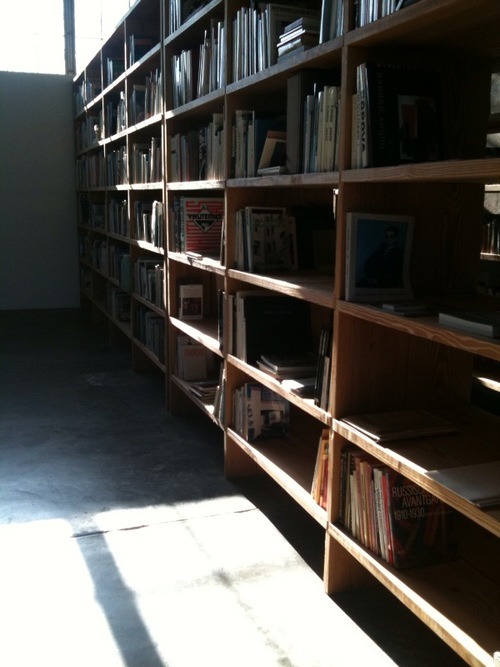
on 3rd avenue, i joined a crowd of walkers leaning into the wind as they walked south, and nearly missed the light yet massive angularity of rem koolhaas's seattle public library, which stacks are arranged in an unbroken spiral climbing many stories up into the prismatic volume of the building. i ducked in for a quick look and took a long series of escalators up to the reading room at the top of the library. the inside was as crystalline as the outside, and filled with medium-toned wood paneling and plenty of matte aluminum, lime green paint, glass, light, and high ceilings. it felt a lot like being inside the fortress of solitude, except with more books and lime green paint.
just down the street, the line outside armandino's was relatively short but glacially slow, and i was bookended by people who had never been there but had seen it on the food network. counter staff came out periodically to pass round small dishes of cured meats for the people in line to try: winter salami (with cracked black peppercorns), finocchiona (with fennel and black pepper), lamb prosciutto (a dark and translucent ruby colour). 45 minutes after getting in line, i got a hot braised oxtail sandwich with peppers, onions, and salsa verde on a baguette-shaped section of bread that actually tasted much more like damper than baguette. the crumb was dense and a pale grey, with large crystals of gluten and only a few airspaces; the crust was firm with only a light crunch. the oxtail had been braised for so long that it had fallen apart into small shreds bound together by a light marinara sauce. very nice.
Apr 19, 2008
the last one to go

on the second floor of the library at the MBL/woods hole oceanographic institute, a letter left behind by a japanese researcher abandoning his research station on one of the japanese islands ahead of the allied invasion:
This is a marine biological station with her history of over sixty years. If you are from the Eastern Coast, some of you might know Woods Hole or Mt Desert or Tortugas. If you are from the West Coast, you may know Pacific Grove or Puget Sound Biological Station. This place is a place like one of those. Take care of this place and protect the possibility for the continuation of our peaceful research. You can destroy the weapons and the war instruments. But save the civil equipments for Japanese students. When you are through with your job here notify to the University and let us come back to our scientific home.
The last one to go
Subscribe to:
Posts (Atom)