
Dominion over his environment was supposed to be one of the hallmarks of man. Now, that dominion is almost wholly vicarious, derived from the past ingenuity of others. In urban and industrial communities it is never direct, physical or spontaneous. Our implements are at twelve removes and we may all live inside so many thermos flasks. It may be well to remember how to use a pair of sticks and stones.as paul rand says: "It is important to use your hands, this is what distinguishes you from a cow or a computer operator."
sybille bedford, the sudden view
Showing posts with label moral fibre. Show all posts
Showing posts with label moral fibre. Show all posts
Jul 27, 2016
the span of control


Jan 23, 2016
accumulated time
Setting up residence in a one-room Siberian hut is a victory in the battle against being buried alive by objects. Life in the woods melts the fat away. Unburdened, the airship of life sails higher. Two thousand years ago, the Indo-Sarmatian steppe nomads knew enough to transport their possessions in a small wooden coffer. One's attachment to belongings is in direct proportion to their rarity, and to a Siberian woodsman, a knife and a gun are as precious as any flesh-and-blood companion. An object that has been with us through the ups and downs of life takes on substance and a special aura; the years give it a protective patina. To learn to love each one of our poor patrimony of objects, we have to spend a long time with them. Soon the loving looks directed at the knife, the teapot and the lamp come to embrace their materials and elements: the wood of the spoon, the candle's wax, the flame itself. As the nature of objects reveals itself, I seem to pierce the mysteries of their essence. I love you, bottle; I love you, little jackknife, and you wooden pencil, and you, my cup, and you, teapot steaming away like a ship in distress.
sylvain tesson, the consolations of the forest.
Mar 10, 2014
hymn to the banal
Languor
Billy Collins
I have come back to the couch—
hands behind my head,
legs crossed at the ankles—
To resume my lifelong study
of the ceiling and its river-like crack,
its memory of a water stain,
The touch of civilization
in the rounded steps of the molding,
and the lick of time in the flaking plaster.
To move would only ruffle
the calm surface of the morning,
and disturb shadows of leaves in the windows.
And to throw open a door
would startle the fish in the pond,
maybe frighten a few birds from a hedge.
Better to stay here,
to occupy the still room of thought,
to listen to the dog breathing on the floor,
better to count my lucky coins,
or redesign my family coat of arms—
remove the plow and hive, shoo away the bee.
Jun 21, 2013
the cow and the computer operator
It is important to use your hands, this is what distinguishes you from a cow or a computer operator.
May 28, 2013
the perks of ease and convenience
I traveled with West to New York. We stopped at a grocery store in which the cash registers were equipped with one of those devices that reads the price of an item automatically, a computerized checkout system. This one wasn't working well. West got down on his hands and knees and poked his head in under the cashier's counter to have a look at the thing. The clerk made her mouth an O. When West came out, dusting off his hands, he explained that he had helped design this particular model when he had worked at RCA. "It's a kludge," he said grinning. The clerk had some trouble figuring what the beer we bought ought to cost, and as we left, West said, out of her earshot, "Ummmmh, one of the problems with machines like that. You end up making people so dumb they can't figure out how many six-packs are in a case of beer."(where are they now? a status update from december 2000.)
tracy kidder, the soul of a new machine
Mar 24, 2013
too light winning make the prize light
self-imposed limits on technology make it more likely that human ingenuity will develop an elegant response to its environment. the idea is not new, but it is certainly not en vogue.
Animal-drawn plows varied from country to country and even from one farm to the next. They had to be coordinated with the type of soil, the moisture content, the kind of planting, the draft animals used, and the farmer's own movement. When animals were replaced by mechanical power, plows were simplified, the differences between them became less, and the variations between plows used in some areas disappeared completely. With mechanical power, it was no longer necessary to design each plow individually. General plows were designed to work almost any kind of soil. The farmer was freed from the constraints of his environment. He no longer had to understand his plow in relation to his soil composition.
christopher and charlotte williams, craftsmen of necessity
Mar 13, 2013
the island
interviewer: What would you like to tell people?
andrei tarkovsky: I don’t know … I think I’d like to say only that they should learn to be alone and try to spend as much time as possible by themselves. I think one of the faults of young people today is that they try to come together around events that are noisy, almost aggressive at times. This desire to be together in order to not feel alone is an unfortunate symptom, in my opinion. Every person needs to learn from childhood how to spend time with oneself. That doesn’t mean he should be lonely, but that he shouldn’t grow bored with himself because people who grow bored in their own company seem to me in danger, from a self-esteem point of view.
[from the increasingly tiresome but still frequently interesting brainpickings, to whom i say: "concision is a virtue."]
Nov 9, 2012
pithy
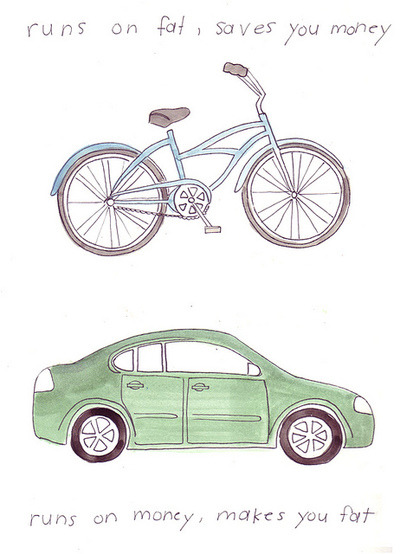
this summarises most of my feelings about cars and bicycles, though it leaves out the grim frustrations of parking in crowded cities, motorists who don't look when they open their doors or make turns, the particularly dispiriting nature of bicycling in wintry mix, and the gloom of car insurance and deductibles.
[found thanks to david neale, who is very cool*]
* did you click on the link and think "wtf?" don't fret: it is a feature not a bug. david neale is an australian jeweler and that is some item of personal adornment in the shape of a slice of rye. it is also available in danish.
Nov 5, 2012
things
Few people are interested in things, except the mechanics who like engines. They are more interested in themselves and humanity, and theories, and emotions. I suppose quite a large percentage of people would not be able to name a grain of wheat from a grain of oats, or perhaps even a blackbird from a rook. Our ancestors of the nineteenth century grew up with things, so that they were real to them and had a sort of comfortable companionship now lost. That is why their things are so often more individual than ours. An old hobby-horse, turned up in an attic, will sometimes be so real that it is a piece of art, and clamours to be put on show in the hall downstairs. Not so the mass-produced Dobbin of to-day.
Oct 25, 2012
nearly there
[from the archive]
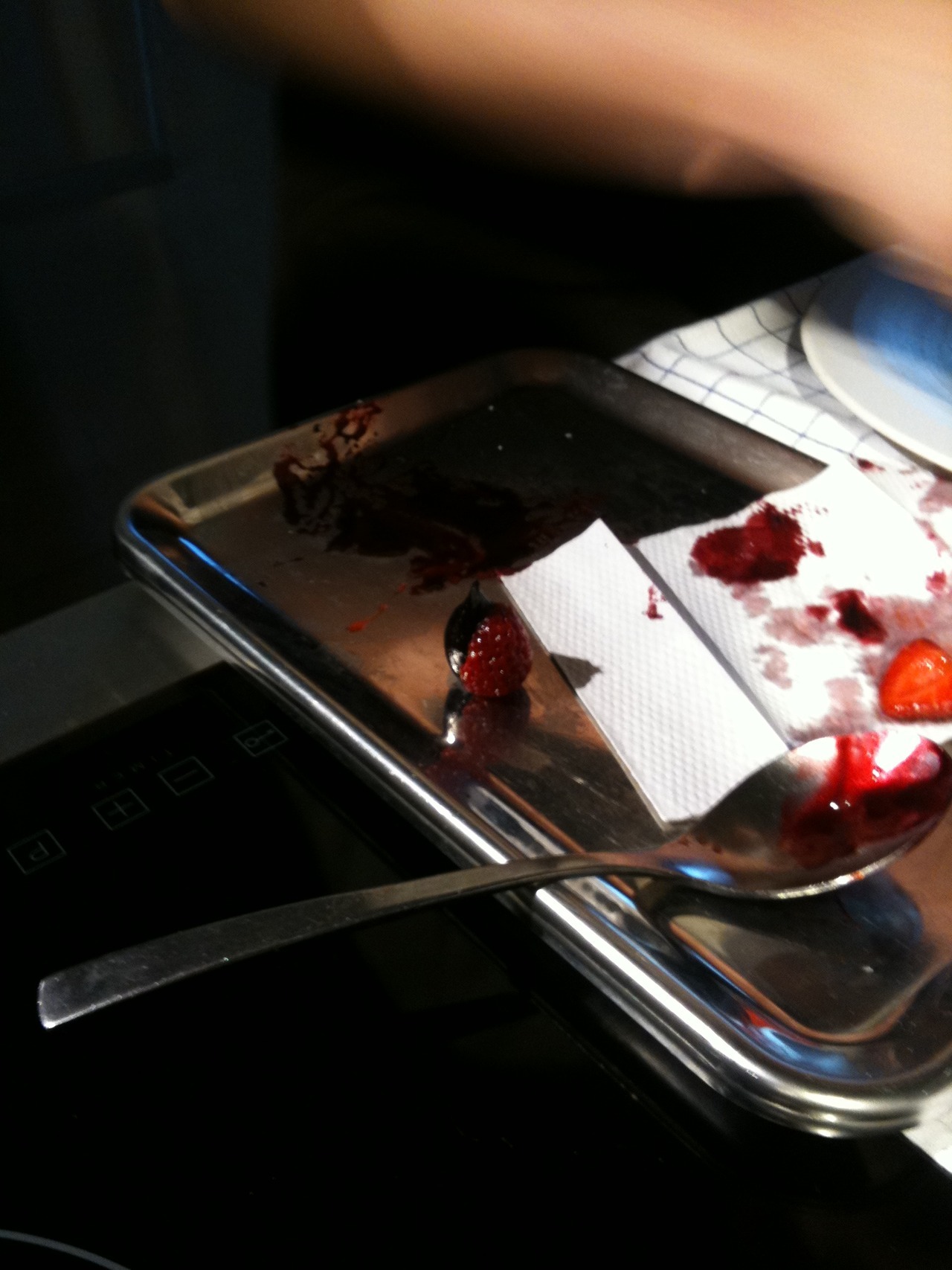
R&D in high-end cuisine looks a lot like R&D anywhere else, but some of its frustrations are domain-specific. up top, a dish that was nearly there but, as things turned out, not quite there enough.
read more here in the first of a series of vignettes on hydration is our highest priority illustrating life in some parts of the remarkably small world of research and development in food.
Oct 20, 2012
moral fibre
edge.org interviews daniel lieberman. of particular note:
... there's a reversal of class today. Now, it's only the very wealthy who can afford to be physically active and to eat a good diet, and it's the lower classes, the people in the working classes that cannot afford to actually be physically active. People who are well-off, the one-percenters or maybe the five-percenters of our country, can afford to go to health clubs and take yoga classes and buy organic food. But most Americans today, particularly those who are in the working class, have to work all day long, they have to commute long hours. They don't have time to exercise; they can't afford to buy food that's very healthy. The result is that there's now an interesting reversal that never occurred before in human evolution, which is that the wealthier you are, the healthier you are.and
We love comfort, and people make a lot of money selling us comfort, but I would challenge the notion that comfort is usually good for us.the meditations and the care of the self are two interesting books to think about here, as is the influence of weather on the development of moral fibre.
Jul 3, 2012
the nature and art of workmanship
People are beginning to believe you cannot make even toothpicks without ten thousand pounds of capital. We forget the prodigies one man and a kit of tools can do if he likes the work enough.
May 29, 2012
the essence of origami
I'm not trying to make a photograph, I'm trying to capture the essence, the impression of something. Some subjects I come back to over and over—cicadas, simple birds. I can do them in a different way and get ever closer to my mind's-eye image of what they ought to look like. You wouldn't think that origami could be reduced to equations, but some parts of it can. But the artistic aspect will never be captured in equations.on which, also see arthur ganson, robert irwin, and the unknown craftsman.
robert j. lang, "into the fold."
May 23, 2012
taste and choice
The thing I like most about rediscovering Led Zeppelin—and listening to the Chemical Brothers and The Bends—is that they can no longer be comfortably accommodated into my life. So much of what you consume when you get older is about accommodation: I have kids, and neighbours, and a partner who could quite happily never hear another blues-metal riff or a block-rockin' beat in her life. I have less time, less tolerance for bullshit, more interest in good taste, more confidence in my own judgement. The culture with which I surround myself is a reflection of my personality and the circumstances of my life, which is in part how it should be. In learning to do that, however, things get lost, too, and one of the things that got lost—along with a taste for, I don't know, hospital dramas involving sick children, and experimental films, was Jimmy Page. The noise he makes is not who I am any more, but it's still a noise worth listening to; it's also a reminder that the attempt to grow up smart comes at a cost.
nick hornby, songbook
Apr 23, 2012
setting type
or, rather, TeX. or, actually, LaTeX. what does someone who doesn't write equations need latex for? the awful truth is: i switched to latex so that i could automatically set old-style numerals. also, it is always nice to separate content from representation and data from metadata (as anyone who has ever had to clean up a word document's formatting will tell you).
latex (built on tex) is a document production system. its chief virtue is in separating content from representation. there is no way to do this without a) thinking through the structure of the document, b) learning how to represent the structure abstractly (ie, structural markup), then c) writing documents separately from how they will appear in finished form (but marked up for structure).
every production system involves massive up-front investments of time (the so-called "learning curve") before the palmy days begin. latex was no different. i spent many tasty hours learning how to insert images, write tables, rotate tables, control linespacing, etc. then, for more typographical control, i added the fontspec package and xelatex. this broke some environmental parameters, which required debugging. did i mention how some typefaces don't have correctly coded glyphs and don't work as expected? (= more debugging). then i decided to go for broke and move my citation database to bibtex. this consumed many more tasty days. now my papers look great, i cite effortlessly, and it's usually all just peachy.
my latex distribution is miktex (2.9). my typeface of choice is minion pro (it handles oldstyle numbering, is readable in block text), and i use the article document class. to handle graphics, i use the graphicx package. for typography, the fontspec package. for tables, the tabulary package. for citations, the natbib package. other miscellaneous utility packages include rotating (to rotate things like tables and figures), booktabs (for high-quality table formatting), and endfloat (to automatically move all figures to the end of a document; endfloat requires a separate configuration file in the source document directory if it is used with rotating).
i renew the quote environment to change the linespacing inside blockquotes. i manage my citation database with jabref and add new citations either by hand (if my citations come single spies) or by importing from zotero (if they come in battalions). i compile by running xelatex, bibtex, then xelatex twice more. (it took a long time to figure out how to get the commands to call the right input files, and that the \bibliography command requires filenames with extensions on some operating systems and not on others.)
then, a dark moment. in the late stages of preparing a manuscript for submission last week, i ran into a problem: the journal calls for an idiosyncratic reference style and provides no style file. two options: rewrite a style file to suit, or generate a new one. let all of us who have been in a similar quandary but lack extensive experience with stack languages thank the creator of this custom reference style maker. you answer a string of questions, it generates a file that you can then compile into a style file (.bst). this took a bit (well, no, let's be honest: hours and hours) of tweaking to get 98% right. (remaining 2%: do you know how i can force a linebreak between the author block and the year block and a tab character between the year block and the rest of the citation? if yes, please email me.)
"triumph!" i thought. but wait, .pdf files are verboten for this journal's submission machinery. fortunately, .ps files are ok. a simple matter, you might think, to take the .xdv files from xelatex and use dvips to produce a .ps file. except dvips doesn't work with .xdv. xpdf's pdftops converter saves the day (though erratic, it is the least temperamental and the one that copes best with transparency in the source pdf).
there must be a better way.
Apr 22, 2012
the argument for quality
Artists need to be in there from the start, making the argument for quality. The key to this thing is, for example, if you give an engineer a set of criteria which does not include a quality quotient, as it were—that is, if this sense of the quality, the character of the place, is not a part of his original motivation—he will then basically put the road straight down the middle. He has no reason to curve it. But if I can convince him that quality is absolutely a worthwhile thing and we can work out a way in which the road can be efficient and also wander down by the river, then we essentially have both: he provides quality in that the road works, I provide quality in that it passes by the river. In that way, art gets built into the criteria from the beginning rather than being added on afterward. In many cases, it may not cost any more, or just a bit more, for the road to wander by the river. As opposed to, say, giving the artist one per cent afterward—which is, hell, just tokenism to the nth degree. The best they’re going to be able to do is put in a few doodads. But if you affect this whole process from the beginning by putting in place some quality criteria and you look around and ask yourself who in this society are trained to make this argument for quality, the only ones that I can think of are artists. We’re the only ones with no real rationale for being except developing aesthetics, or quality—we have no other function. So our key role in our society right now—and what we’re really talking about here is translating values into dollars—is for artists to make winning arguments for why considerations of quality are absolutely necessary.
robert irwinin lawrence weschler's new yorker article "in a desert of pure feeling" [PDF]
Apr 2, 2012
a prescription for a grand cuisine
A prescription for a grand cuisine: Take a vigorous people, give them an empire, let them get accustomed to the spoils, and then take it all away again ... bit by bit. Palates accustomed to good things will fight—hard, then harder still—to keep them, or to find replacements. Luxuries now rationed will become distilled. The ultimate cuisine may not be as luxurious as it was in its "glory," but it will be more inspired, more various, and more complexly realized. Roman cooking was lavish; Italian cooking is great.
john thorne and matt lewis thorne, "la cuisine creole," in serious pig.
Mar 20, 2012
west coast weather report
i passed through san francisco this week on my way back east, causing two days of
nearly continuous mild drizzle across much of the bay area. weather notwithstanding, i walked through the mission as usual to inspect the latest crop of artisanal cafes and stores selling things that are nice but unnecessary, this time beginning at the blue bottle on mint street. by the time i got through soma, i had become most moist. this condition, for which tacos are
indicated, coincided with the close proximity of el norteno, a taco
truck in the parking lot on the corner of 6th and bryant. the carnitas
tacos did not disappoint, nor did the pickled carrots that came with.
aggressive weather promotes the development of moral fibre and philosophical thinking, for instance when you hole up in an ice cave with your sled dogs and reindeer carcase to ponder the transience of life while escaping a blizzard and polar bears. san francisco weather, in contrast, is much more like trying to fall asleep in an uncomfortably chilly room with a buggy thermostat, a too-thin blanket, and abundant finger foods.
Feb 21, 2012
a rectangle of radiant simplicity
The finished product was a rectangle of radiant simplicity, an unfancy, richly hued blank presence that was the predictable result, Barrett insisted, of selecting proper materials, preparing them in patient, time-honored ways and approaching their manufacture with a spirit of total dedication. “This is pretty much how it was done for 1,800 years,” he remarked. “By hand. One sheet at a time.”barrett worked at twinrocker paper for a while. the mark of the maker is a short documentary about them, and is worthwhile.
Nov 28, 2011
limitation
a discussion in the car during a long drive back from new hampshire brought this back to top of mind, where it should really always be.
One tires of living in the country, one moves to the city; one is tired of one's native land, one travels abroad; one is europamüde, one goes to America, and so on; finally one dreams of traveling endlessly from star to star. Or the movement is different but the same. One tires of porcelain dishes, one dines off silver; one tires of that, one dines off gold; one burns half of Rome to get an idea of the conflagration at Troy. This method defeats itself: it is the bad infinite. What did Nero achieve? Antonine was wiser; he says, "It is in your power to review your life, to look at things you saw before, from another point of view."also relevant: renunciation, words from a totem animal, hugh of st. victor, the inner chapters, little gidding, and ithaka. below, the original german:
The method I propose consists not in changing the soil but, as in the real rotation of crops, in changing the method of cultivation and type of grain. Here, immediately, we have the principle of limitation, which is the only saving one in the world. The more you limit yourself, the more resourceful you become. A prisoner in solitary confinement for life is most resourceful, a spider can cause him much amusement.
søren kierkegaard, either/or


Diese Wechselwirtschaft ist die vulgäre, die unkünstlerische, und hat ihren Grund in einer Illusion. Man mag nicht mehr auf dem Lande leben, und reist deshalb in die Residenz; man mag nicht mehr in seinem Vaterlande leben, man reist ins Ausland; man ist »europamüde« und reist nach Amerika u.s.w.; man schwelgt in der schwärmerischen Hoffnung einer unendlichen Reise von einem Stern zum andern. Oder die Bewegung nimmt eine andre, wenn auch noch extensivere Richtung. Man mag nicht mehr von Porzellan essen, man ißt von Silber oder von Gold; man brennt das halbe Rom ab, um den Brand Trojas zu sehen. Diese Methode hebt sich selber auf. Denn was erreichte Nero? Nein, da war Kaiser Antonio klüger, er sagt: anabiônai soi exestin; ide palin ta pragmata, hôs heôras; en toutô gar to anabiônai.
Die Methode, die ich vorschlage, liegt nicht darin, daß man immer neues Land nimmt; man würde dann auch bald am Ende sein. Die wahre Wechselwirtschaft besteht darin, daß man bald diese, bald jene Methode wählt und mit der Saat wechselt. Und da haben wir auch gleich das Prinzip der Beschränkung, das einzige, welches uns retten kann. Je mehr man sich selber beschränkt, um so erfinderischer wird nun. Ein Gefangener, der sein ganzes Leben in einsamer Zelle zubringen muß, von allen andern Gefangenen abgeschlossen, ist sehr erfinderisch; eine Spinne kann ihm die größte Unterhaltung sein. Hier haben wir das Prinzip, das durch seine Intensität, nicht durch seine Extensität Befriedigung sucht.
Subscribe to:
Posts (Atom)