Showing posts with label scalefree. Show all posts

Jul 3, 2015

lightness

Soon I became aware that between the facts of life that should have been my raw materials and the quick light touch I wanted for my writing, there was a gulf that cost me increasing effort to cross. Maybe I was only then becoming aware of the weight, the inertia, the opacity of the world—qualities that stick to writing from the start, unless one finds some way of evading them. At certain moments I felt that the entire world was turning into stone: a slow petrification, more or less advanced depending on people and places but one that spared no aspect of life.
italo calvino, lightness.

Oct 26, 2014

groups and individuals

The concept of intelligence is ambiguous when action and learning occur simultaneously at several nested levels of a system ... [s]ince experimentation often benefits those who copy successes more than it does the experimenting organization, managerial illusions of control, risk taking, and playful experimentation may be more intelligent from the point of view of a community of organizations than from the point of view of organizations that experiment.
barbara levitt and james march, "organizational learning" p335.

Apr 11, 2013

a big room, vast

There is one timeless way of building ... But though this method is precise, it cannot be used mechanically. Indeed it turns out, in the end, that what this method does is simply free us from all method ... To purge ourselves of these illusions, to become free of all the artificial images of order which distort the nature that is in us, we must first learn a discipline which teaches us the true relationship between ourselves and our surroundings. Then, once this discipline has done its work, and pricked the bubbles of illusion which we cling to now, we will be ready to give up the discipline, and act as nature does. This is the timeless way of building: learning the discipline—and shedding it.

We have a habit of thinking that the deepest insights, the most mystical, and spiritual insights, are somehow less ordinary than most things—that they are extraordinary. This is only the shallow refuge of the person who does not yet know what he is doing. In fact, the opposite is true: the most mystical, most religious, most wonderful—these are not less ordinary than most things—they are more ordinary than most things. It is because they are so ordinary, indeed, that they strike to the core.
christopher alexander, the timeless way of building


Mar 24, 2013

too light winning make the prize light

self-imposed limits on technology make it more likely that human ingenuity will develop an elegant response to its environment. the idea is not new, but it is certainly not en vogue.
Animal-drawn plows varied from country to country and even from one farm to the next. They had to be coordinated with the type of soil, the moisture content, the kind of planting, the draft animals used, and the farmer's own movement. When animals were replaced by mechanical power, plows were simplified, the differences between them became less, and the variations between plows used in some areas disappeared completely. With mechanical power, it was no longer necessary to design each plow individually. General plows were designed to work almost any kind of soil. The farmer was freed from the constraints of his environment. He no longer had to understand his plow in relation to his soil composition.
christopher and charlotte williams, craftsmen of necessity

Mar 13, 2013

bedtime reading


worthwhile, and the opening pages about pattern should be required reading for organizational behaviorists.

... no pattern is an isolated entity. Each pattern can exist in the world only to the extent that is supported by other patterns: the larger patterns in which it is embedded, the patterns of the same size that surround it, and the smaller patterns which are embedded in it. This is a fundamental view of the world. It says that when you build a thing you cannot merely build that thing in isolation, but must also repair the world around it, and within it, so that the larger world at that one place becomes more coherent, and more whole ...
christopher alexander and collaborators; a pattern language

Mar 9, 2013

drop by drop, it becomes a river

"Renunciation," I said, "even at this late date, can work." "I'd agree with that," said Arkady. "The world, if it has a future, has an ascetic future."
bruce chatwin, the songlines

Jan 23, 2013

purna kumbh mela


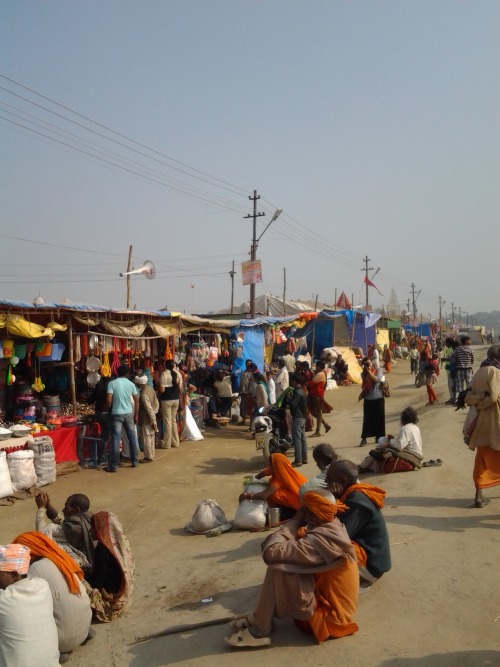
with the powerlines and streetlike aspect, this looks like a desert village. in fact, it is a view of sector 8 of the purna kumbh mela site. located on a floodplain just outside the city of allahabad in uttar pradesh, until a few weeks ago the site lay under the waters of the ganga and yamuna rivers. kilometers of steelplate roadway, thousands of tents, hundreds of public toilets and utility poles, and many temporary bridges have been built since december to make the site habitable for the event's 55-day duration.

the mela continues through the end of february but we're headed back to cambridge, ma today, scoured clean of karmic debt by the chilly waters of the ganga. the mela site's floodplain infrastructure and population continues to grow as the main bathing days approach, something the many vendors and entrepreneurs are counting on. a temporary city accommodating between 2 and 10 million people at any given time is a place to learn (among other things) about how to design more adaptable cities and communities: a topic for deeper consideration.

Dec 27, 2012

problem-finding, problem-solving

I think our whole society is much too problem-solving oriented. It is far more interesting to [participate in] ‘problem creation’ … You know, ask yourself an interesting enough question and your attempt to find a tailor-made solution to that question will push you to a place where, pretty soon, you’ll find yourself all by your lonesome — which I think is a more interesting place to be.
right on; i think of it as problem-finding myself.

Oct 19, 2012

low entropy life

what does a low entropy life look like? and is the only way to reduce entropy locally to export it into the enclosing system?

i hope this is more than just a rationalization of lifestyle choices.

Oct 18, 2012

for the time being

it's been a few years since i was up late in snowmass after a day at the woodshop reading annie dillard's for the time being, a many-threaded extended reflection on theodicy and the ways humans are evil to each other. the book ranges considerably into the realm of cultural evolutionary biology, which i've been thinking about of late (robert boyd and peter richerson write compelling about it in a book anyone interested in the evolution of culture should read). she writes:

Cultural evolution happens fast; it accelerates exponentially and, to put it less precisely, explodes. Biological evolution takes time, because it requires biological generations; the unit of reproduction is the mortal and replicating creature. Once the naked ape starts talking, however, "the unit of reproduction becomes"  in the words of anthropologist Gary Clevidence  "the mouth."
more from pierre teilhard de chardin (who also plays a supporting role in dan simmons's hyperion cantos, one of my favourite space operas):
Geologists have considered every concentric layer forming the Earth except one: the layer of human thought. [chardin might also have said, and of human history and its impact on the land.] However far we look into the past, we see the waves of the multiple breaking into foam.
a recurrent theme: the disparity between religion (which abrogates to itself the experience of holiness) and the experience of holiness itself.
Throughout my whole life, during ever minute of it, the world has been gradually lighting up and blazing before my eyes until it has come to surround me, entirely lit up from within. (chardin)

The more I work, the more I see things differently, that is, everything gains in grandeur every day, becomes more and more unknown, more and more beautiful. The closer I come, the grander it is, the more remote it is. (giacometti)
freeman dyson's infinite in all directions (his gifford lectures) captures this same sense of holiness, of sensing the flame behind the form. there is also an element, as the shakers understood, of doing something for the sake of doing it. mother ann lee said "Do all your work as though you had a thousand years to live, and as though you were going to die to-morrow." dillard finds an example from one of the layers of our shared history:
Solutrean artisans knapped astonishing yellow blades in the shape of long, narrow pointed leaves. The longest Solutrean blade is fourteen inches long, four inches at its beam, and only one-quarter inch thick. Their intricate technique is overshot flaking; it is, according to Douglas Preston, "primarily an intellectual process" ... Hold one of these chert knives to the sky. It passes light. It shines dull, waxy gold  brown in the center, and yellow toward the edges as it clears. At each conchoidal fractured edge all the way around the double-ogive form, at each cove in the continental stone, the blade thins from translucency to transparency. You see your skin, and the sky. At its very edge the blade dissolves into the universe at large. It ends imperceptibly at an atom. Each of these delicate, absurd objects takes hundreds of separate blows to fashion. At each stroke and at each pressure flake, the brittle chert might  and, by the record, very often did  snap. The maker knew he was likely to lose many hours breath-holding work at a tap. The maker worked in extreme cold. He knew no one would ever use the virtuoso blades. He protected them, and his decendants saved them intact, for their perfection. To any human on earth, the sight of one of them means: someone thought of making, and made, this difficult, impossible, beautiful thing.
looking beyond trappings and outward signs is the key. chardin is the originator of the virtual sacrament, first as a soldier in the second world war, and then later as an archaeologist in china:
Since once more, my Lord, not now in the forest of the Aisne but in the steppes of Asia, I have neither bread, nor wine, nor altar, I shall rise beyond symbols to the pure majesty of the real, and I shall offer you, I your priest, on the altar of the whole earth, the toil and sorrow of the world.
it comes back to a particular type of love for the world:
We love in all we seek. The hidden shows up in too-plain sight. It lives captive on the face of the obvious  the people, events, and things of the day  to which we as sophisticated children have long since become oblivious. What a hideout: Holiness lies spread and borne over the surface of time and stuff like colour. What to do? There is only matter, Teilhard said; there is only spirit, the Kabbalists and Gnostics said. These are essentially identical views. Each impels and individual soul to undertake to divinize, transform, and complete the world, to  as these thinkers say quite as if there were both matter and spirit  "subject a little more matter to spirit," to "lift up the fallen and to free the imprisoned," to"work for the redemption of the world," to "extract spiritual power without letting any of it be lost," to "help the holy spiritual substance to accomplish itself in that section of creation in which we are living," to "mend the shattered unity of the divine worlds," to "force the gates of the spirit, and cry, 'Let me come by.'" When one of his Hasids complained of God's hiddenness, Rabbi Pinhas said, "It ceases to be a hiding if you know it is hiding." But it does not cease to hide, not ever, not under any circumstance, for anyone.
on this, also see: a marvellous stagewheatcakes; and the expanding self.

Sep 27, 2012

openness, regulation, ambiguity

The grid is not only predictable but indeterminate, not only prescriptive but ambiguous.
albert pope, "the open city," in ladders.

Aug 23, 2012

freedom and constraints

freedom is often misunderstood as the absence of constraints on your action. this is not the case: freedom is your ability to voluntarily choose the constraints on action and then to voluntarily submit to these constraints.

a useful consideration when designing products, services, organizations, careers, lives.

also see: kodawarithe key speechmindful eatingequilibrium maintenancethe groundwork on the metaphysics of moralsthe mad farmer liberation front; a just balance.

Jun 29, 2012

an equivocal and cautious age

But megalomania can be a useful counterbalance to our own equivocal and cautious age. Judd, whose work looks better as time goes by, reminds us via his Marfa empire what it is to care unreservedly, even maniacally, about art, which he regarded as synonymous with life, not peripheral to it.
this is what i saw in marfa two years ago (even more).

Apr 30, 2012

intentional ambiguity

Tenses are important:

abstract: This ethnography of nine internationally renowned avant-garde culinary groups in the US and Europe shows that they operate successfully despite having intentionally ambiguous (and hence uncertain and unstable) member roles and group goals. This is in contrast to the sizeable body of research suggesting that individuals and groups need clarity and stability to function effectively. I describe how this intentional ambiguity modifies group and interpersonal processes in these groups, then propose explanations for how these modifications might allow them to adapt to changing resources and environments and enable their members to teach and learn complex things such as house style. I conclude by showing how internal ambiguity supports adaptability and thus helps groups respond to external ambiguity.

TL;DR version: Ambiguity and uncertainty are not always bad. Wisely deployed, they can be beneficial for those in the business of innovation or working in unpredictable and rapidly changing environments. Which is nearly everyone working in a high-end restaurant, a startup, or an R&D group these days.

Just saying.

committee: Christopher Winship (co-chair), Amy Edmondson (co-chair), Jeffrey Polzer.

Apr 22, 2012

the argument for quality

Artists need to be in there from the start, making the argument for quality. The key to this thing is, for example, if you give an engineer a set of criteria which does not include a quality quotient, as it were—that is, if this sense of the quality, the character of the place, is not a part of his original motivation—he will then basically put the road straight down the middle. He has no reason to curve it. But if I can convince him that quality is absolutely a worthwhile thing and we can work out a way in which the road can be efficient and also wander down by the river, then we essentially have both: he provides quality in that the road works, I provide quality in that it passes by the river. In that way, art gets built into the criteria from the beginning rather than being added on afterward. In many cases, it may not cost any more, or just a bit more, for the road to wander by the river. As opposed to, say, giving the artist one per cent afterward—which is, hell, just tokenism to the nth degree. The best they’re going to be able to do is put in a few doodads. But if you affect this whole process from the beginning by putting in place some quality criteria and you look around and ask yourself who in this society are trained to make this argument for quality, the only ones that I can think of are artists. We’re the only ones with no real rationale for being except developing aesthetics, or quality—we have no other function. So our key role in our society right now—and what we’re really talking about here is translating values into dollars—is for artists to make winning arguments for why considerations of quality are absolutely necessary.
robert irwin
in lawrence weschler's new yorker article "in a desert of pure feeling" [PDF

Apr 15, 2012

the myth of risk reduction

garry kasparov, considering the slowdown in technological development*, writes that

People have a sense that we should receive benefits from our investment, but need to reduce the uncertainty. Risk should be less, but the income should be the same. This creates a gap, because in a free society, in a market economy, there is a direct relationship between risk and return. If you want to avoid risk, but receive ten percent of of your annual income from your investment, you open the way for the so-called financial engineering. In fact this is all fake, not real income, because it is not based on real changes in the economy, because you do not create new and tangible assets. In the 1960s young boys dreamed of becoming aerospace engineers, now they want to be financial engineers, working in investment companies, which are the most attractive spheres for talent. This naturally affects the quality of the total scientific potential, because financial engineering creates nothing.
he's right, of course, though it would have been nice to distinguish between risk and uncertainty as frank knight (1921) did:
Uncertainty must be taken in a sense radically distinct from the familiar notion of Risk, from which it has never been properly separated.... The essential fact is that 'risk' means in some cases a quantity susceptible of measurement, while at other times it is something distinctly not of this character; and there are far-reaching and crucial differences in the bearings of the phenomena depending on which of the two is really present and operating.... It will appear that a measurable uncertainty, or 'risk' proper, as we shall use the term, is so far different from an unmeasurable one that it is not in effect an uncertainty at all.
the return on any investment (or, more generally, the outcome of any action) comprises three conceptually distinct components: a known part, a knowable unknown part, and an unknowable unknown part. the knowable unknown is risk, and risk can be "reduced" or "managed" by spending effort, time, and money in advance: gathering information and preparing defensive assets of a known nature and quantity.

the unknowable unknown is uncertainty and is not reducible by advance action. the only way to "manage" uncertainty is to be ready to respond to conditions as they change unpredictably: this is costly in a different way since it requires creating a potentially enormous reservoir of excess capacity with which to respond. maintaining this excess capacity is expensive and may not pay off in the short or even the medium term.

responding to risk and responding to uncertainty require different approaches and different processes. all innovation requires both types of response. innovation in rapidly and unpredictably changing environments requires more preparation for uncertainty than risk. surprise! this will be my dissertation.

* found, since i read chessbase only infrequently, through tyler cowen's marginal revolution.

Feb 21, 2012

a rectangle of radiant simplicity

The finished product was a rectangle of radiant simplicity, an unfancy, richly hued blank presence that was the predictable result, Barrett insisted, of selecting proper materials, preparing them in patient, time-honored ways and approaching their manufacture with a spirit of total dedication. “This is pretty much how it was done for 1,800 years,” he remarked. “By hand. One sheet at a time.”
mark levine, on timothy barrett, in the new york times.
[thx ben]
barrett worked at twinrocker paper for a while. the mark of the maker is a short documentary about them, and is worthwhile.

Dec 12, 2011

pattern

A pattern has an integrity independent of the medium by virtue of which you have received the information that it exists. Each of the chemical elements is a pattern integrity. Each individual is a pattern integrity. The pattern integrity of the human individual is evolutionary and not static.
r. buckminster fuller, synergetics: explorations in the geometry of thinking (505.201).

Nov 13, 2011

a marvellous stage

From the age of six I had a mania for drawing the forms of things. By the time I was fifty I had published an infinity of designs, but all I produced before the age of seventy is not worth taking into account. At seventy-five I have learned a little about the real structure of nature—of animals, plants and trees, birds, fishes, and insects. In consequence when I am eighty I shall have made still more progress. At ninety I shall penetrate the mystery of things; at a hundred I shall certainly have reached a marvellous stage; and when I am a hundred and ten, everything I do—be it but a line or dot—will be alive.
katsushika hokusai
on this, also see the true names of things, wheatcakes, and a certain atlas.

Jun 2, 2011

freedom, choices, style

You're bringing an informed aesthetic point of view to a visual problem. You have freedom, so you have to make choices—and at the point when I make a choice, the building starts to look like a Frank Gehry building: It's a signature.