
mobilia gallery; upland street; hungry ghost bread; housatonic; sparks street (geoff hargadon)
Showing posts with label bread. Show all posts
Showing posts with label bread. Show all posts
Jun 22, 2016
neither here nor there


Jul 10, 2011
the st john cream donut
the borough market on saturday was a zoo, as you might expect. the line for monmouth snaked around the big table in the shop, then exited the building and went around the corner. but word on the street is that the only reliable time and place to get these cream donuts is on saturday mornings at the st john bakery outpost in the borough market neals yard. there would be a photograph here of the best filled donuts i've ever had, but they were too quickly engulfed.*
May 10, 2011
i too have stolen a cake
"To summon a thing that is not there at all, to call it by speaking its true name, that is a great mastery, not to be lightly used. Not for mere hunger's sake. Yarrow, your little dragon has stolen a cake."
Yarrow had listened so hard, gazing at Ged as he spoke, that she had not seen the harrekki scuttle down from its warm perch on the kettle-hook over the hearth and seize a wheatcake bigger than itself, She took the small scaly creature on her knee and fed it bits and crumbs, while she pondered what Ged had told her.
"So then you would not summon up a real meat-pie lest you disturb what my brother is always talking about—I forget its name—"
"Equilibrium," Ged replied soberly, for she was very serious.
"Yes, but when you were shipwrecked, you sailed from the place in a boat woven mostly of spells, and it didn't leak water. Was it illusion?"
"Partly it was illusion, because I am uneasy seeing the sea through great holes in my boat, so I patched them for the looks of the thing. But the strength of the boat was not illusion, nor summoning, but made with another kind of art, a binding spell. The wood was bound as one whole, one entire thing, a boat. What is a boat but a thing that doesn't leak water?"
"I've bailed some that do," said Murre. "Well, mine leaked, too, unless I was constantly seeing to the spell." Ged bent down from his corner seat and took a cake from the bricks, and juggled it in his hands. "I too have stolen a cake."
"You have burned fingers, then. And when you're starving on the waste water between the far isles you'll think of that cake and say, Ah! had I not stolen that cake I might eat it now, alas!—I shall eat my brother's, so he can starve with you—"
"Thus is Equilibrium maintained," Ged remarked...
ursula le guin, a wizard of earthsea

Apr 2, 2011
things fall apart
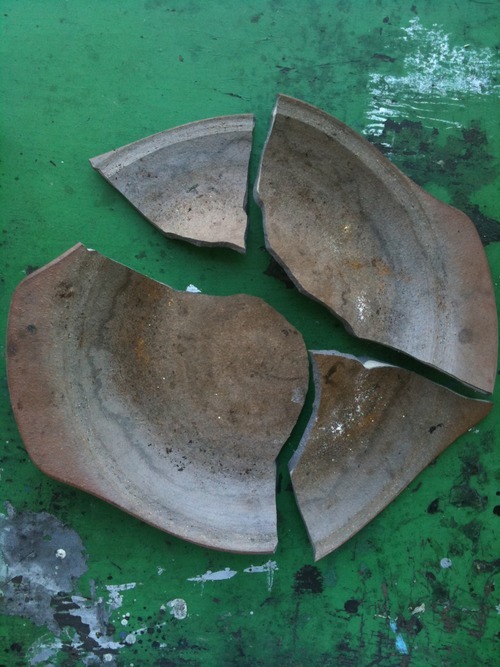
the awesome bread device died catastrophically yesterday while baking a 25% rye sourdough. i brought the carcass to judy motzkin and she thinks it may be a result of the firing process evolving a crystalline form of silica that makes the resultant clay more susceptible to thermal shock at the range of temperatures involved in baking tasty bread. she investigates even now. the universe of subjective knowledge expands outward at a speed far exceeding the individual's capacity to understand it.
Mar 30, 2011
rye
judy motzkin's cloche slays it again. after various experiments with long-retardation, i began to fool around with rough-milled rye and increasing the amount of starter in the dough (this is a formula from peter reinhardt, by way of wildyeast). this accelerates the first fermentation ("bulk fermentation") of the dough so that you could, if you wanted, have fresh bread in about 6 hours.
rye makes dough sticky beyond belief and appears to become workable by hand only after lots and lots of retardation in a nice cold refrigerator. i followed instructions for time and temperature (which did not include a long cold period), so did not benefit. if you choose to knead a rye-heavy dough by hand, here are some discoveries i have made.
- dough on fingers dissolves most readily in warm water. hot water, apart from being uncomfortable, also cooks the dough onto you.
- answering the phone while kneading is not recommended.
- wood toothpicks are best for getting dough out of the spaces between cellphone keys.
- folding the dough is easier and more effective than kneading it.
as a test, i split the dough into two batches of equal mass, one baked with the cloche and the other on a pizza stone with a steel mixing bowl over the top. the loaf you see below is from the cloche: mildly sour, lots of rye flavour, incredible oven spring, great crisp, caramelised crust, tender crumb with great aeration.


this competent but much less delightful loaf is from the stone. still decent oven spring, nice-ish crust caramelisation, but the final rise in the oven was not as uniform, and the crumb is not as well aerated (alas, no crumb shot):

Dec 16, 2010
best croissant of 2010
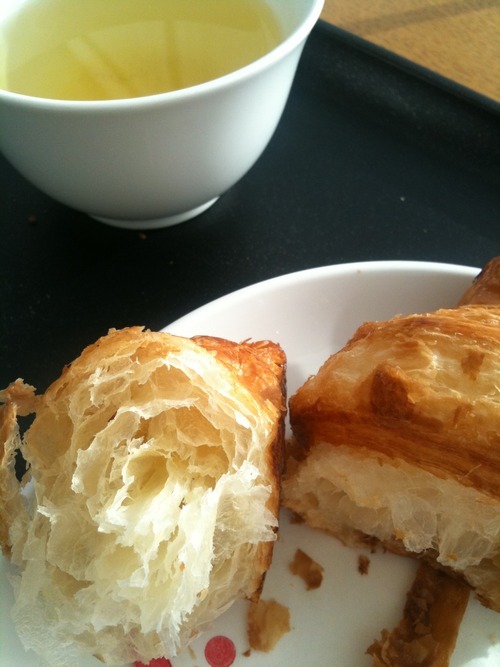
this maison kayser croissant and an apparently unlimited supply of skytime yuzu are about the only benefits of a long layover in narita.
Aug 14, 2010
the chemical sandwich
"every hour is banh mi hour, if the sandwich is eaten within five minutes of it being made. There is something close to alchemy when the baguette is still hot and has lent its warmth to the pâté and the sausage, while not wilting the cilantro or cucumber spears."
Jun 6, 2010
frederiks have
[clearing out the backlog from denmark—i had remarkably good luck eating in copenhagen.]
so, you never go to a conference expecting a really nice dinner. at least, i don't. but surprises are sometimes pleasant. we finished the first day of papers early and were instructed to reassemble at frederiks have, smallegade 41 at 7pm. i left for the restaurant 30 minutes earlier than i had to so i could see what the neighbourhood was like, immediately took a wrong turn, and wound up on a completely residential side street innocent of all but the most mundane charms. i popped out eventually, by sheer chance, on the cross street the restaurant is on and was puzzled by the shutters on the shopfront until i heard a piercing whistle from the people assembled in the outdoor garden around the corner. we sat outside with beers until the rest of the contingent showed up.
the first good sign was an enormous lozenge-shaped carved wood bowl filled with the kind of heavily-caramelized baguette that you know will have a crisp, resilient (yet tender) crust, and a soft, gelatinised crumb. some of these showed up on the table shortly, accompanied by a remarkable, crusty sourdough bread rich with olive oil and sea salt and baked in tiny rounds the size of a small biscuit. they required no butter, but i put some on anyway. at this point, i allowed myself a tiny, pre-emptive chuckle at my luck. a good bread basket is almost always a good sign.
then the first wine of the night emerged, one of three selected by the owner to go with dinner. it was a 2009 natural yeast fermented pinot gris from alsace, from a biodynamic producer called josmeyer. this was richly-flavoured with the flavour (but not much of the fragrance) of soft stone fruit and sweet, but also crisp with acidity. having the owner choose and pour a good biodynamic wine from a relatively unfashionable grape/region combination is a good sign (on which, also see chapeau!). the restaurant was full and the kitchen was open and quiet: a very good sign.
as it turned out, frederiks have is one of the small but growing number of restaurants in copenhagen informed by the manifesto of the new nordic cuisine. the food was consciously seasonal, simple yet complex (you'll see in a minute), competent while concealing its technical refinement, and the staff were serious but weren't taking themselves seriously. awesome. the crockery was white, graciously proportioned, not oddly shaped, and didn't call attention to itself.
dinner was:
- a perfectly poached egg, fat spears of poached green and white asparagus, tiny boiled fjord shrimp, a sharpish foamed custard hollandaise of stinging nettle and shellfish fumet (probably made with the shells and boiling liquid from the fjord shrimp). [mise du printemps, 2009, jos meyer, alsace]
- lamb loin cooked sous-vide to a perfect rareness, then seared quickly to crisp the binding of fat, served with a rectangle of lamb rillettes, fried green cabbage, roasted golden beet, golden beet and sherry vinegar puree, dill, and roasted new yellow potatoes. [avan tempranillo, 2008, nascimento, ribera del duero—a tempranillo with smooth tannins, purple tasting, dry finish, violets]
- a rhubarb soda, pacojet rhubarb ice cream, (green) rhubarb preserve with (green) rhubarb brunoise, white chocolate mousse, cardamom crumbs. [a sparkling gamay FRV jean-paul brun, beaujolais]
at 8.30pm, the kitchen was halfway broken down and ole, the owner, let me poke my head inside. while i talked with mattias the chef (who was passing a heavily reduced stock through some flannel), ole mopped up the floor.* they serve 40-50 covers with a cvap, an immersion circulating heater, a pacojet, and a 4-burner stove and flat-top.
together with great conversation, mark this down as another perfect meal.
* a nicely democratic touch. they also list every major employee, including the waitstaff, on their website.
Apr 3, 2010
sandwich theory
here in the northeast, it is a clear nearly-spring morning (we have to say that, in case it actually still is winter) and the dawn chorus has just been and gone. i am up at 6.20am, for reasons that will be detailed anon, and have just breakfasted on a toasted burrito of my own confection (turtle beans, chipotle morita, aged cheddar, avocado, cilantro and red onion, cholula, on a wheat tortilla). i could eat these every day, they're so tasty.
today, i made a tactical error: i folded the herbs and cold avocado into the burrito and toasted everything slowly on cast iron. i had forgotten that, in some things, there is an absolute minimum number of steps required for satisfactory results. when added only at the end, the cilantro, onion, and avocado in one of these toasted burritos are the requisite cold and crunchy counterpoint to the soft, warm cheese and beans.
which brings us to theory. great sandwiches almost always have contrast. few of the sandwiches i love are uniformly one or another temperature, which is why most of the truly great sandwiches must be made to order and consumed instantly. the two top of mind are: 1) the grilled english muffin, sweet butter, honey, and sea salt; 2) the toasted focaccia or sweet baguette, olive oil, cheddar, tomato, scallions, black pepper.
1) has to be cold and rapidly melting butter, cold honey, salt, blazingly hot muffin. 2) has to be a warm, crusty (but still tender) bread, thinly-sliced, ripe, cold tomatoes, thinly-sliced, cold scallions, cool or room-temperature cheddar, olive oil, and lots of fresh black pepper. this is also a sandwich that can only be eaten satisfactorily standing up at the kitchen sink, with crumbs and juices raining down as you go.
Jan 23, 2010
francisco migoya
francisco migoya is an amusing individual.
One of the strangest desserts I've had was simply a long rectangle of meringue with the name of an island stenciled on it (I think it was Tahiti). I didn't get it. Was it supposed to be white like the sand of an island, hence I am eating the island? I thought for many days after eating this meringue about its meaning.
We had made this ganache before to fill large Valentine's Day chocolate hearts, using not only cream that was steeped with bacon, but we also dehydrated bacon, pulverized it and added it to the mix. The flavor in the heavy cream alone does not add enough flavor, you have to add actual bacon. Why fill hearts with bacon ganache? Because bacon = love.
We were talking about these guys in Spain who were making something called foams. The notion was so novel and exciting we just had to try it and we did. And it was fun because it worked and it was easy and you could do all sorts of funky flavors and combinations. We used it a lot. Too much maybe. And then the world was drowned in foam. But what I have also come to realize is that there hasn't been that much going on when it comes to bread.
Dec 17, 2009
brisk; tasty
two observations:
- took my bike to coffee yesterday at 8am when it was -4F with wind chill (-20C, if you're in a country where the system of measures is rationalized). not a good time to forget gloves or a hat.
- the swedish have a baked good called a lussebulle (named for saint lucy, who appears to be its patron saint) that shows up around this time of year, after the feast of saint lucy. the lussebulle is shaped out of yeasted enriched bread spiced with saffron and cardamom, two of the three most expensive spices in the world by weight. the subtle ostentation is very appealing.
more soon,
Dec 14, 2009
not single spies but in battalions
as the semester winds to a close, everything speeds up and slows down at the same time. this year, the end of fall is a little more fraught than usual: everything got bumped up three weeks so that we'd be done with exams and grading and papers before christmas. much better than spending the end of the old year and the start of the new one with many swords of damocles overhead. other benefit: this is the only fall semester i've ever spent here without the prospect of toiling to classes through snowdrifts. we'll still have the snow, but we'll be toiling through it on our way to things that are not class.
meanwhile, everyone has suddenly realized that there are two weeks left to the term and meetings postponed unpostpone themselves, distant papers come due, examinations on long-forgotten content loom, late work approaches its final deadline. and yet, classes are done so the days again stretch into the hazy distance, to be filled with grilled cheese sandwiches and other forms of toasted bread. should be productive, but instead am drinking calvados and canvassing the corners of the internet for parts for an even more improved version of a vacuum distillation device than this.*
* apparently the cooking issues team have a plan for an improved rotovap that dumps at least the rotating bit with the failure-prone, expensive gasket. the real question is: how many moving parts and tubes can you take away and still have it work in principle? the answer, i suspect, is quite a few.
Sep 8, 2009
skillet pizza: this changes everything
if you are lucky enough to live in brooklyn, close to di fara, you have the opportunity to eat, daily if you so desire, a pizza that will cause you to jump up and down with pleasure during and after each bite: the tremendous heat (more than 700F) of a commercial pizza oven cooks the pie in just a couple of minutes. this short, intense burst of dry heat yields a pizza crust that is lightly charred on the underside and on the rim, moist and tender within, light and airy, chewy yet crisp, with sauce and toppings bubblingly-hot but not yet desiccated. if urban manhattan is not your domicile, and you have high standards for your pizza, you may be forced to go to great, often costly, lengths. fortunately, there is an inexpensive, easy, and incredibly effective solution to this problem. we tested it tonight (making it 8 runs in total) and can confirm that there is, indeed, jumping up and down with pleasure both during and after each bite, and sounds of pleasure also. detailed instructions for this pizza follow, after a brief discussion of process.
this is the result of experiment 7.

fresh tomato sauce with garlic, basil, and pesto blobs. left it in the oven maybe 30 sec longer than we should have, hence the excessive charring on top. the second pizza we made, which we didn't photograph, was perfect. perfect.

a lightly charred underside
let us review:
commercial ovens designed to cook a steady stream of pizza or bread have thick stone or refractory brickwork floors on which the cooking takes places; this floor is preheated to a high temperature and has sufficient thermal mass that placing wet dough on it reduces the temperature by only a small amount--the side effect is that whatever is on the oven floor also cooks extremely quickly. commercial ovens are also free of the thermostatic regulators that prevent most home ovens from reaching the high temperatures for which they are almost all designed (during a self-clean cycle, the temperature inside a home oven reaches north of 900F). clearly, of the many trials faced by the home cook hell-bent on the pizza of his (or her dreams), the two biggest are
- achieving a high-temperature cooking base to crisp the bottom of the pizza.
- achieving a high-temperature cooking environment to rapidly cook the top of the pizza.
attempts to surmount these twin problems have included (but are not limited to*)
- buying or building a pizza oven much like a serious pizza restaurant would have. while solving both problems, this solution is not feasible for those with insufficient room (or sufficient floor bracing) for an 800-pound brick structure.
- using a pizza stone. these stoneware discs are usually 1/2" to 3/4" thick and take about 80 minutes to heat up fully (ie, for the thermal mass to reach saturation) in a very hot oven. this solves problem 1, but in a spectacularly energy-inefficient way.
- jerry-rigging home ovens to cook on the cleaning cycle. this involves subverting the automatic lock that usually engages when the cleaning cycle is turned on. if successful, a magnificent pizza. if unsuccessful in opening the oven and retrieving the pizza, ashes, a calcined pizza stone, and the smell of smoke pervading throughout. i know this from bitter experience as, apparently, does jeffrey steingarten.*
- investing in specialized home pizza-oven machines that surround the pie with ample heat. perfect, but at what price? also, i despise equipment that has only one purpose.
who can really say what the thought processes and proximate triggers behind breakthrough ideas are? they are invariably subject to retrospective meaning-making. perhaps the seed of the idea was planted by the itinerant crepe-seller in the luxembourg gardens (wherein there is a statue of a woman in classical garb holding an ice cream cone) whose incessant beating on his crepe-griddle woke me from a deep and viscous nap. maybe the idea took shape as the pile of pans fell off the counter and onto the tomatoes (an excuse to make sauce) as i rummaged for a pizza stone. in any case, about two weeks ago, after restacking a large pile of pans, it occurred to me to ask three questions:
does a cast-iron skillet have enough thermal mass to cook and lightly char a pizza base if thoroughly preheated, then taken off heat?- does a broiler generate enough radiant heat and hot air to cook and lightly char a pizza top fast enough to not dry it out?
- can a preheated skillet and broiler be combined to produce pizza awesomeness?
the answer to all three questions, as it turns out, is yes. a broiler and a cast-iron skillet in combination are the easy secret to a light, airy, moist, chewy, crisp, lightly-charred pizza without an expensive wood-fired oven or a potentially-expensive experiment with your home oven's safety lock. this pizza will not be nearly as good as something baked in under a minute in a roaringly-hot pizza oven but it comes awfully close, all things considered. after several trial runs, i am ready to share the following learnings with you.
instructions for a home pizza of stunning perfection:
- [4-6 days before you want pizza] prepare a good dough and allow it to mature. i can add nothing to jeff varasano's minutely-detailed recipe and instructions. shape into single serving balls of dough and allow to mature in the fridge.
- 60-80 minutes before you want your pizza, take the dough out. lightly coat each ball of dough in oil a separate bowl and leave to warm up to room temperature and double in size. do not neglect the oil, as it prevents the dough from adhering inconveniently and frustratingly to the bowl later on. if the dough appears laggardly (ie, if it isn't doing much of anything after 20-30 minutes), placing it in a gently-warmed oven helps accelerate the process: switch on the oven for a minute, then shut it off and open the door to vent hot air before placing the dough inside. do not use this dough until it has at least doubled in volume (this may be a smaller visual change than you expect; be vigilant and remember that volumetric expansion is less dramatic).
- prepare your sauces and toppings. have a spoon for every sauce and all the toppings grated, cut, and ready for extremely rapid deployment.
- prepare your broiler drawer by putting baking sheets or other heat-proof objects into the broiler drawer. the skillet will rest upon these objects, and the intent is to raise the skillet as close to the broiler heating element as possible without touching the element. you should be able to slide the skillet into the broiler easily. this is an important step that you should not neglect.
- when all is in readiness, turn on the broiler and begin preheating the dry, ungreased skillet on the stovetop on the highest flame setting. the skillet should preheat for 8-10 minutes to reach thermal saturation. as soon as you begin heating the skillet, lightly flour a wood cutting board or (better yet) a pizza peel. if you flour too assiduously, there will be flour pockets under the pizza when it is baked. these will burn and become bitter, while robbing your crust of the slightly charred patches that make it crisp, yet tender.
- [note that everything in step 6 should happen within 3-4 minutes, at most.] with about 4 minutes of skillet heating to go, begin to shape your pizza. scoop a ball of risen dough out of its bowl, taking care to deflate it as little as possible. holding it gently by an edge, allow gravity to stretch it out. move around the edge so that the ball of dough becomes a thin disk with a slightly thicker edge all around. speed here is of the essence. lay the disk on the floured board and shake the board from side to side to prevent the dough from sticking. immediately sauce it lightly, being careful not to deflate the dough by pressing down with your saucing spoon, then add toppings. speed, not perfection, is the objective: if you dally, the wet dough will stick to your board and be impossible to slide onto the hot skillet. because the pizza cooks so quickly, a small amount of sauce will remain moist and delightful and allow the crust underneath to aerate.
- slide the pizza onto the skillet. you may find that having another pair of hands to guide the leading edge of the pizza onto the skillet helps. there is no way to get this right without practice or to describe in words the experience of sliding a damp, soft, floppy disk of dough covered in liquids onto a smoking iron skillet. your first pizza is likely to be a mess, but you should bake it anyway. persevere, but clean the charred bits off the skillet before you do so. when your pizza is in the skillet, immediately take the skillet off the flame and place it in the preheated broiler with the handle of the skillet pointing as far to one side of the oven as possible. close the broiler door as quickly as possible. place a heatproof dish into the main oven compartment (not the broiler) to warm up.
- after 45 seconds, rotate the skillet so that the handle points to the opposite side of the oven. after 1 minute 30 seconds, pull out the pizza to see if the unsauced rim has begun to char lightly. if not, push the skillet back in and cook for another 20 seconds, then check again. if your broiler runs cool, your pizza may take up to 3 minutes to cook. when cooked, take the pizza out of the broiler and place it on the now-warm plate you put in the oven in step 7.
(experiment 8 featured an 18" diameter griswold cast iron skillet that produced a pesto and salami pizza so good that we continue to dream about it.)
* for a full account, see jeffrey steingarten's amusingly self-deprecating review article.
Jun 2, 2009
munich
[catching up #1] an assortment of thoughts:
- there's quite a lot of art in munich (i cherrypicked and went to the glyptothek, the moderne*, and the brandhorst).
- the munich subway train stations have no faregates, only a ticket validator. this is quite nice and for sure reduces cost of enforcement. but such a fare system (essentially self-checking) only works when a few conditions coexist. rule-abiding, non-freeriding users are probably critical, but the incentive structures built into fares is also important. in munich, a single trip in the two central zones runs about EUR2; a 7 day unlimited pass for the same zones is EUR11.50; the fine for not having a valid ticket is EUR40. clearly, the only intelligent decision is to buy the long-term unlimited pass. this encourages high-volume usage and reduces the need for enforcement. the same thing, by the way, happens in zurich (on which more anon). if only we knew which were necessary and which were sufficient.
- shops close early. you can't buy a band-aid after 8, but you can be drinking beer and eating sausages til well past midnight. on balance, this is a good thing.
- and what beer and what sausages. holy crap. special mention: thanks to patrick, we made an excursion to the stunningly touristy andechser pub in the old city and had some draft andechser doppelbock. dark in the glass, crisp, surprisingly clean-tasting, very aromatic with citrus and malt.
- also, the grocery stores sell beer for less than the price of bottled water, less, in fact, than the price of PBR in cambridge, mass. this was a cause of joy in munich and now, as i write this in cambridge, a source of crushing despair. i thought of buying water for the grilling excursion, but the thought perished rapidly.
- the isar river runs through munich and is remarkably clean and cold. near thalkirchen, there is a gravel bank where enormous crowds gather to grill on myriad disposable grilling devices and drink beers cooled by immersion in the river. our grilling was almost thwarted by defective matches and failure to completely read the detailed instructions on the grilling device. competence prevailed, and we eventually succeeded in attaining perfectly caramelised bratwurst, herbed pork loin, and white asparagus (you know it is spargel-season when asparagus costs EUR4.60 for a half-kilogram and EUR5 for one kilogram), accompanied by copious quantities of toasted rye bread, cheese, and summer beverages of choice, which are
- either a radler (wheat beer or lager mixed with lemonade or lemon soda) or an apple-soda (exactly what you'd expect). both are quite civilized, much like
- quark. why have i never before encountered this remarkable dairy product? it is so versatile, delicate-tasting, and available in germany in a panoply of baked goods
- which include breads! you can buy them by weight, they are baked fresh every day, and they are strong, brown, and full of spices. the pretzels (or brez'n) are chewy, glossy, flecked with salt and, if you're lucky, still warm.
* what is a pinakothek? it is a mystery.
Mar 8, 2009
sunlight and wintry mix
some of us got lunch at casablanca, where the bread and meat are good and the grillperson is a pearl of great price. i had a slab of perfectly medium-rare skirt steak, charred on the edges and with a layer of charmoula on top (heavy on the parsley), a correctly soft-scrambled egg, and a small heap of fried polenta--a superb deal at 1.5x the price. after, we tried to get bread at the hi-rise just down the street but were foiled.
today is another 60F day, so i'm writing this at the top of the front steps with a large mug of tea and assorted readings on sociological methodology, much of which appears to be concerned with the ethics of field research. it is always a red-letter day when environmental context makes taking out the camp chair a moral imperative. the sky is full of stratocirrus clouds and it will be sleet and slush all day tomorrow.
public service announcement: today is the last day of the million year picnic 35th anniversary sale. 30% off everything in the store.
Jan 23, 2009
bread
it's unclear how we got onto the subject of bread.
at dinner last night at lagnaa in little india, when the subject of consubstantion and transubstantiation arose, su-lin related the fabled incident in which a piece of the sacrament was transformed into an actual slice of human heart when placed in the mouth of an unsuspecting parishioner. (is it polite to spit out from your mouth the body of christ?this slightly terrifying transformation appears to be a not-uncommon occurrence.) around this time, it also transpired that far from using for the Host bread baked only from the purest ingredients, worthy of being the essential (or, depending on your religious inclination, actual) body of christ, su-lin's church uses slices of gardenia bread* instead, so that the ceremonial fraction or breaking of the bread is more a limp tearing and compression.
also, am i the only one who remembers the bread man in threadbare shorts and shirt who would come around on his bicycle with a large zinc box on the back, filled with bread in plastic bags?
* gardenia bread has so many softeners and preservatives in it that looking at the ingredient list is a mildly unpleasant experience. the best thing you can say about it is that it is easy to tessellate.
Subscribe to:
Posts (Atom)