
I find it very precarious for a culture only to be able to measure performance and never to be able to credit the questions themselves ... As the questions go up, the performance level goes down—and that's natural, since people don't yet know how to act on those questions, they're stumbling around in a fog—whereas when performance goes up the quality of the questions tends to go down.
Showing posts with label process. Show all posts
Showing posts with label process. Show all posts
Nov 25, 2014
questions


Nov 20, 2013
through the science and back into freedom
Although art in practice brings great difficulties for all those entering into it, this is so to the greatest possible degree in our own time. But for someone who has reached an age at which the intellect has already come to predominate to begin exercises in the initial stages, it must surely be impossible—without destroying himself—to pass forth from his own individuality toward more general endeavours ... He who loses himself in the boundless abundance of the life unfolding around him, and is thereby irresistibly prompted to copy it—and who thus feels so powerfully moved by the total impression—will surely seek to penetrate into the proportions, nature, and strengths of the great masses in precisely the same fashion in which he enters into the characteristic quality of the details ... He who considers the great masses—with a constant sense of the way in which all things are alive, down to the tiniest detail, affecting everything else—cannot conceive of them without a particular connection or affinity, far less depict them without being drawn to consider their fundamental causes. And when he does so, he cannot return once again to his initial freedom without working his way through to the pure ground, as it were ... To clarify what I mean: I believe that the old German artists, if they had known something of form, would have lost the immediacy and naturalness of expression in their figures, until they had reached a certain stage in this science ... There have been those who have built bridges and suspension work and other such technical things simply by eye. That is certainly possible for a time, but once a certain height has been reached and one naturally hits upon mathematical conclusions, his whole talent will be for nothing unless he works his way through the science and back into freedom.
runge to goethe, 7.05.1806
At ninety I shall penetrate the mystery of things; at a hundred I shall certainly have reached a marvellous stage; and when I am a hundred and ten, everything I do—be it but a line or dot—will be alive.
May 9, 2013
katsuhira's tiger
this long but worthwhile video documents ford hallam's meticulous reconstruction of the lost half of a pair of tsuba by hagiya katsuhira. nearly every stage is embedded in the workmanship of risk: the further along, the more stands to be lost by the commission of even a small error in work.
slow is always better ... you have to feel what's going on. this is why i reject power tools. they're simply far too fast. you can't feel the irregularities. the tool simply takes over.
[found thanks to joakim]
Mar 13, 2013
the island
interviewer: What would you like to tell people?
andrei tarkovsky: I don’t know … I think I’d like to say only that they should learn to be alone and try to spend as much time as possible by themselves. I think one of the faults of young people today is that they try to come together around events that are noisy, almost aggressive at times. This desire to be together in order to not feel alone is an unfortunate symptom, in my opinion. Every person needs to learn from childhood how to spend time with oneself. That doesn’t mean he should be lonely, but that he shouldn’t grow bored with himself because people who grow bored in their own company seem to me in danger, from a self-esteem point of view.
[from the increasingly tiresome but still frequently interesting brainpickings, to whom i say: "concision is a virtue."]
Dec 27, 2012
problem-finding, problem-solving
I think our whole society is much too problem-solving oriented. It is far more interesting to [participate in] ‘problem creation’ … You know, ask yourself an interesting enough question and your attempt to find a tailor-made solution to that question will push you to a place where, pretty soon, you’ll find yourself all by your lonesome — which I think is a more interesting place to be.right on; i think of it as problem-finding myself.
Dec 1, 2012
first principles
Before researchers become researchers they should become philosophers. They should consider what the human goal is, what it is that humanity should create ... Modern research divides nature into tiny pieces and conducts tests that conform neither with natural law nor with practical experiences. The results are arranged for the convenience of research, not according to the needs of the farmer. To think that these conclusions can be put to use with invariable success in the farmer's field is a big mistake.
Apr 23, 2012
setting type
or, rather, TeX. or, actually, LaTeX. what does someone who doesn't write equations need latex for? the awful truth is: i switched to latex so that i could automatically set old-style numerals. also, it is always nice to separate content from representation and data from metadata (as anyone who has ever had to clean up a word document's formatting will tell you).
latex (built on tex) is a document production system. its chief virtue is in separating content from representation. there is no way to do this without a) thinking through the structure of the document, b) learning how to represent the structure abstractly (ie, structural markup), then c) writing documents separately from how they will appear in finished form (but marked up for structure).
every production system involves massive up-front investments of time (the so-called "learning curve") before the palmy days begin. latex was no different. i spent many tasty hours learning how to insert images, write tables, rotate tables, control linespacing, etc. then, for more typographical control, i added the fontspec package and xelatex. this broke some environmental parameters, which required debugging. did i mention how some typefaces don't have correctly coded glyphs and don't work as expected? (= more debugging). then i decided to go for broke and move my citation database to bibtex. this consumed many more tasty days. now my papers look great, i cite effortlessly, and it's usually all just peachy.
my latex distribution is miktex (2.9). my typeface of choice is minion pro (it handles oldstyle numbering, is readable in block text), and i use the article document class. to handle graphics, i use the graphicx package. for typography, the fontspec package. for tables, the tabulary package. for citations, the natbib package. other miscellaneous utility packages include rotating (to rotate things like tables and figures), booktabs (for high-quality table formatting), and endfloat (to automatically move all figures to the end of a document; endfloat requires a separate configuration file in the source document directory if it is used with rotating).
i renew the quote environment to change the linespacing inside blockquotes. i manage my citation database with jabref and add new citations either by hand (if my citations come single spies) or by importing from zotero (if they come in battalions). i compile by running xelatex, bibtex, then xelatex twice more. (it took a long time to figure out how to get the commands to call the right input files, and that the \bibliography command requires filenames with extensions on some operating systems and not on others.)
then, a dark moment. in the late stages of preparing a manuscript for submission last week, i ran into a problem: the journal calls for an idiosyncratic reference style and provides no style file. two options: rewrite a style file to suit, or generate a new one. let all of us who have been in a similar quandary but lack extensive experience with stack languages thank the creator of this custom reference style maker. you answer a string of questions, it generates a file that you can then compile into a style file (.bst). this took a bit (well, no, let's be honest: hours and hours) of tweaking to get 98% right. (remaining 2%: do you know how i can force a linebreak between the author block and the year block and a tab character between the year block and the rest of the citation? if yes, please email me.)
"triumph!" i thought. but wait, .pdf files are verboten for this journal's submission machinery. fortunately, .ps files are ok. a simple matter, you might think, to take the .xdv files from xelatex and use dvips to produce a .ps file. except dvips doesn't work with .xdv. xpdf's pdftops converter saves the day (though erratic, it is the least temperamental and the one that copes best with transparency in the source pdf).
there must be a better way.
Apr 15, 2012
the myth of risk reduction
garry kasparov, considering the slowdown in technological development*, writes that
People have a sense that we should receive benefits from our investment, but need to reduce the uncertainty. Risk should be less, but the income should be the same. This creates a gap, because in a free society, in a market economy, there is a direct relationship between risk and return. If you want to avoid risk, but receive ten percent of of your annual income from your investment, you open the way for the so-called financial engineering. In fact this is all fake, not real income, because it is not based on real changes in the economy, because you do not create new and tangible assets. In the 1960s young boys dreamed of becoming aerospace engineers, now they want to be financial engineers, working in investment companies, which are the most attractive spheres for talent. This naturally affects the quality of the total scientific potential, because financial engineering creates nothing.he's right, of course, though it would have been nice to distinguish between risk and uncertainty as frank knight (1921) did:
Uncertainty must be taken in a sense radically distinct from the familiar notion of Risk, from which it has never been properly separated.... The essential fact is that 'risk' means in some cases a quantity susceptible of measurement, while at other times it is something distinctly not of this character; and there are far-reaching and crucial differences in the bearings of the phenomena depending on which of the two is really present and operating.... It will appear that a measurable uncertainty, or 'risk' proper, as we shall use the term, is so far different from an unmeasurable one that it is not in effect an uncertainty at all.the return on any investment (or, more generally, the outcome of any action) comprises three conceptually distinct components: a known part, a knowable unknown part, and an unknowable unknown part. the knowable unknown is risk, and risk can be "reduced" or "managed" by spending effort, time, and money in advance: gathering information and preparing defensive assets of a known nature and quantity.
the unknowable unknown is uncertainty and is not reducible by advance action. the only way to "manage" uncertainty is to be ready to respond to conditions as they change unpredictably: this is costly in a different way since it requires creating a potentially enormous reservoir of excess capacity with which to respond. maintaining this excess capacity is expensive and may not pay off in the short or even the medium term.
responding to risk and responding to uncertainty require different approaches and different processes. all innovation requires both types of response. innovation in rapidly and unpredictably changing environments requires more preparation for uncertainty than risk. surprise! this will be my dissertation.
* found, since i read chessbase only infrequently, through tyler cowen's marginal revolution.
Apr 6, 2012
what is design?
design is not about making things pretty, nor is it all about problem-solving (though some people think so).
- design is problem-finding first, and only then problem-solving.
- if design is problem-finding first, then "designer" isn't necessarily a specific role played by specific people on a team. design thinking (see below) is a way to approach the world that every constituency and individual should possess, so that they can figure out the right problems to solve.
- sometimes, finding the right problem requires lots of search and research. but this isn't just reading papers and essays. research is also (maybe more about) being in the world, exploring it, and understanding it.
- most importantly, if design thinking is deciding what the right problems are to solve, then design at base is an issue of figuring out what values we have, what makes a problem the right one to put effort behind. values aren't objectively evaluatable, they cannot be commensurated. all you can do with values is state what values you have and be open to changing your mind.
Though it's tempting to think of design in terms of final output, say a chair or piece of software, it is more useful to think of design as a process that leads to an outcome intended to solve a problem. The kinds of problems to be solved can be in nearly any domain—physical objects, processes, interactions, foods, intangible systems, data representations, institutions, organizations, public policy all can be developed using a design process, though the concrete details of the design process will vary depending on the domain.
Design as a process
While it is possible for, say, the design of a more efficient dialysis pump or a better system for mobilizing non-voters during an election year to materialize fully-formed from a designer's head, this is a rare occurrence. More often, the design process iterates through several stages. You can begin this process at any one of the stages (and go in any direction). The process ends when the designer is satisfied with the outcome (or loses patience).
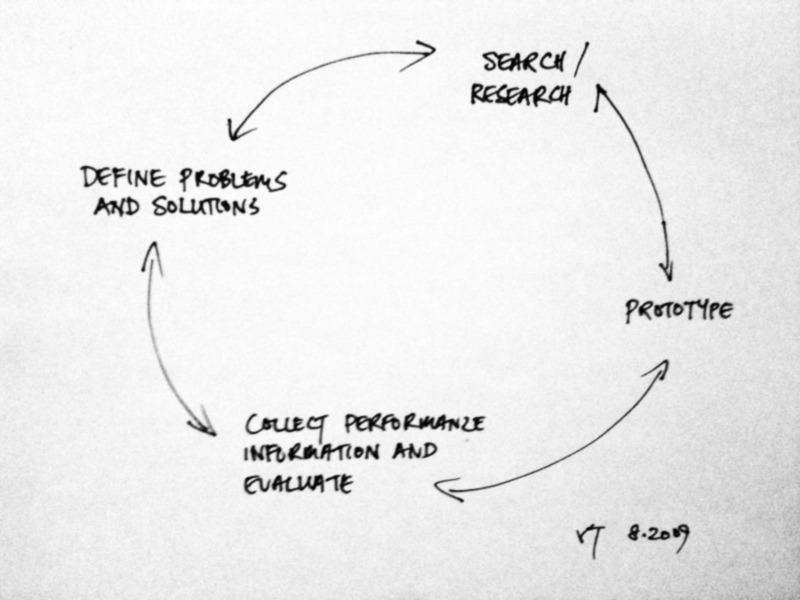
Defining the need (or problem-finding) often involves identifying problems to solve, problems to not solve, and criteria for judging solutions. Problems can be defined at many levels of abstraction and frequently interact with each other; the outcome of a design process reflects the constellation of problems driving the process. For example, Gmail (the webmail service) resulted from a process driven by numerous problems ranging from relatively abstract ones like "How can email service be improved?" to concrete ones like "How can webpage programming languages like HTML and Javascript be modified to make a web application feel like a client application to the user?" or "Folders are silly. What do we replace them with?" Often, research, prototyping, and testing will indicate either that that the problem needs to be redefined, or that solutions to the original problems posed generate new problems.
For the designer trying to solve a given set of problems, the universe of possible solutions to a given set of problems is infinitely large and insufficiently understood. Research helps begin the process of increasing knowledge of possible solutions while also eliminating impossible, unfeasible, inelegant, or problematic solutions. Conducting research takes different forms depending on the kinds of problems faced and the degree of design iteration that has already occurred. Some examples of research include market studies, patent searches, product testing, conference attendance, and field studies. The objective of research in the design process is to leave the designer with a smaller, more probably viable, set of possible solutions to dissect, recombine, and evaluate.
Often, evaluation is easier and more effective when possible solutions are given a more concrete form that designers and testers can interact with—a prototype. Prototyping can range from developing a policy proposal, to making wireframes (mockups of how webpages or software applications will look and the order in which users will encounter them), to 3D and physical models of varying degrees of precision. Prototypes made early in the iteration process tend to be simpler, faster, and cheaper than those made later in the process. Building prototypes used to be expensive and slow, and required extensive equipment and/or specialized knowledge (hence the proliferation of proof printers, model shops, one-off precision milling shops, and the like). Fortunately, fast, inexpensive prototyping software, hardware, and facilities are becoming increasingly available. Fast, inexpensive prototyping accelerates the design iteration process significantly, since prototypes are frequently the source of rich insights for designers, particularly in fine-tuning elements of the product and in recognizing new problems that must be resolved.
Design prototypes are evaluated against the solution criteria established in the design process's problem-definition stage. Designers collect information about the design's performance and use this to evaluate the design; in other words, they try to understand if and how the design should be modified in the next iteration of the design process. Particularly in the case of software applications, it is becoming increasingly clear that designs cannot be considered complete or effective if they do not include methods for collecting information needed to evaluate the application's effectiveness in solving the design problem. As with prototyping, gathering information about design performance has become easier, less expensive, faster, and more comprehensive for many categories of products.
Apr 3, 2012
les jardins
a box of macarons from pierre hermé landed, unexpectedly, in my hands last night.* macarons are a bubble which has not yet popped. a few years ago, most people wouldn't know them from a macaroon. today, many places with aspirations to quality (and some without those aspirations) manufacture and sell them. for a while, mcdonalds in france sold macarons.
macarons are little sandwiches with cookie shells made of ground and blanched almonds held in a flavoured meringue, filled with a flavoured ganache or cream. it is easy to make a mediocre macaron.
the shell is notoriously finicky. the meringue must be robust enough to support the almond flour during baking, requiring the maker to detect and respond to very small gradations in the texture of the uncooked meringue. this in turn responds to very small gradations in ambient temperature and humidity and the hydration of the meringue. macaron-making thus features many arcane directives. some recipes call for aged egg whites (which have lower water content due to evaporation). many formulations also call for uncooked macaron shells to be set out for a while to dry further and develop a skin on the top surface. this skin constrains the cookie as it rises during baking, producing the desired smooth, glossy top and rough-edged foot.
fillings should have flavours and textures that complement the shells. overly aggressive flavours are unfortunately common, but texture seems to be the bigger hurdle. many fillings in inferior macarons are poorly matched to the texture and robustness of their shells. biting into a robust shell causes a too-fluid filling to squeeze out of the sides. conversely, a delicate shell collapses too quickly around a too-rigid filling. both scenarios are untasty. (not incidentally, the same principle of textural harmony applies to sandwich construction and design.)
inevitably, average macaron quality declines as supply of macarons increases. i am happy to leave most macarons on the shelf, for those who would exchange their hard-earned doubloons for dense (or over-airy and/or sticky) shells and tasteless (or overly flavourful and/or overly avant-garde and/or poorly textured) fillings.
on the other hand, it is a good day when life hands you a box of macarons from pierre hermé. their shells have perfect texture, density, and surface, and just enough understated filling of precisely the right texture (some traditionally flavoured, others quite unusual). naturally, he is Big in Japan. confiserie sprüngli, conveniently close to the main train station in zurich, is another place to get very correct macarons of a different style. (and different name. these luxemburgerli are smaller, with a more fluid filling and a more delicate shell, and more traditional flavours.)
a great macaron is usually a rare and costly experience.
* thx journeyman; welcome home.
Apr 2, 2012
a prescription for a grand cuisine
A prescription for a grand cuisine: Take a vigorous people, give them an empire, let them get accustomed to the spoils, and then take it all away again ... bit by bit. Palates accustomed to good things will fight—hard, then harder still—to keep them, or to find replacements. Luxuries now rationed will become distilled. The ultimate cuisine may not be as luxurious as it was in its "glory," but it will be more inspired, more various, and more complexly realized. Roman cooking was lavish; Italian cooking is great.
john thorne and matt lewis thorne, "la cuisine creole," in serious pig.
Feb 21, 2012
kodawari
more writing on craft and care in work here.
the new york times may have figured it out: instead of short, unpolished articles, how about some quality journalism? today's nyt contains two good reads about quality. the first one was about timothy barrett, the second was about not mocking the artisanal pickle-maker.
corky introduced me to a great japanese word: kodawari (こだわり). the word is now often used to describe cafes in japan where the baristi pay uncompromising attention to detail and quality in the preparation of coffee. (from darryl, other source of information about japan-related esoterica: "kodawari = unrelenting, exhaustive devotion to a chosen small area of expertise.") those interested in kodawari may also enjoy the wall street journal's report on how things are made better in japan.
i get flak all the time about buying into the single-origin, time-temp control, calibrated grind size, ritual of coffee (or chocolate, or wine, or cheese, or whatever). does this kind of nearly fetish-level obsessiveness always translate to a better cup of coffee? and, more important, can you tell even if it did? i lack the discernment necessary to distinguish reliably between the aromas of beans grown in different countries. the real reason i buy into this kind of thing is because it increases my expectation of getting a decent to excellent cup of coffee.
too many times, i've had junk coffee drinks. these are always made by someone whose mind was elsewhere, or who wasn't trained to notice the details that good craftspeople notice. nothing induces more of a sinking feeling in me than ordering a latte and seeing the characteristic greyish tinge of what will inevitably be a bitter yet tasteless brew. this is invariably accompanied by the barista spooning froth onto the top of the drink to imitate the microfoamed texture of correctly-steamed milk. the final insult is to be asked to pay an enormous sum for this junk beverage (i always do, filled with resentment).
if junk coffee (or food, or furniture, or software) is the price of spontaneity and openness to serendipity, sign me up for having the guy behind the counter calibrate his grind several times before pulling my espresso, time my pourover's extraction with a stopwatch, and measure his water temperature with a thermocouple. there is an element of showmanship and ritual here, but also the reasonable expectation that the coffee will, at very least, be made with an attempt at care.
and then, on the other hand, there's patience gray on winemakers:
In Apulia, the cultivation of the olive has always gone hand in hand with the vine. Planted together, the olive trees come into their own forty years later when the vines are in decline. It would be odd indeed to make your own oil without also making your own wine. For this an apprenticeship, not scholarship, is required, which the Sculptor served during the years we spent in the vineyards above Carrara. Everyone agrees that the magnificent wine he makes is better than the neighbours'. There are many reasons for this, one is that nothing is put in it, medicaments I mean. An artist who has taken risks all his life accepts the risk of his wine "going off" and only takes the more care of his barrels. The agriculturalist spoils his wine by "making sure."
from honey from a weed, which is certainly worth a read
Feb 7, 2012
the land breathing
Watching the animals come and go, and feeling the land swell up to meet them and then feeling it grow still at their departure, I came to think of the migrations as breath, as the land breathing. In spring a great inhalation of light and animals. The long-bated breath of summer. An exhalation that propelled them all south in the fall.
barry lopez, arctic dreams
Nov 28, 2011
limitation
a discussion in the car during a long drive back from new hampshire brought this back to top of mind, where it should really always be.
One tires of living in the country, one moves to the city; one is tired of one's native land, one travels abroad; one is europamüde, one goes to America, and so on; finally one dreams of traveling endlessly from star to star. Or the movement is different but the same. One tires of porcelain dishes, one dines off silver; one tires of that, one dines off gold; one burns half of Rome to get an idea of the conflagration at Troy. This method defeats itself: it is the bad infinite. What did Nero achieve? Antonine was wiser; he says, "It is in your power to review your life, to look at things you saw before, from another point of view."also relevant: renunciation, words from a totem animal, hugh of st. victor, the inner chapters, little gidding, and ithaka. below, the original german:
The method I propose consists not in changing the soil but, as in the real rotation of crops, in changing the method of cultivation and type of grain. Here, immediately, we have the principle of limitation, which is the only saving one in the world. The more you limit yourself, the more resourceful you become. A prisoner in solitary confinement for life is most resourceful, a spider can cause him much amusement.
søren kierkegaard, either/or

Diese Wechselwirtschaft ist die vulgäre, die unkünstlerische, und hat ihren Grund in einer Illusion. Man mag nicht mehr auf dem Lande leben, und reist deshalb in die Residenz; man mag nicht mehr in seinem Vaterlande leben, man reist ins Ausland; man ist »europamüde« und reist nach Amerika u.s.w.; man schwelgt in der schwärmerischen Hoffnung einer unendlichen Reise von einem Stern zum andern. Oder die Bewegung nimmt eine andre, wenn auch noch extensivere Richtung. Man mag nicht mehr von Porzellan essen, man ißt von Silber oder von Gold; man brennt das halbe Rom ab, um den Brand Trojas zu sehen. Diese Methode hebt sich selber auf. Denn was erreichte Nero? Nein, da war Kaiser Antonio klüger, er sagt: anabiônai soi exestin; ide palin ta pragmata, hôs heôras; en toutô gar to anabiônai.
Die Methode, die ich vorschlage, liegt nicht darin, daß man immer neues Land nimmt; man würde dann auch bald am Ende sein. Die wahre Wechselwirtschaft besteht darin, daß man bald diese, bald jene Methode wählt und mit der Saat wechselt. Und da haben wir auch gleich das Prinzip der Beschränkung, das einzige, welches uns retten kann. Je mehr man sich selber beschränkt, um so erfinderischer wird nun. Ein Gefangener, der sein ganzes Leben in einsamer Zelle zubringen muß, von allen andern Gefangenen abgeschlossen, ist sehr erfinderisch; eine Spinne kann ihm die größte Unterhaltung sein. Hier haben wir das Prinzip, das durch seine Intensität, nicht durch seine Extensität Befriedigung sucht.
Nov 9, 2011
freedom, and how you can achieve it
instructions on how to buy an inexpensive but decently built and swiftly unlockable smartphone and switch to a low-cost pay-as-you-go cellphone service.
you, like me, could soon be free of the iphone's tyranny and AT&T's colossal rip-off cellular service (so bad it would be laughable if it weren't also tear-inducingly frustrating, inconvenient, and expensive).
update: t-mobile unlocked the phone after 60 days of active service.
update: grooveip works fine. it is a bit buggy but i use voice sufficiently infrequently that it doesn't matter to me. (last month, my total talk time was 33 minutes using both the t-mobile network and grooveip). jacob h-a has been fooling around with a combo of sipdroid and pbxes.org that he says is working out well for him. no doubt he'll send an update once he's figured it out completely.
you, like me, could soon be free of the iphone's tyranny and AT&T's colossal rip-off cellular service (so bad it would be laughable if it weren't also tear-inducingly frustrating, inconvenient, and expensive).
update: t-mobile unlocked the phone after 60 days of active service.
update: grooveip works fine. it is a bit buggy but i use voice sufficiently infrequently that it doesn't matter to me. (last month, my total talk time was 33 minutes using both the t-mobile network and grooveip). jacob h-a has been fooling around with a combo of sipdroid and pbxes.org that he says is working out well for him. no doubt he'll send an update once he's figured it out completely.
my new t-mobile unlimited 4G data and text plan (with 100 voice minutes a month) costs $30 (prepaid, no contract). i use it with the admittedly absurdly named samsung exhibit ii 4g: a $200 phone (without contract) that isn't perfect but, in the many ways detailed below, is probably the best compromise handset to come onto the US market in the last 12 months. the current setup is an exhibit ii 4g, t-mobile's new $30/month prepaid unlimited data plan (approx $53/month less than my current data plan with AT&T), my previous AT&T number ported to google voice and forwarded to the new t-mobile number, and my previous google voice number retained as a second number.
WHY THIS IS GOOD
- i will save about $53/month ($1250 over 2 years) in service costs compared to renewing my 2-year AT&T contract. my total startup cost was $252.37, my monthly payments will be no more than $30.
- i don't have to tell everyone and their dog what my new number is—they call the old numbers, my new phone rings. all my voicemails and text messages can go to email if i desire it.
- i can travel easily with my phone without extortionate roaming fees.
- once i unlock the phone, i can discontinue service at any time and resume it with t-mobile or any other provider with almost no disruption in how people call me or send me text messages.
HOW TO BE FREE OF YOUR AT&T IPHONE
there is much conflicting information on the interwebs about setting up this brand new wal-mart t-mobile plan. there are hundreds of phones, most of which suck for one or more reasons (on which, see below). consequently, setting up the phone and related services took 4 hours of research instead of 15 minutes. finding the phone took weeks of research.
we stand upon the shoulders of those who go before us (or, more precisely, those who stand underneath us). below, i provide excruciatingly precise detail on what to buy, where to buy it, and how to do everything you need to do to replicate my current situation of cellular bliss—all in the interest of human progress and freedom from digital tyrannies. and because i care about you.
there is much conflicting information on the interwebs about setting up this brand new wal-mart t-mobile plan. there are hundreds of phones, most of which suck for one or more reasons (on which, see below). consequently, setting up the phone and related services took 4 hours of research instead of 15 minutes. finding the phone took weeks of research.
we stand upon the shoulders of those who go before us (or, more precisely, those who stand underneath us). below, i provide excruciatingly precise detail on what to buy, where to buy it, and how to do everything you need to do to replicate my current situation of cellular bliss—all in the interest of human progress and freedom from digital tyrannies. and because i care about you.
first, the caveats. this scheme is ideal only if you
- use data intensively and send text messages all the time
- barely use voice calling
- are off contract with your current cell service provider
- have a google voice account
- don't really need domestic data roaming
if you wish to proceed, do the following in order (full disclosure: some of the links below will send me referral dollars if you buy through them.):
- a final caveat: you may face a termination fee if you port your phone while your contract is still in force. google voice's porting process may get fubar-ed (horror stories abound). in the grand scheme, these are minor annoyances for which i claim no responsibility.
- get a phone: purchase an off-contract prepaid-service t-mobile samsung exhibit ii 4g at wal-mart or online (see below for why it is the best compromise phone available today). amazon has the cheapest handsets and fastest fulfilment too. if you want to be nice to me, buy it through this link. important note: you cannot purchase your phone or activate it in a t-mobile physical store location if you want the $30 unlimited data plan described above. while the plan is marketed through wal-mart, it appears to be one of the t-mobile monthly4G plans and is available on any newly activated monthly4G SIM card, as long as activation happens on t-mobile.com.
- switch the phone on: when your phone arrives, insert the SIM and battery and begin to charge the phone.
- activate cell service with t-mobile: have the ugly pink box handy and go to t-mobile's prepaid service activation page. enter the activation code (on a card inside the box) and the IMEI and SIM serial number (both listed on a sticker on the box), choose the $30/month prepaid plan with unlimited data, and complete your activation process but skip step 5 (funding your account). write down the new phone number which t-mobile assigns to you.
- fund your account: buy your account minutes from callingmart instead, which often has standard discounts on t-mobile prepaid service, in addition to a host of coupons (like these). again, if you want to be nice to me, please use this link to buy your minutes from callingmart.
- forward google voice to your new t-mobile number: go to this page and click on the link to "add a new phone"
- port your current cellphone number to google voice: if you are with AT&T, find your AT&T account number and PIN number ready, as well as the exact address and telephone number AT&T has on file for you (you should sign into your account at AT&T to check all this). then, go to this page, click on the link to port or change your number, and follow the quite clear instructions. if, despite entering the exactly correct account number and other details, the google voice workflow tells you to "Please fill out all of the required fields," be persistent and check for extra spaces and that you have the correct case. once you get to google checkout, pay the $20 port fee and confirm the port request. (you will note that there is no field to enter your AT&T PIN.)
- wait for the porting error message and fix it: eventually, google voice will send you an email titled "Oops! Issue with your Google Voice Number Porting Request." click on the link in the email and enter your AT&T PIN number.
- make your current google voice permanent: when the port is completed, you'll get an email titled "Google Voice Number Porting is Complete!" rejoice, then go to google voice again, click on the link to "make permanent," follow instructions and pay another $20.
- unlock your phone: if you purchased your phone for full price, you can request that it be unlocked immediately. full details here.
- bask.
why, you ask, would i go through all this hassle?
THE STORY
- it's locked to AT&T forever. i took a second phone with me whenever i was out of the country, so i would not be subject to AT&T's ludicrous roaming prices.*
- the silent-mode toggle switch is broken, but works unpredictably. this is always awkward in meetings.
- there is no way to shut off the shutter sound on the iphone camera without resorting to jailbreaking and doing other silly workarounds.*
- the battery life seriously blows.
- dropped calls all the time. all. the. time.
- i regularly used a small fraction of the hundreds of minutes i paid for on even the least expensive AT&T iphone plan.
every alternative phone i looked at was deficient on at least one of the following dimensions:
- screen too big = device is enormous (bigger than iphone)
- screen too crappy
- looks like a sex aid
- way too expensive (>$200)
- CDMA-only
- not 4G-compatible in the US
- not world GSM-compatible
- processor slower than molasses
- obnoxious colour
- no front-facing camera
- not warrantied in the US
- battery cannot be replaced by user
- lousy battery life
- soon-to-be obsolete operating system
- locked to one carrier
this samsung handset is the only one i have found that has none of these deficiencies. it has a screen of modest but acceptable size and quality, a decent camera and front-facing camera, a modest but acceptable processor, runs gingerbread. all this is contained in a chassis the size of an iphone. it accepts regular-sized SIM cards and can be used worldwide with prepaid voice/data/text services from other service providers. intended as the mid-market member of the galaxy family, it is not ridiculously expensive. see reviews here and here, and full specifications here.
* yes, i jailbroke it but then that broke voice reception. and i was on a baseband that didn't have an easy unlock strategy. anyway.
** the W, in case you are wondering, stands for Wonder.
Oct 28, 2011
mindful eating
Eating is often a knee-jerk reaction: we cook and eat what is most convenient, what is least expensive, what appears to taste good. But deciding what to eat involves consequences that are wide-ranging and long-lasting, even if we don't recognise what those consequences are. We can make good decisions about what actions to take only by knowing the consequences of those actions. And we can only know these consequences if we investigate, inquire, and gather more information.
Meat is a good example. Meat is environmentally costly. Most easily available meat is intensively raised and processed in operations that raise ethical and food-safety concerns in addition to the environmental ones. Learning more about meat production allows you to make better decisions about the meat you choose to consume. You may choose to eat less meat, and buy what meat you do eat from producers who claim to raise and process the meat in ways that minimise the risk of food-borne illness. In doing so, you are choosing to eat not the least expensive or most convenient meat, but rather the meat that is produced with attention to health or environmental impact. Or you may continue eating the meat you've always eaten, with a better knowledge of the risks that you are exposed to.
Another example: You go to eat at a very good restaurant. The food has been made with care from good ingredients. The check comes—it is for a staggering amount. Yet the prices, though high, are subsidised by chefs, stagiaires, and producers who work long hours for little money; there is not much profit in food sourced and made with care. Fast food, in contrast, is inexpensive. It is often made with indifferent ingredients and by poorly paid workers. There are considerable profits to be made from fast food. Questioning what goes into the price of the food you eat may make you decide to cook for yourself most of the time and to eat out infrequently and only at restaurants that cook with care. Or it may not.
All this has been said before. Being mindful of the consequences of eating sounds like submitting to nothing but limitation, restrictions, and unaffordable food. Acknowledging, for instance, that eating food grown far away seriously damages the environment means for the most part restricting the food you eat to things grown locally—a smaller and less predictable selection.
But the limitations imposed by mindful eating are not the full story.
Questioning what, how, and why we eat limits us in some ways but also opens up new possibilities. Limitations are like frames that, by excluding much of the view, allow you to look more closely at whatever is within the frames. If you decide to eat only local, seasonal fruit, you have no choice but to begin to pay close attention to the fruit that is around you. But you come to realise that strawberries taste different from day to day as the season progresses, that there are in fact different varieties of strawberries that ripen at different times, and you begin to eat strawberries only when they are at their very best.
Asking questions about the food you eat can lead you to discover techniques and methods of cooking and flavour combinations that are new to you but well-known elsewhere and to other people. For cooks, asking questions and finding answers is a way to learn how to express a particular sense of what tastes good and what is good to eat. It is also a way to develop that particular sense, the style of cooking that distinguishes you from other chefs—a way to develop a vocabulary for communicating your values in food, the reason why you cook.
We should ask ourselves a multitude of questions about the food we eat. Our decisions about food will be informed by the answers we find. The point is not to find the single right answer to each question (it doesn't exist) but rather to begin to ask the questions.
Oct 4, 2011
a new book
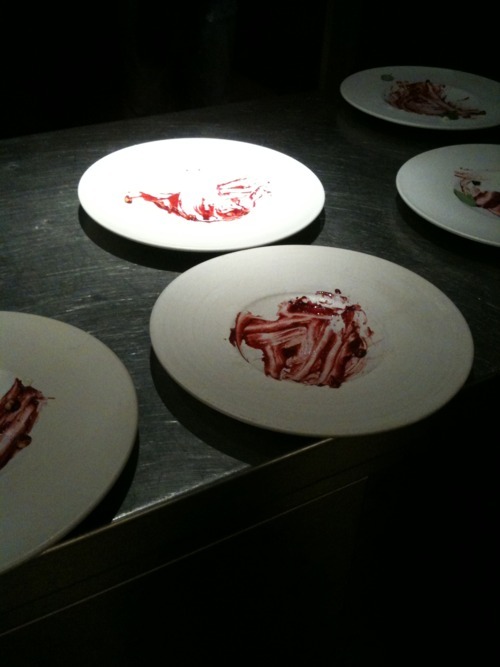
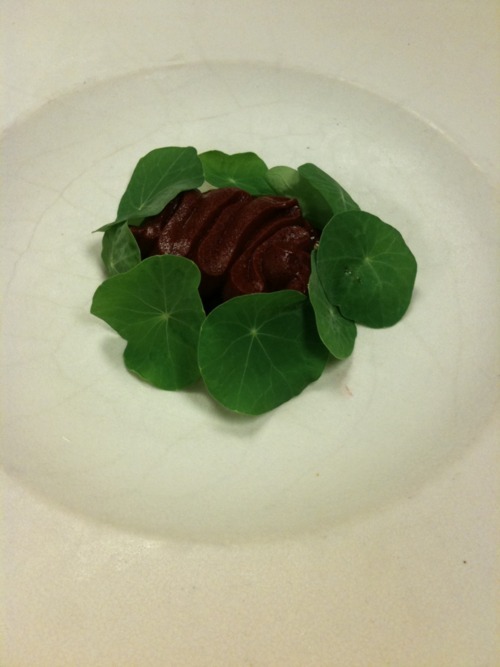
opinions differ on dessert. is it meant to be a comforting, sweet, predictable ending to a good meal, or is it meant to be unsettling and to provoke the eater into a consideration of new flavours? i fall into both camps, depending on the day. especially at restaurants on the cutting edge, i incline to the latter. below you see a dessert which is so much on the cutting edge it may have gone slightly beyond it.
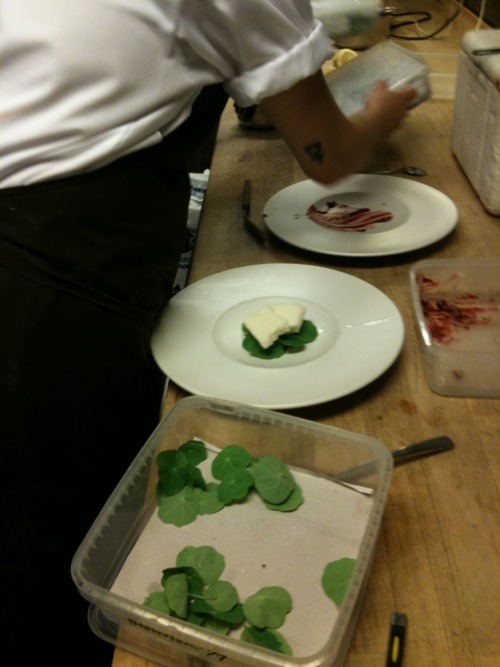
the pleasure of a good brioche is not primarily in the buttery flavour or the lightness of the baked bread. rather, it is in the gentle aroma of yeast left over from a long, slow fermentation. this dessert plays on this yeast smell and connects it to similar musty aromas in blackberries and corn. it consists of grilled corn kernels shaved off the cob and bound with blackberry puree, a tart blackberry sorbet, young nasturtium leaves for acid, and a frozen foam made of heavy cream infused with yeast.
the yeast cream parfait is aerated by warming the infused cream slightly, then placing it in a valve container and drawing a vacuum on it in a chamber vacuum. the water begins to boil at a relatively low temperature creating a fragile foam, at which point the vacuum is released. the foamed liquid in the container is kept under partial vacuum because of the valve and the whole is placed into the blast freezer to freeze while still aerated. this fiddly procedure produces blocks of a white sponge that tastes of brioche and which disappears in the mouth.
one comment about this was particularly apposite: "many desserts take pages out of old books. this dessert is like a new book completely. perhaps diners are not quite ready for this. after a meal of new and uncomfortable textures and flavours, they might be expecting something familiar and sweet. for diners like that, this is like a big 'fuck you.'"
Jun 9, 2011
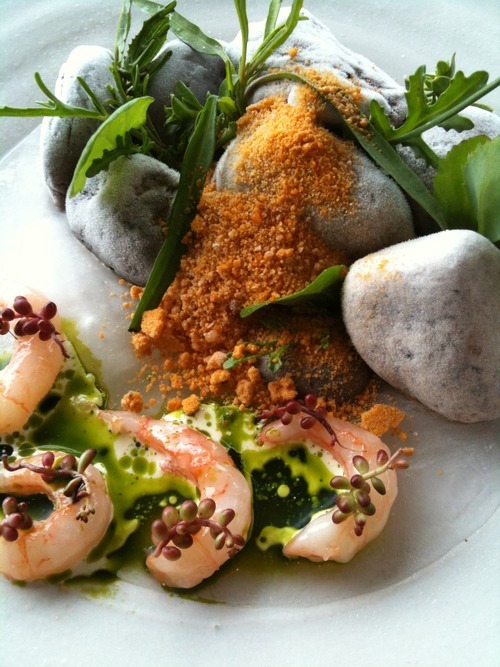
Jun 2, 2011
freedom, choices, style
You're bringing an informed aesthetic point of view to a visual problem. You have freedom, so you have to make choices—and at the point when I make a choice, the building starts to look like a Frank Gehry building: It's a signature.
Apr 17, 2011
strategies, tactics
michel de certeau, in the practice of everyday life (an unfairly neglected book) , makes a useful distinction between strategies and tactics as ways of acting.
a strategy is "the calculus of force-relationships which becomes possible when a subject of will and power … can be isolated from an 'environment.' A strategy assumes a place that can be circumscribed as proper and thus serve as the basis for generating relations with an exterior distinct from it." these opposing ways of acting, strategy and tactics, are ideal types and there is a combination of strategy and tactic in every action; the issue here is that tactics become a much more significant part of action under conditions of diffusion. In this, certeau's definition of strategy makes reference to a situation marked by coherence and clarity in one key respect—a "place" is a domain of clearly-defined activity, and strategy can be the dominant strategy only possible in such a domain where there are clear means to ends. a tactic, on the other hand "has at its disposal no base where it can capitalize on its advantages, prepare its expansions, and secure independence with respect to circumstances … it is always on the watch for opportunities that must be seized 'on the wing' … the intellectual synthesis of these given elements takes the form, however, not of a discourse, but of the decision itself, the act and manner in which the opportunity is 'seized'"—tactics are contextual in the most profound way and are dominant where the domain is not clearly-defined.
implicit in the actor's creation of a membership-seeking line based on the context in which it will be deployed is the belief that the line constitutes an argument that certain affiliations and characteristics—his story about himself—justify a relative position in the group. again, this activity is not unilaterally undertaken by the individual seeking a position in the group; rather, the argument and bargaining process is one undertaken as mutually-conducted negotiation. for the individual, the uncertainty inherent in the process of negotiating a valid group identity introduces the need for tactical behavior.
bricolage, the art of making-do exemplified by odysseus (the many-sided), is what individuals do on a daily basis, and certeau discusses the nature of use or consumption (the act of choice and decision-making) as a particular case of bricolage. In a more conscious way, individuals who seek to negotiate membership in a group also engage in a form of bricolage—action conditioned by contingency and constantly in flux. this same lens can be turned on the nature of identity construction. returning to the idea that tactics are decisions and actions, it is important to bear in mind that the construction by individuals of stories about themselves is a sequence of decisions and actions—tactics—contingent on an understanding sense of the group to which entry is being sought: "a tactic boldly juxtaposes diverse elements in order suddenly to produce a flash shedding a different light on the language of a place and to strike the hearer." agents construct themselves through this mix of strategies and tactics; their design to disrupt the target group's definition and change it in their favor.
, makes a useful distinction between strategies and tactics as ways of acting.a strategy is "the calculus of force-relationships which becomes possible when a subject of will and power … can be isolated from an 'environment.' A strategy assumes a place that can be circumscribed as proper and thus serve as the basis for generating relations with an exterior distinct from it." these opposing ways of acting, strategy and tactics, are ideal types and there is a combination of strategy and tactic in every action; the issue here is that tactics become a much more significant part of action under conditions of diffusion. In this, certeau's definition of strategy makes reference to a situation marked by coherence and clarity in one key respect—a "place" is a domain of clearly-defined activity, and strategy can be the dominant strategy only possible in such a domain where there are clear means to ends. a tactic, on the other hand "has at its disposal no base where it can capitalize on its advantages, prepare its expansions, and secure independence with respect to circumstances … it is always on the watch for opportunities that must be seized 'on the wing' … the intellectual synthesis of these given elements takes the form, however, not of a discourse, but of the decision itself, the act and manner in which the opportunity is 'seized'"—tactics are contextual in the most profound way and are dominant where the domain is not clearly-defined.
implicit in the actor's creation of a membership-seeking line based on the context in which it will be deployed is the belief that the line constitutes an argument that certain affiliations and characteristics—his story about himself—justify a relative position in the group. again, this activity is not unilaterally undertaken by the individual seeking a position in the group; rather, the argument and bargaining process is one undertaken as mutually-conducted negotiation. for the individual, the uncertainty inherent in the process of negotiating a valid group identity introduces the need for tactical behavior.
bricolage, the art of making-do exemplified by odysseus (the many-sided), is what individuals do on a daily basis, and certeau discusses the nature of use or consumption (the act of choice and decision-making) as a particular case of bricolage. In a more conscious way, individuals who seek to negotiate membership in a group also engage in a form of bricolage—action conditioned by contingency and constantly in flux. this same lens can be turned on the nature of identity construction. returning to the idea that tactics are decisions and actions, it is important to bear in mind that the construction by individuals of stories about themselves is a sequence of decisions and actions—tactics—contingent on an understanding sense of the group to which entry is being sought: "a tactic boldly juxtaposes diverse elements in order suddenly to produce a flash shedding a different light on the language of a place and to strike the hearer." agents construct themselves through this mix of strategies and tactics; their design to disrupt the target group's definition and change it in their favor.
Subscribe to:
Posts (Atom)