
Dominion over his environment was supposed to be one of the hallmarks of man. Now, that dominion is almost wholly vicarious, derived from the past ingenuity of others. In urban and industrial communities it is never direct, physical or spontaneous. Our implements are at twelve removes and we may all live inside so many thermos flasks. It may be well to remember how to use a pair of sticks and stones.as paul rand says: "It is important to use your hands, this is what distinguishes you from a cow or a computer operator."
sybille bedford, the sudden view
Showing posts with label technology. Show all posts
Showing posts with label technology. Show all posts
Jul 27, 2016
the span of control


Jun 30, 2015

Jun 21, 2015
hardware and software
the traditional sherry bodega's solera system blends wines from casks representing many vintages. this allows each bodega to produce a set of consistent products despite the inherent variation across vintages. it takes years of continuous guided observation for bodega's foreman to learn the patterns in how casks of wine develop and what interventions in their development are possible and desirable.
the complexity and optionality of the solera system gives the capataz enormous freedom to move particular casks into and out of different criaderas and soleras; each capataz makes a slightly different set of intervention decisions; consistently made, the differences in these decisions generate distinctiveness in the bottled wine.
the physical bodega and the know-how of the capataz are, in combination, a large part of a technology for reproducing style in wine.

3 plaza cordobeses, 11408 - jerez de la frontera
Dec 18, 2013
value, counterfeits, authentication, and trust
these statements seem indisputable:
the more valuable a class of objects becomes, the more likely it is that someone will try to counterfeit instances of the class.let us consider the implications of this for bitcoin. the only media of exchange that are systemically immune to authentication-related trust failures (though not immune to local trust failures) are those in which trust in the medium is highly distributed.
the more counterfeiting attempts there are, the more likely it is that good counterfeits will be produced.
the better the counterfeits, the more effortful it will be to authenticate any object.
trust in the value of the class of objects is proportional to the ease with which any instance of the class can be authenticated.
Aug 2, 2013
general magic
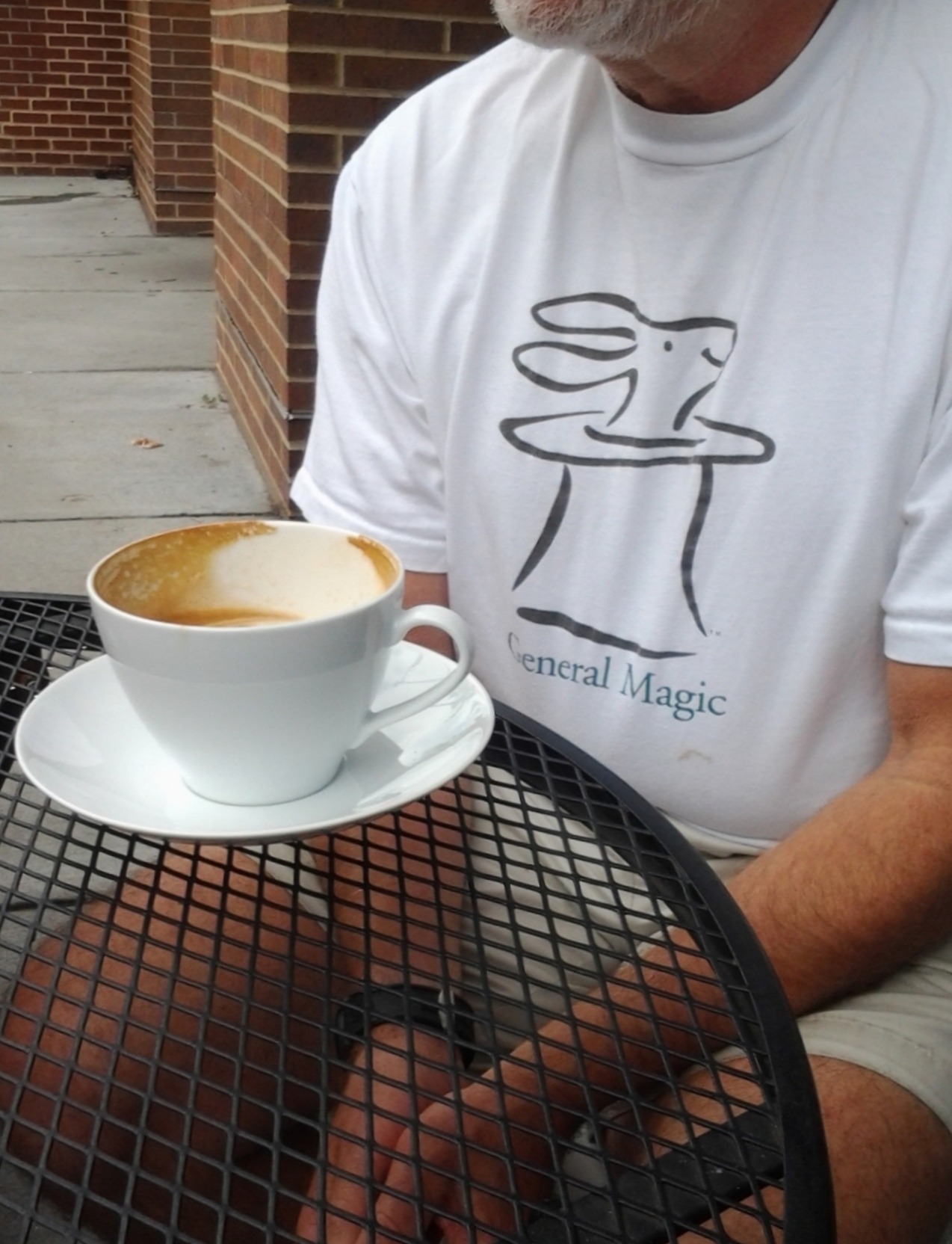 ed brought a little piece of technology history to coffee this morning. they had better logos back then.
Jun 21, 2013
the cow and the computer operator
It is important to use your hands, this is what distinguishes you from a cow or a computer operator.
May 9, 2013
katsuhira's tiger
this long but worthwhile video documents ford hallam's meticulous reconstruction of the lost half of a pair of tsuba by hagiya katsuhira. nearly every stage is embedded in the workmanship of risk: the further along, the more stands to be lost by the commission of even a small error in work.
slow is always better ... you have to feel what's going on. this is why i reject power tools. they're simply far too fast. you can't feel the irregularities. the tool simply takes over.
[found thanks to joakim]
Apr 11, 2013
a big room, vast
There is one timeless way of building ... But though this method is precise, it cannot be used mechanically. Indeed it turns out, in the end, that what this method does is simply free us from all method ... To purge ourselves of these illusions, to become free of all the artificial images of order which distort the nature that is in us, we must first learn a discipline which teaches us the true relationship between ourselves and our surroundings. Then, once this discipline has done its work, and pricked the bubbles of illusion which we cling to now, we will be ready to give up the discipline, and act as nature does. This is the timeless way of building: learning the discipline—and shedding it.
We have a habit of thinking that the deepest insights, the most mystical, and spiritual insights, are somehow less ordinary than most things—that they are extraordinary. This is only the shallow refuge of the person who does not yet know what he is doing. In fact, the opposite is true: the most mystical, most religious, most wonderful—these are not less ordinary than most things—they are more ordinary than most things. It is because they are so ordinary, indeed, that they strike to the core.christopher alexander, the timeless way of building

Mar 24, 2013
too light winning make the prize light
self-imposed limits on technology make it more likely that human ingenuity will develop an elegant response to its environment. the idea is not new, but it is certainly not en vogue.
Animal-drawn plows varied from country to country and even from one farm to the next. They had to be coordinated with the type of soil, the moisture content, the kind of planting, the draft animals used, and the farmer's own movement. When animals were replaced by mechanical power, plows were simplified, the differences between them became less, and the variations between plows used in some areas disappeared completely. With mechanical power, it was no longer necessary to design each plow individually. General plows were designed to work almost any kind of soil. The farmer was freed from the constraints of his environment. He no longer had to understand his plow in relation to his soil composition.
christopher and charlotte williams, craftsmen of necessity
Feb 2, 2013
Oct 6, 2012
civilization
Pelorat said, "It seems to me, Golan, that the advance of civilization is nothing but an exercise in the limiting of privacy."
isaac asimov, foundation's edge
Sep 14, 2012
my new binding system is unstoppable
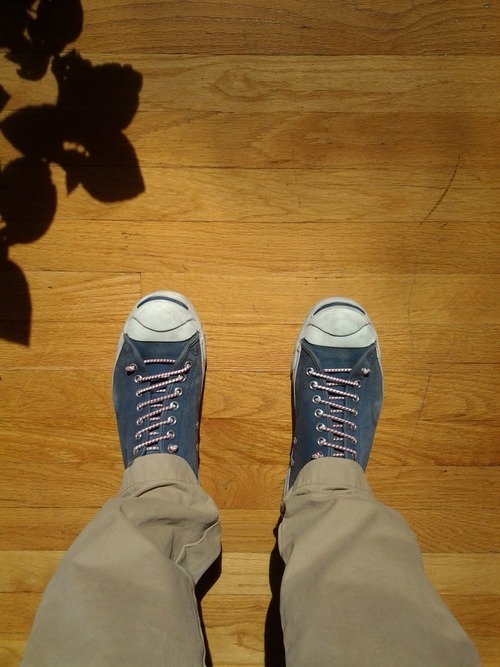
shock cord makes jack purcell much easier. this is MSR's silicone-core product intended for replacing tent-pole cords. you will also require scissors (make sure the blades are sharp) and an open flame (a lighter or gas burner will work).
do not pre-cut your cord. choose a hole to start with (A; above, the toe-ward outside hole) and thread from the outside in. the loose end of the shock cord will end up protruding from the last hole (B; above, the heel-ward inside hole) while the spool end will protrude from A. pull through to leave about 2-3 inches extra on the B-end. coarse adjust for tightness (err on the side of being a little loose), then cut the A-end of the shock cord and tie a stopper knot in it. adjust for tightness again and tie a loose stopper knot in the B-end. repeat on the other shoe. walk around for a bit to be sure of things. try the shoes with socks and without. when you're happy with the fit, secure the knot and trim both loose ends to just shy of the stopper knots. wet fingers and seal the cut cord ends quickly with an open flame, pinching immediately with wet fingers to fuse the melted sheathing.
walk around smugly.
Aug 22, 2012
co-presence and collaboration
last night, we talked about the difference between services that allow users to be remotely co-present and those that allow users to remotely collaborate.
co-presence is consumption behavior: you are with someone, observing what they are doing. all get, no post, no problems with collision. collaboration is production behavior: you are with someone, working on something together. collaboration is much harder to do well, and gets harder the closer to realtime the collaboration is: at minimum, it requires good collision handling and clear attribution at close to the minimum atomic size of the content being produced. text seems to be the only content being collaboratively produced in any large quantity now and text requires sub-sentence attribution markings. gdocs does neither particularly well, while hackpad does a great job: it is a first-class collaborative document editing tool marked by economy of means. hackpad is nearly feature-complete for my use-cases.
the closer to realtime the collaboration behavior is, the more important it is to have both a way be co-present and a way to collaborate. this is not only good for the user, it is a natural way for the service to reduce collision problems: collaborators tend to avoid bits which they know other collaborators are actively working on. it is smart to build services that tacitly encourage good use. the co-presence information that supports this kind of behavior can be parsimonious and still be useful. this is the only thing that hackpad doesn't yet do which i would love and gdocs does it well: the highlight cursor that shows where someone else in the document's cursor is, to me, a lightweight and effective co-presence indicator. a richer but still lightweight co-presence implementation would be to indicate what other active users are looking at as well as where they are entering new text: viewports and cursor locations.
importantly, though, not all products need this sort of collaboration and co-presence infrastructure built in. some collaboration products need strong norms rather than technical infrastructure to support collaboration. wikis are good for large distributed production and solve the collaboration problem with human gardening; making it possible for lots of people to work on a wiki without wiki interaction norms is probably not a good idea. other products simply don't require collaboration at all. just because you can doesn't mean you should. motivations and objectives are good to think about when making things.
Aug 21, 2012
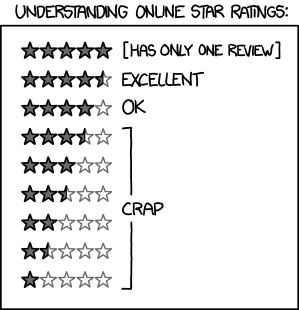
univariate ratings of multivariate objects
Aug 3, 2012
mind, hands, tools
Science originated from the fusion of two old traditions, the tradition of philosophical thinking that began in ancient Greece and the tradition of skilled crafts that began even earlier and flourished in medieval Europe. Philosophy supplied the concepts for science, and skilled crafts provided the tools.
freeman dyson, the sun, the genome, and the internet
Jul 29, 2012
ads on streaming radio
i believe, the way some xooglers do, that properly targeted, relevant, well-produced ads are unobjectionable and can even be enjoyable. spotify is a beautifully designed, well-implemented service and i thought, at first, that the radio ads on spotify wouldn't bother me much. i was wrong. wrong, wrong, wrong. the voice talent is awful but the worst thing is that spotify ads are incredibly poorly targeted: playing a tanqueray gin ad between tracks of glenn gould's goldberg variations is comical only once.
(though i will admit to snorting some coffee in dwelltime yesterday when i overheard the laptop next to me play an ad for durex condoms right after maria callas sang ave maria.)
Jul 24, 2012
the importance of the corner
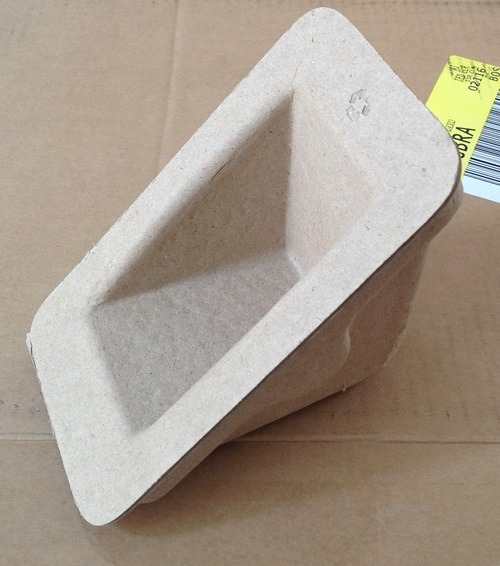
i don't have stuff shipped to me very often, so the arrival of a box in the mail is the occasion for great excitement: what new development in packaging will be revealed today?
when packing an object within a box to be shipped, the goal is to immobilise the object so that agitation and crushing forces don't harm it, while keeping the enclosing box as small as possible. there's been some interesting consumer-facing packing innovation in the last decade, mostly driven by companies that ship a lot of high-value stuff. about 10 years ago, i noticed that dell was shipping assembled laptops in folded, die-cut cardboard matrices. they have recently switched to modular pop-out foam sheets, which do a better job at immobilisation, compression-protection, and volume conservation. dell's boxes have become noticeably smaller. amazon, maybe 8 years ago, started shipping books packed flat and sandwiched inside two layers of corrugated, self-adhering cardboard, like a book raviolo (they have been doing some smart things with packaging research) and have also begun to immobilise objects with large air-filled plastic packs that fill up empty space using a minimum of material that must later be disposed of.
i'd never gotten a box in the mail from apple before and was expecting some interesting packing considering how much trouble they go to in designing the product box-opening experience. i wasn't disappointed. these fiberboard corners are mostly empty (i dissected one), have tremendous crush resistance (i applied 168lbs to one of them by standing on it), spread external forces over a large internal surface, and contain one material and one binder (good for recycling). four units completely isolate and immobilise the object (a macbook air) from the surrounding shipping container, and they add less than 2" to each outer dimension. there is no other packaging material other than the box and the corners are recyclable.
this parsimonious packing solution is thrillingly elegant.
Jul 21, 2012
bigger isn't always better
and certainly not for mobile devices. the size of a device determines its mobility: those intended to be mobile, such as laptops and smartphones, should be small, small, small.
laptop manufacturers might consider that some people still use their laptops for things other than movie-watching, and that some people enjoy carrying around a laptop that is fast and fully functional but not the size of a butcher block cutting board. for those who don't watch movies on their laptops, a 16:9 screen proves mildly useful for using the kind of application that has toolbars on the side, but is worse than useless for popular laptop use-cases such as document-reading, code-writing, and scrolling-page navigation. a 4:3, retina-display, 11" macbook air would be a dream with a small footprint. it is all but certain that 2 out of the 3 will be in the next air refresh; will the 4:3 aspect ratio be an option? we, or at least i, can only hope.
smartphones are inherently mobile devices, and the good ones (fast, high-resolution, with good platform compatibility) are now almost all too big. the few small phones these days are mostly underpowered budget models with crummy displays. the iphone is the only exception to this trend: a premium phone with a small footprint. samsung's galaxy line would be more competitive with the iphone if they released a galaxy nexus with a better designed rear camera housing and a smaller footprint than the iphone.
though i am not an apple fanboy, i will say this: apple gets a lot of credit for detail-oriented hardware but they should get more credit for resisting—as few major hardware manufacturers appear to be doing—the urge to differentiate their products by simply making them bigger. that, as kierkegaard says, is the bad infinite.
Jul 3, 2012
the nature and art of workmanship
People are beginning to believe you cannot make even toothpicks without ten thousand pounds of capital. We forget the prodigies one man and a kit of tools can do if he likes the work enough.
Jun 21, 2012
surface
a tablet and a laptop are two conceptually separate things which will probably have to evolve separately as long as keyboards are our primary method for entering text data. on a laptop, writing is possible, even easy (we do it all the time). on a tablet, regardless of the quality of the attached keyboard, writing is a pain. a tablet is primarily and optimally a device for consuming content, not for generating content. a laptop or desktop is relatively better for generating content and is okay for consuming it.
the tablet's native text input device is a virtual keyboard and other interactions occur through a touch-screen interface. this pulls the hand away from the keyboard even for minor navigation, as anyone who's ever tried to move a cursor in a block of text knows. worse, as implemented in the major tablet operating systems, virtual keyboards don't persist when users switch applications or views (nor should they persist, given the size of current virtual keyboards relative to tablet display sizes).
when entering and editing text is a major use case, both a keyboard touchpad (as on a laptop) or a mouse next to the keyboard (as with a desktop) are superior to touch interfaces for non-text entry interaction. i've brought only an ipad and a keyboard with me on several trips of various lengths, leaving the laptop at home. if i have to do any real work at all—writing, editing, really anything more than reading feeds and emails that require only short responses—the combination of ipad and keyboard is intolerable: it remains a tablet that needs you to touch its screen to navigate, except with a keyboard attached.
now, how about a tablet (with exclusively touch-oriented interaction) that might convert under some conditions to a keyboard- and touchpad-oriented tablet device? (such conditions being: a keyboard + pointer combination being attached, whether directly or over the air.) this would work, but only if the OS successfully switches interaction logics completely, from virtual keyboard+touchscreen to keyboard + pointer device. something like this is probably unlikely to come from accessory manufacturers, since it requires significant OS integration.
this means that surface is potentially quite interesting. but i am ready to have my heart broken again by technology and dumb UX decisions.
Subscribe to:
Posts (Atom)