
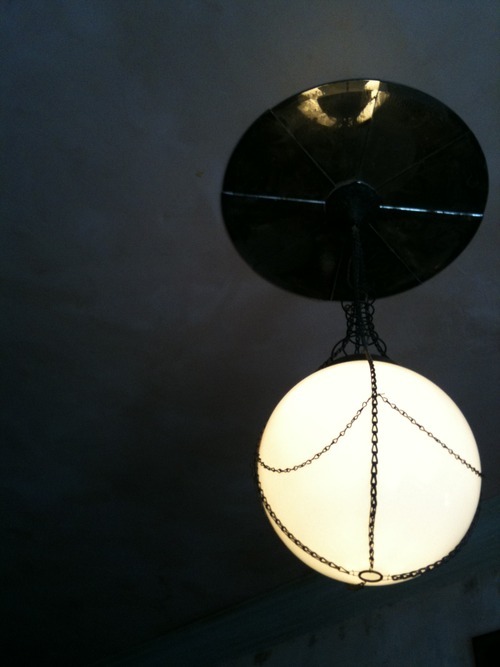
maison premiere has many absinthes.
May 14, 2011


May 13, 2011
May 11, 2011
May 10, 2011
i too have stolen a cake
"To summon a thing that is not there at all, to call it by speaking its true name, that is a great mastery, not to be lightly used. Not for mere hunger's sake. Yarrow, your little dragon has stolen a cake."
Yarrow had listened so hard, gazing at Ged as he spoke, that she had not seen the harrekki scuttle down from its warm perch on the kettle-hook over the hearth and seize a wheatcake bigger than itself, She took the small scaly creature on her knee and fed it bits and crumbs, while she pondered what Ged had told her.
"So then you would not summon up a real meat-pie lest you disturb what my brother is always talking about—I forget its name—"
"Equilibrium," Ged replied soberly, for she was very serious.
"Yes, but when you were shipwrecked, you sailed from the place in a boat woven mostly of spells, and it didn't leak water. Was it illusion?"
"Partly it was illusion, because I am uneasy seeing the sea through great holes in my boat, so I patched them for the looks of the thing. But the strength of the boat was not illusion, nor summoning, but made with another kind of art, a binding spell. The wood was bound as one whole, one entire thing, a boat. What is a boat but a thing that doesn't leak water?"
"I've bailed some that do," said Murre. "Well, mine leaked, too, unless I was constantly seeing to the spell." Ged bent down from his corner seat and took a cake from the bricks, and juggled it in his hands. "I too have stolen a cake."
"You have burned fingers, then. And when you're starving on the waste water between the far isles you'll think of that cake and say, Ah! had I not stolen that cake I might eat it now, alas!—I shall eat my brother's, so he can starve with you—"
"Thus is Equilibrium maintained," Ged remarked...
ursula le guin, a wizard of earthsea

May 9, 2011
travel and leisure
He was not only the greatest traveller I've ever known (because he was the truest), he was also one of the happiest people I have had the good fortune to meet. I'm sorry not to know what has become of him, though, to be honest, I'm not really sorry, I only feel that I should be. I'm not really sorry because today, ten or more years on from that brief period in which I knew him, he must be a grown man, stolid, reliably fulfilling his duties, married perhaps, someone's breadwinner—in other words, one of the living dead.
fernando pessoa, the book of disquiet.
May 8, 2011
beginners
Nobody tells this to people who are beginners, I wish someone told me. All of us who do creative work, we get into it because we have good taste. But there is this gap. For the first couple years you make stuff, it's just not that good. It's trying to be good, it has potential, but it's not. But your taste, the thing that got you into the game, is still killer. And your taste is why your work disappoints you. A lot of people never get past this phase, they quit. Most people I know who do interesting, creative work went through years of this. We know our work doesn't have this special thing that we want it to have. We all go through this. And if you are just starting out or you are still in this phase, you gotta know its normal and the most important thing you can do is do a lot of work. Put yourself on a deadline so that every week you will finish one story. It is only by going through a volume of work that you will close that gap, and your work will be as good as your ambitions. And I took longer to figure out how to do this than anyone I've ever met. It's gonna take awhile. It's normal to take awhile. You've just gotta fight your way through.this was posted and reposted everywhere, but that doesn't mean it's not worth reposting again. on this see jackson pollock, arthur ganson, and robert irwin
ira glass, on telling stories (but really on everything)
May 5, 2011
May 3, 2011
long-term thinking
Every human action gains in honour, in grace, in all true magnificence, by its regard to things that are to come ... Therefore, when we build, let us think that we build for ever ... For, indeed, the greatest glory of a building is not in its stones, nor in its gold ... it is in that golden stain of time, that we are to look for the real light, and colour, and preciousness of architecture.
john ruskin, the seven lamps of architecture(the lamp of memory)
khichdi, khichri, khichuri, khichari, kedgeree
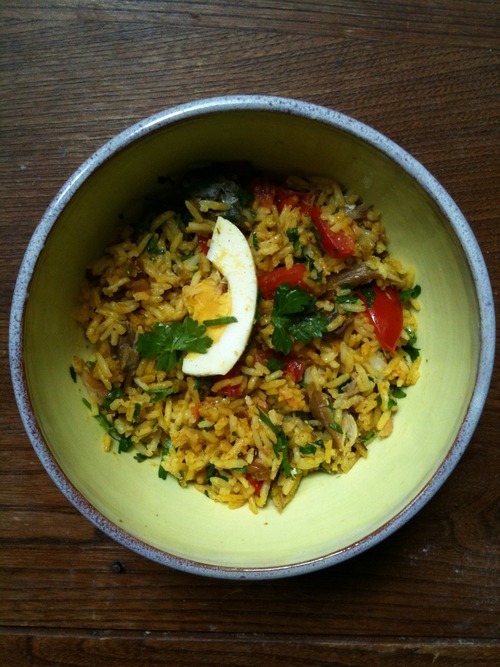
large quantities of parsley and a healthy dose of turmeric and cumin are crucial. good with smoked mackerel, but maybe even better with the original, but hard-to-find, smoked haddock. our people are working on it even now. bowl by judith motzkin, maker of the awesome bread device. for more on kedgeree, consult pages 305-327 of john thorne's superb pot on the fire.

May 1, 2011
Apr 28, 2011

Apr 27, 2011
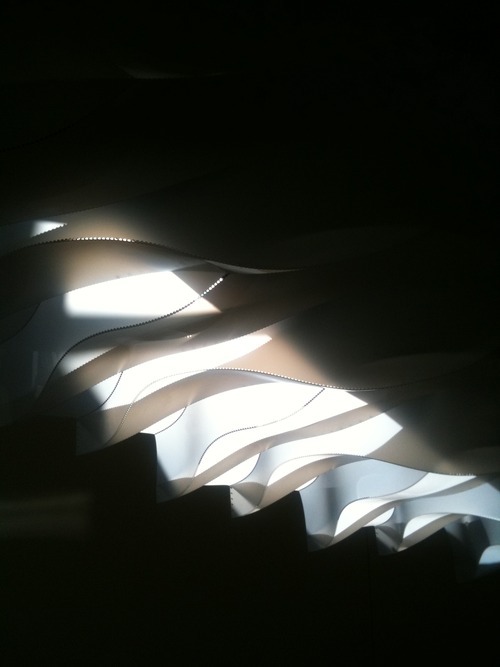 a view of overliner, from mit's 150th anniversary celebrations.
Apr 21, 2011

Apr 19, 2011
the perpetual motion machine
"When we started, we thought we were looking for smart people, but it turned out that intelligence was not as important as we expected. If you imagine someone with 100 percent determination and 100 percent intelligence, you can discard a lot of intelligence before they stop succeeding. But if you start discarding determination, you very quickly get an ineffectual and perpetual grad student."
otomata
this generative sequencer is very neat. it is a set of rules that "produces chaotic results in some settings, therefore you can end up with never repeating*, gradually evolving sequences."
* also neat is the FAQ:
Q: You are a filthy liar! You can't create "never repeating" patterns with a system whose state space is finite!
A: You are right. I should have said "(practically) never repeating" above. But please do the math, it is possible (but not proven) that there might exist some configurations where the exact repetition would take (billions of billions of times) longer than the known age of our universe. I am not a mathematician by any means, so that is as far as infinity goes for me (I also believe that light travels in infinite speed in a vacuum, come at me bro! I am a digital being, speed of light is my universe's sampling rate).
Apr 17, 2011
strategies, tactics
michel de certeau, in the practice of everyday life (an unfairly neglected book) , makes a useful distinction between strategies and tactics as ways of acting.
a strategy is "the calculus of force-relationships which becomes possible when a subject of will and power … can be isolated from an 'environment.' A strategy assumes a place that can be circumscribed as proper and thus serve as the basis for generating relations with an exterior distinct from it." these opposing ways of acting, strategy and tactics, are ideal types and there is a combination of strategy and tactic in every action; the issue here is that tactics become a much more significant part of action under conditions of diffusion. In this, certeau's definition of strategy makes reference to a situation marked by coherence and clarity in one key respect—a "place" is a domain of clearly-defined activity, and strategy can be the dominant strategy only possible in such a domain where there are clear means to ends. a tactic, on the other hand "has at its disposal no base where it can capitalize on its advantages, prepare its expansions, and secure independence with respect to circumstances … it is always on the watch for opportunities that must be seized 'on the wing' … the intellectual synthesis of these given elements takes the form, however, not of a discourse, but of the decision itself, the act and manner in which the opportunity is 'seized'"—tactics are contextual in the most profound way and are dominant where the domain is not clearly-defined.
implicit in the actor's creation of a membership-seeking line based on the context in which it will be deployed is the belief that the line constitutes an argument that certain affiliations and characteristics—his story about himself—justify a relative position in the group. again, this activity is not unilaterally undertaken by the individual seeking a position in the group; rather, the argument and bargaining process is one undertaken as mutually-conducted negotiation. for the individual, the uncertainty inherent in the process of negotiating a valid group identity introduces the need for tactical behavior.
bricolage, the art of making-do exemplified by odysseus (the many-sided), is what individuals do on a daily basis, and certeau discusses the nature of use or consumption (the act of choice and decision-making) as a particular case of bricolage. In a more conscious way, individuals who seek to negotiate membership in a group also engage in a form of bricolage—action conditioned by contingency and constantly in flux. this same lens can be turned on the nature of identity construction. returning to the idea that tactics are decisions and actions, it is important to bear in mind that the construction by individuals of stories about themselves is a sequence of decisions and actions—tactics—contingent on an understanding sense of the group to which entry is being sought: "a tactic boldly juxtaposes diverse elements in order suddenly to produce a flash shedding a different light on the language of a place and to strike the hearer." agents construct themselves through this mix of strategies and tactics; their design to disrupt the target group's definition and change it in their favor.
, makes a useful distinction between strategies and tactics as ways of acting.a strategy is "the calculus of force-relationships which becomes possible when a subject of will and power … can be isolated from an 'environment.' A strategy assumes a place that can be circumscribed as proper and thus serve as the basis for generating relations with an exterior distinct from it." these opposing ways of acting, strategy and tactics, are ideal types and there is a combination of strategy and tactic in every action; the issue here is that tactics become a much more significant part of action under conditions of diffusion. In this, certeau's definition of strategy makes reference to a situation marked by coherence and clarity in one key respect—a "place" is a domain of clearly-defined activity, and strategy can be the dominant strategy only possible in such a domain where there are clear means to ends. a tactic, on the other hand "has at its disposal no base where it can capitalize on its advantages, prepare its expansions, and secure independence with respect to circumstances … it is always on the watch for opportunities that must be seized 'on the wing' … the intellectual synthesis of these given elements takes the form, however, not of a discourse, but of the decision itself, the act and manner in which the opportunity is 'seized'"—tactics are contextual in the most profound way and are dominant where the domain is not clearly-defined.
implicit in the actor's creation of a membership-seeking line based on the context in which it will be deployed is the belief that the line constitutes an argument that certain affiliations and characteristics—his story about himself—justify a relative position in the group. again, this activity is not unilaterally undertaken by the individual seeking a position in the group; rather, the argument and bargaining process is one undertaken as mutually-conducted negotiation. for the individual, the uncertainty inherent in the process of negotiating a valid group identity introduces the need for tactical behavior.
bricolage, the art of making-do exemplified by odysseus (the many-sided), is what individuals do on a daily basis, and certeau discusses the nature of use or consumption (the act of choice and decision-making) as a particular case of bricolage. In a more conscious way, individuals who seek to negotiate membership in a group also engage in a form of bricolage—action conditioned by contingency and constantly in flux. this same lens can be turned on the nature of identity construction. returning to the idea that tactics are decisions and actions, it is important to bear in mind that the construction by individuals of stories about themselves is a sequence of decisions and actions—tactics—contingent on an understanding sense of the group to which entry is being sought: "a tactic boldly juxtaposes diverse elements in order suddenly to produce a flash shedding a different light on the language of a place and to strike the hearer." agents construct themselves through this mix of strategies and tactics; their design to disrupt the target group's definition and change it in their favor.
Apr 16, 2011

Apr 15, 2011
Apr 14, 2011
excavations
from the department of frozen and dried foods #2: chicken stock (7/11/2009)(!), koyadofu (9/27/2010), buckwheat soba (6/10/2010), red miso (3/1/2010), kailan, and daikon.
Apr 12, 2011
the divine comedy
the divine comedy is a frankly stunning collection of installations by ai weiwei (last year's unilever artist at the tate bankside, who has not incidentally been arrested (as of april 3) by the chinese government), tomas saraceno, and olafur eliasson (the 2003 unilever artist). having only been to the eliasson installations i can say that they are wondrous in a subtle and unsettling way (about which more below), but the collection of the three artists together is stunning because i cannot imagine how harvard pulled off something so cool without getting terminally stuck in the mud of bureaucracy and administration.
the eliasson installation deserves a fuller post in the future, after i've gone back when the lights are on. i stopped by tonight after a lecture/panel by david brooks and discovered that the installations are powered only between 8am and 5pm each day. this is extraordinarily lame because this series of installations, like much of the other work eliasson has done, explores our perception of light and visual stimulus and deserves to be explored in the off hours when the exhibition space is mostly empty of people.
i openly admit to being a philistine who visits museums because they have good light and great spaces rather than nice art. with few exceptions, i'm not much of a fan of figurative painting or other things like that. what i do like is art that requires technical sophistication in execution, a thorough understanding (even if not a formal one) of perception, and a bit of a sense of humour (even when this is not obvious). hence a deep and abiding appreciation of donald judd (more judd here), robert irwin, fred sandback, michael heizer, richard serra (more serra here), and all those other people. (dia beacon is a great place to go for these artists, not only because their works are concentrated there but also because the museum itself is jawdroppingly gorgeous. the renovation of the beacon building was supervised by ... robert irwin.)
eliasson's work falls into this category. rumour has it that his atelier is staffed by a relatively enormous team of fabricators, which may account for the intricate construction of some of the pieces i saw tonight. but not all the pieces in the divine comedy are extraordinarily expensive, complex, and intricate. what is most delighting is that the best piece is almost the simplest one.
here are two views of it: one concave spherical section, mirrored on one side and penetrated around its edge with rods mounted exactly perpendicular to the surface at the points of mounting. the section is suspended by piano wire from the ceiling so that it rotates unpredictably and slowly. because the rods are perpendicular to the surface and close to the edge, their reflections are only minimally spherically distorted and connect with the non-occluded portion of the rod on the opposite side of the mirror. as such, they appear to penetrate through a clear piece of glass. however, when the section rotates to reflect a part of the room that has rectilinear objects in it, those relatively distant objects are considerably distorted, and the whole gives the appearance of what it actually is: a concave mirror. at other times, when the piece rotates to face a relatively featureless section of wall, it appears like a convex lens. the overall effect is of simultaneously perceiving a mirror, a lens, and a regular piece of glass at the same time; unsettling if you stop to think about it for even a moment. if he'd been able to make the section out of a much thinner material while still maintaining the concavity, the illusion and incongruity would have been total.
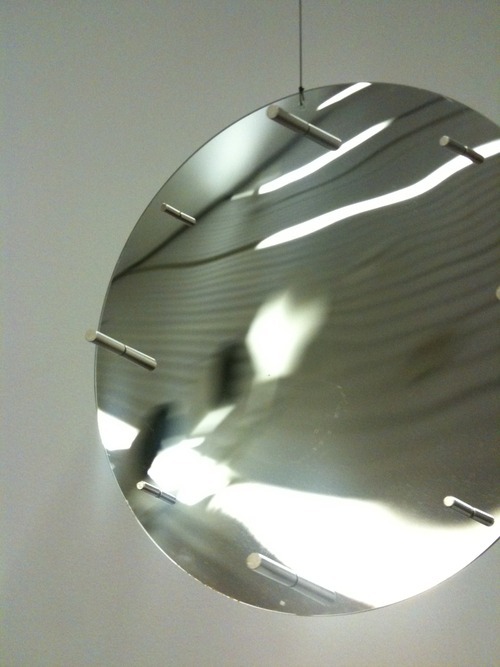
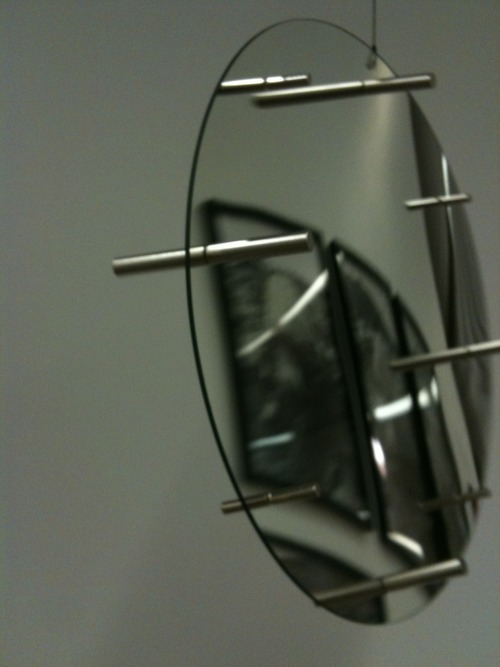
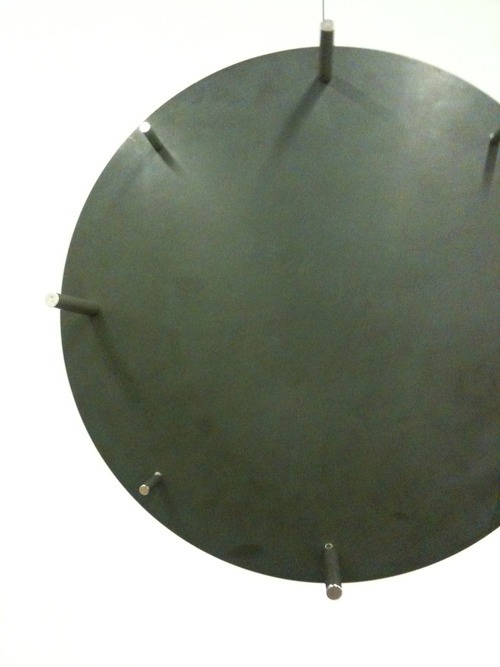
what's wondrous about the piece is that it forces the viewer to reconsider what an incredible exercise it is to interpret visual stimulus and come away with a snap identification of the thing being seen: a concave mirror, a piece of glass. donald hoffman's great and very accessible book on visual intelligence goes into some detail about the logic and processing behind these everyday miracles that happen in our heads, but eliasson's work (and especially that one piece described above) does so in the gentle, non-didactic, but insistent manner that is one of the hallmarks of great art.
eliasson is now chair of the Institut für Raumexperiment at the berlin university of the arts. this is a place i would like to visit.
using things up
today, an archaeology of the freezer, in which we discover that a thick layer of oil is effective at preventing freezer burn.
cilantro, almond, garlic pesto (7/27/2010), maine rock shrimp (9/12/2010), oven-roasted cherry tomatoes (8/19/2009)(!), pecorino (10/10/2010), and linguine = lunch in 11 minutes.
Apr 11, 2011
when the time comes
The love which brings the right answer is an exercise of justice and realism and really looking. The difficulty is to keep the attention fixed upon the real situation and to prevent it from returning surreptitiously to the self with consolations of self-pity, resentment, fantasy and despair. The refusal to attend may even induce a fictitious sense of freedom: I may as well toss a coin. Of course virtue is good habit and dutiful action. But the background condition of such habit and such action, in human beings, is a just mode of vision and a good quality of consciousness. It is a task to come to see the world as it is. A philosophy which leaves duty without a context and exalts the idea of freedom and power as a separate top level value ignores this task and obscures the relation between virtue and reality. We act rightly 'when the time comes' not out of strength of will but out of the quality of our usual attachments and with the kind of energy and discernment which we have available.[thx yen]
iris murdoch, the sovereignty of good

Apr 10, 2011


Apr 8, 2011

Subscribe to:
Posts (Atom)