
Oct 29, 2011


Oct 28, 2011
mindful eating
Eating is often a knee-jerk reaction: we cook and eat what is most convenient, what is least expensive, what appears to taste good. But deciding what to eat involves consequences that are wide-ranging and long-lasting, even if we don't recognise what those consequences are. We can make good decisions about what actions to take only by knowing the consequences of those actions. And we can only know these consequences if we investigate, inquire, and gather more information.
Meat is a good example. Meat is environmentally costly. Most easily available meat is intensively raised and processed in operations that raise ethical and food-safety concerns in addition to the environmental ones. Learning more about meat production allows you to make better decisions about the meat you choose to consume. You may choose to eat less meat, and buy what meat you do eat from producers who claim to raise and process the meat in ways that minimise the risk of food-borne illness. In doing so, you are choosing to eat not the least expensive or most convenient meat, but rather the meat that is produced with attention to health or environmental impact. Or you may continue eating the meat you've always eaten, with a better knowledge of the risks that you are exposed to.
Another example: You go to eat at a very good restaurant. The food has been made with care from good ingredients. The check comes—it is for a staggering amount. Yet the prices, though high, are subsidised by chefs, stagiaires, and producers who work long hours for little money; there is not much profit in food sourced and made with care. Fast food, in contrast, is inexpensive. It is often made with indifferent ingredients and by poorly paid workers. There are considerable profits to be made from fast food. Questioning what goes into the price of the food you eat may make you decide to cook for yourself most of the time and to eat out infrequently and only at restaurants that cook with care. Or it may not.
All this has been said before. Being mindful of the consequences of eating sounds like submitting to nothing but limitation, restrictions, and unaffordable food. Acknowledging, for instance, that eating food grown far away seriously damages the environment means for the most part restricting the food you eat to things grown locally—a smaller and less predictable selection.
But the limitations imposed by mindful eating are not the full story.
Questioning what, how, and why we eat limits us in some ways but also opens up new possibilities. Limitations are like frames that, by excluding much of the view, allow you to look more closely at whatever is within the frames. If you decide to eat only local, seasonal fruit, you have no choice but to begin to pay close attention to the fruit that is around you. But you come to realise that strawberries taste different from day to day as the season progresses, that there are in fact different varieties of strawberries that ripen at different times, and you begin to eat strawberries only when they are at their very best.
Asking questions about the food you eat can lead you to discover techniques and methods of cooking and flavour combinations that are new to you but well-known elsewhere and to other people. For cooks, asking questions and finding answers is a way to learn how to express a particular sense of what tastes good and what is good to eat. It is also a way to develop that particular sense, the style of cooking that distinguishes you from other chefs—a way to develop a vocabulary for communicating your values in food, the reason why you cook.
We should ask ourselves a multitude of questions about the food we eat. Our decisions about food will be informed by the answers we find. The point is not to find the single right answer to each question (it doesn't exist) but rather to begin to ask the questions.
Oct 27, 2011
the world is concurrent
The world is concurrent. Things in the world don't share data. Things communicate with messages. Things fail.

Oct 25, 2011

Oct 24, 2011

Oct 23, 2011


Oct 20, 2011
Oct 19, 2011
Oct 18, 2011
Oct 12, 2011
Oct 11, 2011
food aversions
when push comes to shove, you eat. in the course of research, i’ve been handed ants, raw lamb brain, cooked lamb brain, fermented shark, and a live fjord shrimp to try. the shrimp, which comes with slowly moving feelers and scrabbly legs, feels a lot like what i imagine a live cricket would feel like in your mouth. it’s quite delicious though, and crunchy. there goes another food aversion.
about the fermented shark, the less said the better.
Oct 9, 2011

Oct 8, 2011

Oct 7, 2011
Oct 5, 2011
commemoration
tonight, google commemorated steve jobs by changing its homepage and adding what used to be called a homepage promotion in every language google.com is available in: a link under the search box. (the link points to apple.com, a beautiful gesture in itself.)
the amount of traffic to the google homepage makes it tremendously valuable real estate, and that promotional spot is fiercely protected because it is so closely associated with the google brand. homepage promotions go through many rounds of approval because so many people see the homepage every day. because of that little line under the searchbox, tens of millions of people (at least, maybe over a billion, depending on how long the link stays up) around the world will know of steve jobs's passing. it's hard to imagine a more effective way to spread the word. the homepage promotion went up within a few hours of the apple announcement and i'd like to think that the phone call that did it came out of a flurry of emails up top and didn't go through weeks of the usual approvals and clearances.
one thing i won't regret about having worked for a short time in the valley is seeing first-hand that technology is made by people. i was working on earth and maps in 2007, the year when jim gray was lost at sea after putting out his boat in san francisco bay. gray was a computer scientist at microsoft who'd influenced many senior googlers. a few days after he'd been reported missing, the maps team got a phone call to buy up satellite imagery of the area for the last few days, timestamp and georeference it, break it into little pieces, and send it on to amazon where the web services team was going to run a mechanical turk project to have people look in each little image for jim gray's boat. the imagery team dropped everything that day to do this, and the pictures went out to amazon in a few hours.
the search for jim gray proved fruitless but it called forth acts of human discretion all through the valley and beyond. and so it is today. loss shows that technology is a family.

Oct 4, 2011
a new book
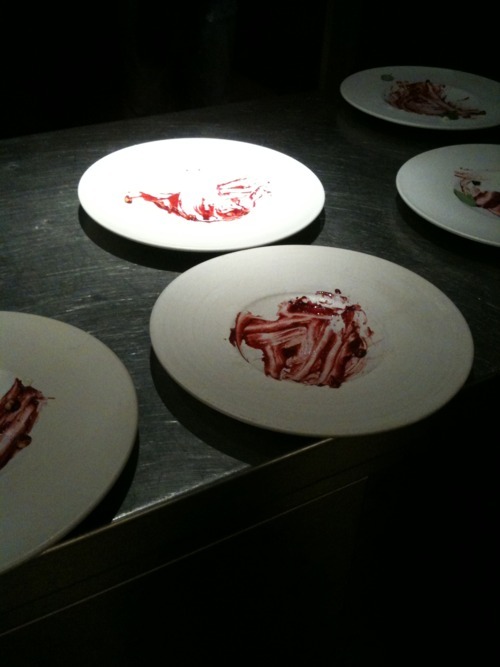
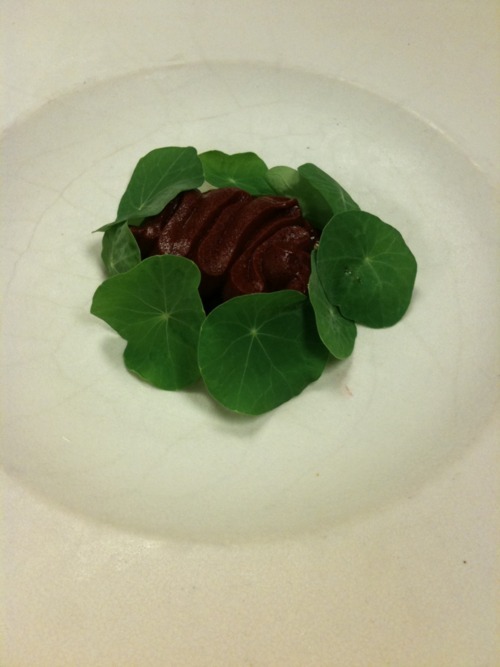
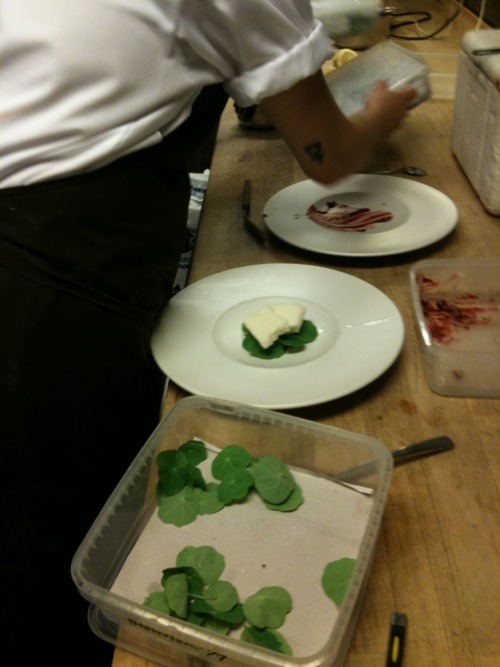
opinions differ on dessert. is it meant to be a comforting, sweet, predictable ending to a good meal, or is it meant to be unsettling and to provoke the eater into a consideration of new flavours? i fall into both camps, depending on the day. especially at restaurants on the cutting edge, i incline to the latter. below you see a dessert which is so much on the cutting edge it may have gone slightly beyond it.
the pleasure of a good brioche is not primarily in the buttery flavour or the lightness of the baked bread. rather, it is in the gentle aroma of yeast left over from a long, slow fermentation. this dessert plays on this yeast smell and connects it to similar musty aromas in blackberries and corn. it consists of grilled corn kernels shaved off the cob and bound with blackberry puree, a tart blackberry sorbet, young nasturtium leaves for acid, and a frozen foam made of heavy cream infused with yeast.
the yeast cream parfait is aerated by warming the infused cream slightly, then placing it in a valve container and drawing a vacuum on it in a chamber vacuum. the water begins to boil at a relatively low temperature creating a fragile foam, at which point the vacuum is released. the foamed liquid in the container is kept under partial vacuum because of the valve and the whole is placed into the blast freezer to freeze while still aerated. this fiddly procedure produces blocks of a white sponge that tastes of brioche and which disappears in the mouth.
one comment about this was particularly apposite: "many desserts take pages out of old books. this dessert is like a new book completely. perhaps diners are not quite ready for this. after a meal of new and uncomfortable textures and flavours, they might be expecting something familiar and sweet. for diners like that, this is like a big 'fuck you.'"
Oct 3, 2011
Oct 2, 2011
you can change your life
There are two ways of looking at the work you do to earn a living:
One is the way propounded by the late Henry Ford: Work is a necessary evil, but modern technology will reduce it to a minimum. Your life is your leisure lived in your ‘free’ time.We opt uncompromisingly for the second way.
The other is: To make your work interesting and rewarding. You enjoy both your work and your leisure.
There are also two ways of looking at the pursuit of happiness:
One is to go straight for the things you fancy without restraints, that is, without considering anybody else besides yourself.We, again, opt for the second way.
The other is: to recognise that no man is an island, that our lives are inextricably mixed up with those of our fellow human beings, and that there can be no real happiness in isolation. Which leads to an attitude which would accord to others the rights claimed for oneself, which would accept certain moral or humanitarian restraints.
Sep 28, 2011
solution
By the next day at lunch, Kant and Wittgenstein had dissolved in the marinara on the fifty-cent spaghetti plate at Romeo's. I returned to Rimbaud, Apollinaire, and Char for wisdom, abandoning forever the academic pursuit of trying to answer questions that no one ever asks.more jim harrison here.
jim harrison, "principles" in the raw and the cooked
duck duck goose
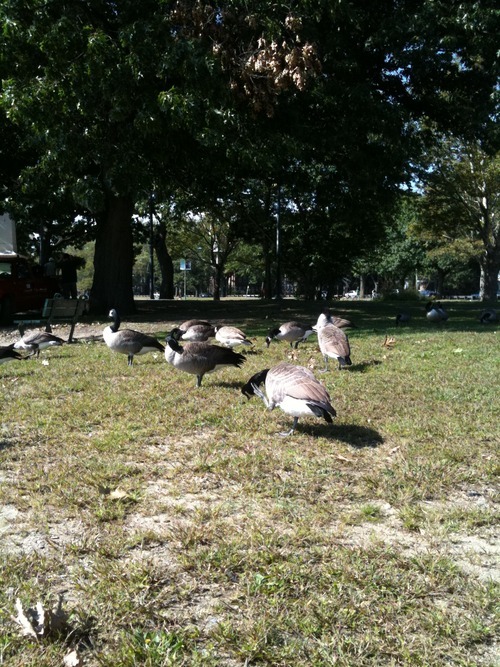
the only advantage of reading on a barren patch by the river is that it is relatively free of goose shit.
Sep 22, 2011
this just in
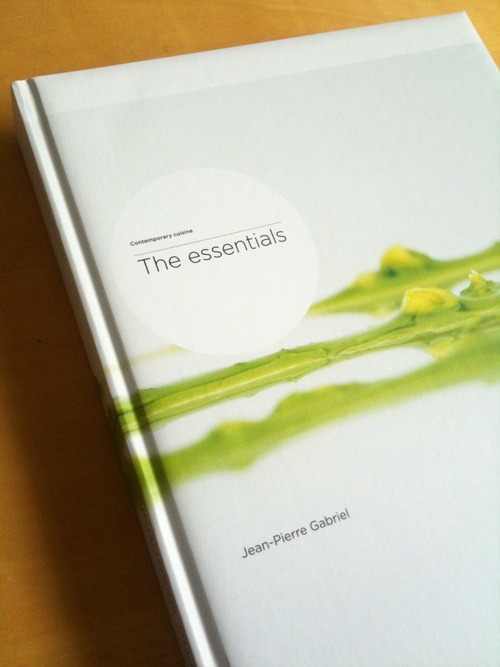
a battered box from belgium arrives, its contents fortunately unscathed. the essentials (unilever, 2009) is lavishly illustrated and filled with commentary and recipes from a slew of dutch chefs. at first glance it appears to be a precursor to modernist cuisine. more later, after a much longer look.
[thx, j-pg]
how chefs can (help) save the world

Though lacking a grand theme, a common thread ran through Planting Thoughts, a food symposium held in Copenhagen in late August that promised serious thinking and discussion about food. Good food, the diverse crowd of speakers (chefs, food scientists, farmers, biologists, foragers, and more) argued, takes time and effort from everyone involved in making it: There are no short-cuts. The symposium also showed how haute cuisine—often derided as elitist—can support efforts towards building a system that can make enough good, sustainably grown food for everyone and make it accessible to all.
Most obviously, haute cuisine can extend and reinvigorate local food culture and history, the context of people, places, stories, and traditions that surrounds food in a given place. Fine dining restaurants can afford to pay a premium for what we now think of as artisanal ingredients, keeping them in production and their producers in business. Less obviously but more importantly, many chefs use culture and history when creating new dishes in their restaurants. Japan's Yoshihiro Narisawa, Italy's Massimo Bottura, Spain's Andoni Aduriz, Australia's Ben Shewry, Daniel Patterson from the United States—they all use the historical and cultural context in which they work to help them answer the question: "This was what came before, what should we cook next?"
Patterson's food is an example of how culture and history can point chefs in the right direction. He often researches how particular ingredients have historically been cooked, then bases novel interpretations on what he finds. At the symposium, he showed three beet dishes in which he took the familiar texture of the roasted beet (from the roasted beet and goat cheese salad that was introduced in the late 1970s and is now ubiquitous) and transformed it into something new but—crucially—not forbidding. Here's one: roasted beets on a rose-scented snow with yogurt, a novel pairing of flowers and earth, united by the familiar combinations of floral/milky and earthy/milky flavors. Chefs like Patterson create new and delicious things by returning to what we already know. For them good food is anchored in context, and requires investigation of place, time, and history.
Clearly, the labor-intensive food these chefs make will never be the food of the people. This is why haute cuisine seldom participates in discussions about how to feed many people sustainably and healthfully. This is a false divide. Even if the food itself does not scale up from the fine dining restaurant, the approach—examining context more closely—could be part of the solution.
Looking to history and culture helps us understand why we eat the way we do today. Thousand of years of food choices have led us to eat mostly starches from a few cultivated plants instead of the diverse set of foods that we used to eat. This modern, developed-country way of growing food and eating has expanded dramatically in the last half-century. Accelerating urbanization and changing work patterns during this time have made it less likely that families cook and eat together. Now, it's the exception rather than the rule to eat good food made with care, that originates in a place and with people that you know, part of a culture and history that you share. "You would think that at the end of thousands of years of development, it would take a long time to destroy these memories of good food," Patterson said, "but industrial agriculture took that all away in a generation, wiped it all out."
Our food production and distribution system is a litany of connected problems. We grow more food per capita than we need, but we grow the wrong food, in the wrong places, in the wrong way. On average, we consume more calories than we require. Industrial agriculture produces trillions of calories but at tremendous and mostly hidden cost. The energy spent in manufacturing the fertilizers and pesticides, operating the machinery, and fueling the transport required for industrial agriculture is hidden in subsidies on agriculture, fuel, and transportation. Our starchy diet is associated with chronic health problems that we pay for indirectly with taxes and overloaded health-care systems. When cheap energy finally becomes too expensive and the chronic health crisis can no longer be ignored, what we choose to eat and how we we grow, process, transport, prepare, and sell it will have to change.
What, then, might the future of food look like? About the only certainty is that it will have to be built from a lot of smaller solutions rather than a single industrial mega-solution. Hans Herren, an author of the IAASTD (an international review of agricultural knowledge), noted that small-scale organic farming is as productive as the world average for agricultural production, and challenges the widely held assumption that mechanized, industrial agriculture is the only viable solution. While too many people live in urban areas for all agriculture to be local, Thomas Harttung, an urban agriculture advocate, suggested that urban agriculture can produce an enormous volume of food to supplement our food supply. The foragers who spoke at Planting Thoughts, Miles Irving and Francois Couplan, also argued that wild foods are diverse and plentiful enough to be as meaningful and delicious a part of our food supply in the future as they were in the past. Diversifying our food production systems is critical, and this means including elements based on old ways of doing things like foraging and local, organic production methods, but with the advantage of new knowledge.
Changing how we produce, distribute, and consume food will require us to unlearn what we take for granted now: apparently cheap food, reliance on starches, unnecessarily abundant calories, eating a lot of meat. Then we'll have to learn something new: spending time and effort to find and make real food, growing and eating closer to home, eating less but better, eating more plants. This will be tremendously difficult. A change in our food system won't happen if it isn't supported by an equally radical change in our food culture.
Change, though, is easier if it is delicious and pleasurable—and this is where haute cuisine comes back into the picture. Chefs are, as Michel Bras called them, "marchands de bonheur," their know-how employed in making delicious things. This knowledge gives chefs the ability to use pleasure to help change what people want to eat. "Poor choices lead to unsustainable foods," Ben Shewry said. "The responsibility of the chef is to know and to act." Activists for sustainable food and food access rightly emphasize how urgently we need to change our food system. Chefs can help make that change delicious and desirable, not just necessary and inevitable.
click here for other posts about Planting Thoughts, including session summaries.
[this post was cross-published in The Atlantic|Life]
Sep 20, 2011
reason
So convenient a thing it is to be a reasonable Creature, since it enables one to find or make a Reason for everything one has a mind to do.
Sep 19, 2011
the hard truths
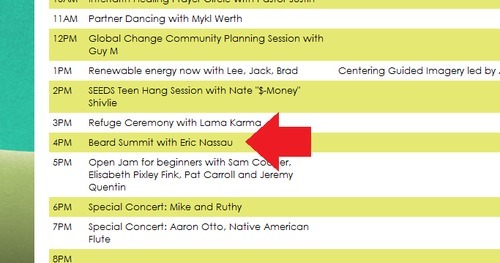
jd: let's go to this
vt: i won't fit in. i don't have a massive beard.
jd: see below.
Sep 18, 2011
Subscribe to:
Posts (Atom)