
to the best of our knowledge examines typography with tobias frere-jones, jonathan hoefler, and matthew carter.
Oct 31, 2009


Oct 30, 2009
wilco|I am trying to break your heart
the wilco documentary by sam jones (in 6 parts on youtube). crafted music.
Oct 28, 2009
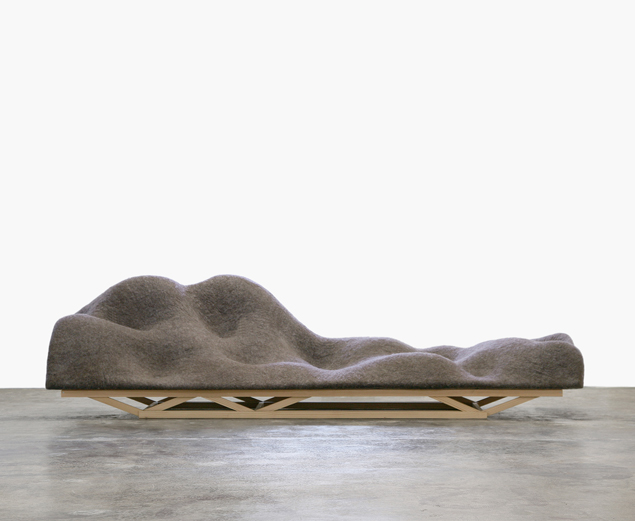
brainwave sofa
lucas maassen's brainwave sofa is a representation of a 3 second wave of Alpha brain activity
captured with an EEG, modeled, milled in 3D foam, and upholstered by hand.
Oct 26, 2009
Oct 24, 2009
Oct 23, 2009
Look Around You - Sulphur
via youtube.com
from experiment 2, an investigation into the effect of iron on sulphur (6:26): "for this experiment, we will be using a common household item rich in iron. that's right: champagne. a quantity of champagne is poured into a large glass trough. we're using about 17 bottles worth. there's a lot of cheap brands on the market these days, but we suggest using one of the better ones. there's no hiding quality. next, a quantity of sulphur is added and the mixture is agitated, producing sulphagne. write that down."
you are what you eat
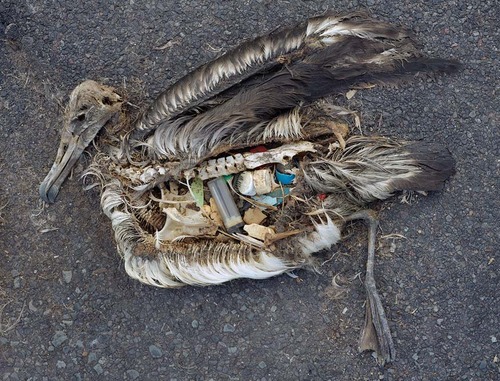
chris jordan photographs the gut contents of albatross chicks on midway island. (its a long way away from anywhere.)
Oct 22, 2009

Oct 21, 2009
Oct 19, 2009

Oct 15, 2009


Oct 8, 2009
kaiseki+
this post got neatened up and, through an improbable sequence of events, is now on the atlantic food channel.
understanding kaiseki (with a slideshow of dishes from hon-kogetsu, in osaka, circa 2004)
Sep 13, 2009
on kaiseki
[also see this article]
so, here is the stake in the ground, the brief explanation of kaiseki that rejects as fundamentally flawed the idea that kaiseki is primarily a culinary tradition emphasizing presentation. kaiseki is one of these mythical ideas in japanese cooking -- little understood except by culinary history wonks, so no one seems to be able to agree about the early history of kaiseki. i suppose this is my contribution to misinformation.
there is an ideal type for kaiseki which is now more honoured in the breach than the observance. these days, it is best known as sumptuous dining -- expensive, rarefied, exclusive, something like the japanese version of going to the french laundry. it is more accurate, though, to think of kaiseki as an approach to cooking and consumption which finds expression in two broad types of dining.
the kanji for kaiseki can be written in two ways -- the first, 会席, stands (approximately) for "formal occasion," the second, 懐石, (again approximately) for "stone in the robe." most of what is today called kaiseki is of the formal occasion variety and descends from japanese court cuisine. because this was, broadly speaking, food for the nobility, price was usually irrelevant to preparation. kaiseki meals are some of the most expensive dining experiences you can have. the stone in the robe form of kaiseki is much rarer, especially outside japan. this lineage of kaiseki derives from the tea ceremony (cha-no-yu) and from the cooking traditions of zen monasteries (shojin ryori). this lineage of kaiseki emphasises economy and wise use of materials rather than waste: the story (which i find singularly unconvincing) is that monks in temples used to warm stones and keep them in their robes next to their stomachs to ward off hunger pangs -- hence the name. i am told that an extremely minimalist version of shojin ryori may be found in california at the tassajara zen monastery. though different in ancestry, both lineages of kaiseki emphasize mindful eating and, over time, have developed into quite highly formalized culinary systems.
the original kaiseki (stone in the robe variety) was of the form ichi-ju issai (or ni-sai, or san-sai) -- meaning one soup and a prepared dish or two or three (rice always being a given). kaiseki of both lineages have elaborated the form, but always the basic structure remains: there is the soup, and then there is an array of prepared dishes. kaiseki menus are thus variations on a theme -- chefs use ingredients in season and cook them within the kaiseki framework and the broader wa-shoku framework (wa-shoku translates as japanese cooking, and it has its own set of principles for success -- seven methods of cooking, five flavours, five colours, etc etc). the kaiseki format (which is almost infinitely extensible, as you'll see) offers some boundary conditions within which the kaiseki chef's duty is to optimize. i like to think of it as a multivariate optimization exercise, like many crafts.
for most formal occasion variety kaiseki, the standard format and one interpretation of an approximate order is given below:
startersshiizakana/sakizuki: appetizers (the former accompanying sake)zensai: vegetable appetizers (yet more appetizers, but these are more substantial)suimono: the soup courseseasonalstsukuri/mukuzuki: sashimihassun: a platter (the name derives from the platter's edge-length, which is 8 inches or hassun) of complementary foods from either the seas and the mountains or the fields and the streams. a hassun for the early spring might be tai (sea bream) and a mountain herb like fukinoto (butterbur buds); one for the midsummer might be freshwater eel (unagi) and new potatoes (imo).ways of cookingyakimono: grilled courseaemono: dressed course (dressed with some kind of sauce -- this course is usually dropped in smaller kaiseki, as far as i know)nimono: simmered coursemushimono: steamed coursesunomono: vinegared course (quick-pickled is the best analogue)riceshokuji: course eaten with ricethen dessert is usually fresh fruit of some sort, plus matcha and a wagashi (if in kyoto, or in a really fancy restaurant, the wagashi will be made of wasanbon, a hand-refined sugar from shikoku). the rice course is specially set apart because, really, no meal is complete without rice (even if it is only a token amount of rice). this is true in japan as it is in china and many other parts of east asia.
in kaiseki, chefs are at liberty to take out anything (almost) except the suimono and shokuji courses. they will frequently replace courses with analogues or referential courses -- for example, in place of nimono (the traditional simmered course), an innovative chef might serve a braised dish or a rustic claypot dish. the starters are also relatively easily interchanged or omitted. in short kaiseki, many chefs seem to eliminate the aemono course and one other dependent on season: in the winter, the nimono is a staple but mushimono and yakimono might go away; in the summer, nimono probably goes away and yakimono sticks around. everyone loves the grill in the heat, even in japan.
gesshinkyo (a temple vegetarian restaurant in tokyo, off omotesando, now closed. see here) is an interesting combination of the two lineages of kaiseki. since tanahashi's training is in shojin ryori (temple cooking, usually associated with the stone in the robe line) but his restaurant is decidedly upscale (formal dining, expensive, elaborate), dinner with him combines the vegetarian/non-alcoholic/introspective and the lavish/expensive. it also forces a reinterpretation of many of the courses because meat and alcohol are prohibited in shojin. you will not get the tsukuri and shiizakana courses, but tropes like the hassun will likely be interpreted in a quite refreshing way. i am told that he once served junsai (water shield shoots) and myoga (japanese ginger shoots) for a hassun -- a quite innovative way to combine foods from streams/fields without resorting to serving meat. as with almost all shojin, there will be no attempt to disguise vegetables/tofu as meat -- you'll get many dishes and more different types of vegetables than you're likely to have seen before in one sitting.
as a cooking tradition, shojin also appears to have a more granular awareness of shun (seasonality) than the rest of japanese cooking in general. shun is best translated as "season," though no really adequate english word exists for it. shun makes reference to a time of year (recurrent and thus seasonal), a food, and an application -- thus, there is a shun for bamboo shoots (it lasts about 10-12 days in early spring), recognizing that during this window of time bamboo shoots are tender enough to be eaten as a root vegetable without the leaching and processing necessary later in the season. some foods have multiple shun. for example, tai (sea bream) has something like 3 separate shun. one is in early spring, when the fish are lean and clean-tasting after the winter and best suited for some kinds of sashimi; another is in the midsummer when glycogen levels in the flesh are moderately high and thus suitable for some other variety of sashimi; and the third is just before spawning when the flesh is suitable for char grilling. or something. you have to be a japanese chef to keep up with these things. because the shun for foods overlaps with the seasons, foods become markers of seasons as well as marked by seasons -- hence the idea of shun no mono (seasonal foods) and menus that closely reflect seasonality. good japanese chefs are particularly intimately aware of the foods that are at the peak of their season at any given point and adjust their menus accordingly -- these are now rare and you only get to see this quality of cooking if you hang out with professors at cooking schools and the like. good japanese chefs are also frequently versed in the art, culture, and history of japan -- lots of little in-jokes get folded into the composition and presentation of japanese dishes. going into more detail about this would be really tiresome -- as sociologists like to say, the practice exists in an impenetrable hermeneutic circle. in any case, high-quality kaiseki is characterised by this kind of dual richness in the food: strong awareness of seasonality and multiple layers of cultural meaning. if you are particularly attuned to shun and japanese culture, eating at a really fancy kaiseki place is a bit like having a private conversation with the chef through the medium of the dishes he sends out. this is akin to how thomas keller sends out things like oysters and pearls (savory pearl tapioca custard with oyster and caviar) at the french laundry, except the conversation in a kaiseki setting runs along the lines of "i have put a sansho leaf on this humble piece of sesame tofu. [meaningful look]" "ah, a sansho leaf. it must be midsummer. i hope there will be some tai sashimi later on, perhaps in an ice-bowl, as is appropriate to this midsummer heat. this sesame tofu is quite delicate and, even though it looks like nothing very complicated, i am refined and cultured enough to see that someone has spent hours grinding the seeds to produce this smooth and silky gel designed to appear humble and unassuming. bravo to the chef." and so on.
Sep 9, 2009
research directions
a new year begins, and work and research projects begin to coalesce or, in some cases, resurface. here's what's on the plate:
- a quantitative analysis of the determinants of formal association within developer groups on sourceforge.net, backed by survey and interview data. this should be an opportunity to deploy some interesting hazard rate models and, with the survey data, some new multiplex network analytic techniques. also talking again with berkman's law lab about supporting a field experiment on the same domain once the initial quantitative analysis is complete.
- experimental research on search behavior. we're in such early days on this that it's not really worth discussing at the moment but things should come to a head within the next 2 months.
- engineering sciences 147, which i'll be tf-ing. i'm excited about this because it will be one of a small handful at harvard that emphasises the process of innovation as well as the product and seriously grapples with the benefits and disadvantages of interdisciplinarity. if you're in the undergraduate college, think about taking this class. (and check out also this rather slick thing the lab produced for the class.)
- a theoretical treatment of diffusion in organizations, grounded in the empirical data i collected for a previous project on information efficiency in the north american haute cuisine organization.
if you have thoughts or leads, send them on.
informal
When we conjure up impressions, ideas, and images of the engineer, we tend to think of an ingenious individual and Promethean spirit who overcomes huge obstacles to realise the most daring constructions. The tallest, the biggest, the largest, are the records set by the great engineers. The Isambard Kingdom Brunels, the Gustave Eiffels, become the heroes in our transgressions of Nature. In the public mind the engineer turns into the supreme technological legislator--a hard person of science--who makes the impossible work. This romantic notion of the engineer conspires to keep art and science separate. Engineering as a catalyst to inspire a creativity is not the generally held view. But in the Greek word 'techne' the unity of engineer-architect describes a sharing of design values, the diagram and calculation, the concept and proportion being viewed as cycles of noetic invention ... A cycle of invention and post rationalisation runs from one start to another--and in between are the judgements and criticisms one makes. What remains constant is the motivation to keep entering that creative dialogue between architecture and engineering, and the writing of new stories.cecil balmond, informal.
Sep 8, 2009
skillet pizza: this changes everything
if you are lucky enough to live in brooklyn, close to di fara, you have the opportunity to eat, daily if you so desire, a pizza that will cause you to jump up and down with pleasure during and after each bite: the tremendous heat (more than 700F) of a commercial pizza oven cooks the pie in just a couple of minutes. this short, intense burst of dry heat yields a pizza crust that is lightly charred on the underside and on the rim, moist and tender within, light and airy, chewy yet crisp, with sauce and toppings bubblingly-hot but not yet desiccated. if urban manhattan is not your domicile, and you have high standards for your pizza, you may be forced to go to great, often costly, lengths. fortunately, there is an inexpensive, easy, and incredibly effective solution to this problem. we tested it tonight (making it 8 runs in total) and can confirm that there is, indeed, jumping up and down with pleasure both during and after each bite, and sounds of pleasure also. detailed instructions for this pizza follow, after a brief discussion of process.
this is the result of experiment 7.

fresh tomato sauce with garlic, basil, and pesto blobs. left it in the oven maybe 30 sec longer than we should have, hence the excessive charring on top. the second pizza we made, which we didn't photograph, was perfect. perfect.

a lightly charred underside
let us review:
commercial ovens designed to cook a steady stream of pizza or bread have thick stone or refractory brickwork floors on which the cooking takes places; this floor is preheated to a high temperature and has sufficient thermal mass that placing wet dough on it reduces the temperature by only a small amount--the side effect is that whatever is on the oven floor also cooks extremely quickly. commercial ovens are also free of the thermostatic regulators that prevent most home ovens from reaching the high temperatures for which they are almost all designed (during a self-clean cycle, the temperature inside a home oven reaches north of 900F). clearly, of the many trials faced by the home cook hell-bent on the pizza of his (or her dreams), the two biggest are
- achieving a high-temperature cooking base to crisp the bottom of the pizza.
- achieving a high-temperature cooking environment to rapidly cook the top of the pizza.
attempts to surmount these twin problems have included (but are not limited to*)
- buying or building a pizza oven much like a serious pizza restaurant would have. while solving both problems, this solution is not feasible for those with insufficient room (or sufficient floor bracing) for an 800-pound brick structure.
- using a pizza stone. these stoneware discs are usually 1/2" to 3/4" thick and take about 80 minutes to heat up fully (ie, for the thermal mass to reach saturation) in a very hot oven. this solves problem 1, but in a spectacularly energy-inefficient way.
- jerry-rigging home ovens to cook on the cleaning cycle. this involves subverting the automatic lock that usually engages when the cleaning cycle is turned on. if successful, a magnificent pizza. if unsuccessful in opening the oven and retrieving the pizza, ashes, a calcined pizza stone, and the smell of smoke pervading throughout. i know this from bitter experience as, apparently, does jeffrey steingarten.*
- investing in specialized home pizza-oven machines that surround the pie with ample heat. perfect, but at what price? also, i despise equipment that has only one purpose.
who can really say what the thought processes and proximate triggers behind breakthrough ideas are? they are invariably subject to retrospective meaning-making. perhaps the seed of the idea was planted by the itinerant crepe-seller in the luxembourg gardens (wherein there is a statue of a woman in classical garb holding an ice cream cone) whose incessant beating on his crepe-griddle woke me from a deep and viscous nap. maybe the idea took shape as the pile of pans fell off the counter and onto the tomatoes (an excuse to make sauce) as i rummaged for a pizza stone. in any case, about two weeks ago, after restacking a large pile of pans, it occurred to me to ask three questions:
does a cast-iron skillet have enough thermal mass to cook and lightly char a pizza base if thoroughly preheated, then taken off heat?- does a broiler generate enough radiant heat and hot air to cook and lightly char a pizza top fast enough to not dry it out?
- can a preheated skillet and broiler be combined to produce pizza awesomeness?
the answer to all three questions, as it turns out, is yes. a broiler and a cast-iron skillet in combination are the easy secret to a light, airy, moist, chewy, crisp, lightly-charred pizza without an expensive wood-fired oven or a potentially-expensive experiment with your home oven's safety lock. this pizza will not be nearly as good as something baked in under a minute in a roaringly-hot pizza oven but it comes awfully close, all things considered. after several trial runs, i am ready to share the following learnings with you.
instructions for a home pizza of stunning perfection:
- [4-6 days before you want pizza] prepare a good dough and allow it to mature. i can add nothing to jeff varasano's minutely-detailed recipe and instructions. shape into single serving balls of dough and allow to mature in the fridge.
- 60-80 minutes before you want your pizza, take the dough out. lightly coat each ball of dough in oil a separate bowl and leave to warm up to room temperature and double in size. do not neglect the oil, as it prevents the dough from adhering inconveniently and frustratingly to the bowl later on. if the dough appears laggardly (ie, if it isn't doing much of anything after 20-30 minutes), placing it in a gently-warmed oven helps accelerate the process: switch on the oven for a minute, then shut it off and open the door to vent hot air before placing the dough inside. do not use this dough until it has at least doubled in volume (this may be a smaller visual change than you expect; be vigilant and remember that volumetric expansion is less dramatic).
- prepare your sauces and toppings. have a spoon for every sauce and all the toppings grated, cut, and ready for extremely rapid deployment.
- prepare your broiler drawer by putting baking sheets or other heat-proof objects into the broiler drawer. the skillet will rest upon these objects, and the intent is to raise the skillet as close to the broiler heating element as possible without touching the element. you should be able to slide the skillet into the broiler easily. this is an important step that you should not neglect.
- when all is in readiness, turn on the broiler and begin preheating the dry, ungreased skillet on the stovetop on the highest flame setting. the skillet should preheat for 8-10 minutes to reach thermal saturation. as soon as you begin heating the skillet, lightly flour a wood cutting board or (better yet) a pizza peel. if you flour too assiduously, there will be flour pockets under the pizza when it is baked. these will burn and become bitter, while robbing your crust of the slightly charred patches that make it crisp, yet tender.
- [note that everything in step 6 should happen within 3-4 minutes, at most.] with about 4 minutes of skillet heating to go, begin to shape your pizza. scoop a ball of risen dough out of its bowl, taking care to deflate it as little as possible. holding it gently by an edge, allow gravity to stretch it out. move around the edge so that the ball of dough becomes a thin disk with a slightly thicker edge all around. speed here is of the essence. lay the disk on the floured board and shake the board from side to side to prevent the dough from sticking. immediately sauce it lightly, being careful not to deflate the dough by pressing down with your saucing spoon, then add toppings. speed, not perfection, is the objective: if you dally, the wet dough will stick to your board and be impossible to slide onto the hot skillet. because the pizza cooks so quickly, a small amount of sauce will remain moist and delightful and allow the crust underneath to aerate.
- slide the pizza onto the skillet. you may find that having another pair of hands to guide the leading edge of the pizza onto the skillet helps. there is no way to get this right without practice or to describe in words the experience of sliding a damp, soft, floppy disk of dough covered in liquids onto a smoking iron skillet. your first pizza is likely to be a mess, but you should bake it anyway. persevere, but clean the charred bits off the skillet before you do so. when your pizza is in the skillet, immediately take the skillet off the flame and place it in the preheated broiler with the handle of the skillet pointing as far to one side of the oven as possible. close the broiler door as quickly as possible. place a heatproof dish into the main oven compartment (not the broiler) to warm up.
- after 45 seconds, rotate the skillet so that the handle points to the opposite side of the oven. after 1 minute 30 seconds, pull out the pizza to see if the unsauced rim has begun to char lightly. if not, push the skillet back in and cook for another 20 seconds, then check again. if your broiler runs cool, your pizza may take up to 3 minutes to cook. when cooked, take the pizza out of the broiler and place it on the now-warm plate you put in the oven in step 7.
(experiment 8 featured an 18" diameter griswold cast iron skillet that produced a pesto and salami pizza so good that we continue to dream about it.)
* for a full account, see jeffrey steingarten's amusingly self-deprecating review article.
Aug 31, 2009
the wasteland
went to lechmere tonight in search of a tasty beverage and can confirm that 1) it is infested by chain stores, 2) all of which are closed after 9.30pm, 3) and what is open after 9.30pm is reprehensible.
Aug 29, 2009
paris, recollected
 through an improbable sequence of events, i wound up in paris for 10 days a few weeks ago. i spent most of that time underground, reading for generals between answering questions, in the main space at le laboratoire. events and observations:
- the first morning, i ran through the louvre to the seine, and then across the bridge to the left bank on my way to the champs de mars. i slowed down passing the overflowing summer gardens at the musee de quai branly, and then did a double take at the vegetal wall by patrick blanc covering the entire administrative building (longer article here). much of the wall up to head height is covered with a particularly soft and fuzzy moss that invites you to hug it, so i did.
- the tubular metal seating in paris parks and gardens is magnificent, especially the low reclining chair, which is perfect for reading. one evening, after failing to find the pont des artes, we sat in these chairs in the tuileries garden with a large bottle of warm orange juice and watched the sun go down over the obelisk.
- france does not believe in adequate ventilation.
- i met a friend from google for drinks and one of his ex-googler friends came along too. she went to pastry school in paris and now lives there, making stunningly good artisanal caramels in her paris pastry lab. (extra points if you know what a galipette is. i didn't. trust the french to have a polite word for it.)
- shanaz showed up from zurich for some kind of wedding celebration, and we made an executive decision to go to le comptoir du relais. it was great: pea soup with mint and tapioca, a terrine of pork, a poêlée of girolles and zucchini topped with a shaving of dry-cured pork, beef cheeks with tremendous depth of flavour, and a round slab of crisp, tender, slightly gelatinous suckling pig.
- some people got invited to mathieu lehanneur's workshop and i insinuated myself into the contingent. five (or possibly six) floors up, at the top of an old building surrounded by fabric stores, is a large workspace filled with marvelous things. it reminded me of the roomful of olafur eliasson's* maquettes that traveled with take your time, except much slicker.
- all the boulangeries and patisseries i wanted to go to were closed. chance alone guided me to regis colin, on rue montmartre, at the end of another early morning run into the 2nd, 3rd, and 4th arrondissements. it was an unpromising-looking store and they had just opened for the day. the bleary-eyed counterlady sold me a compact croissant and a pain au chocolat, both still warm from the oven. i ate the croissant standing on the corner as the sun cleared the horizon. it may have been the best croissant i've ever had. (as it turns out, it took over 18 months for me to run across a better croissant in narita airport.)
* on that note: the Institut für Raumexperimente
the sackler
on my way home today, inspired by housemate ben's example, i stopped in at the sackler to see the latest rotation of the review exhibition on show while the fogg undergoes renovations. i didn't know that the museums were still acquiring, but there were several pieces there from the last couple of years, including a beautifully-made bar of milled aluminium with cast resin spelling out "confidence in daybreak modifies dusk" (a quote from emily dickinson's letters), that appeared to be made of glass from a distance and only became comprehensible close up. the docent and the curatorial commentary opined that piece was made of plastic around which aluminium was cast, but this seems implausible: the resin would char and discolour immediately on contact with molten aluminum. much more likely that the aluminium was milled to form the negative spaces between the letters and then locked into a matrix for the resin pour. in any case, a beautiful object.

roni horn, 2007. image from the harvard art museums.
then, as i was leaving, i bumped into one of the board members of storm king and zaha hadid, in town for the weekend. which only goes to show that museums are worth going to.
Aug 28, 2009
the generals
are done with; suddenly, there is a sense of release, and the days are filled with hours to each of which a determinate number of pages to be digested is not attached. we celebrated with inglourious basterds and discovered that cinema on friday morning is a blissfully isolate experience.
Aug 20, 2009
maps and representations
We say the map is different from the territory. But what is the territory? Operationally, somebody went out with a retina or a measuring stick and made representations which were then put on paper. What is on the paper map is a representation of what was in the retinal representation of the man who made the map; and as you push the question back, what you find is an infinite regress, an infinite series of maps.gregory bateson, steps to an ecology of mind
Aug 14, 2009
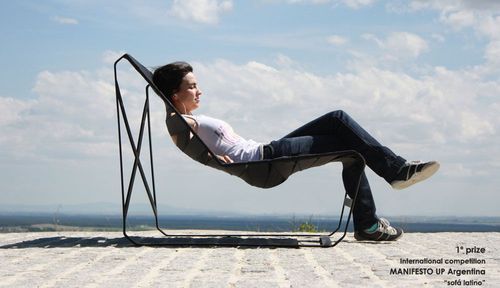
the perfect reading chair

the height and pitch of the back are perfect. these chairs are literally strewn all over parisian parks and gardens but, despite repeated searches, i can't figure out where to get one.
update: the brainy julien benayoun has solved this puzzle. this perfect reading chair is part of the luxembourg family of outdoor furniture designed by frederic sofia and made by fermob.on a street in paris

ike jime smackdown
turns out ike jime (the mystical japanese fish-killing technique) yields better-tasting, better-textured fish by acclamation. the folks at cooking issues (now officially my favourite blog) proceeded to do some nifty investigative research on why this might be the case. the plausible explanation is that inserting the needle up the spine destroys the fish's spinal cord:
Certain fish that swim for very long periods have highly a highly developed autonomic nervous system for swimming (sounds like the CPG’s Bob was talking about). These fish, like bass, like horse mackerel, etc. benefit from spinal cord destruction. Other fish, like plaice, that don’t have highly evolved constant swimming reflexes, don’t benefit (or at least not as much). The paper recommends doing a species by species test to see which fish benefit the most. The paper didn’t mention CPG’s (in fact no paper did that I could find). Someone needs to do some research on that. So then, when you destroy the spinal cord, you destroy the swim reflex, which helps reduce ATP loss, delaying and softening rigor, increasing the quality of the fish.
this definitely did not emerge when i was talking to the professors at the tsuji academy about their fish preparation techniques in 2005.
Aug 11, 2009
more cooking issues
i keep telling people that being a graduate student is, apart from the comparatively lousy pay, the best thing ever: you get to do stuff you're interested in, doze off reading, work in cafes, the whole bit. then i read the latest post from cooking issues and it is clear that in fact the real best thing ever is to be dave arnold and nils noren. this episode, they do an in-depth analysis of ike jime (a semi-mystical japanese fish-killing process purported to yield superior fish flesh).

convivium

if you have £49.50 kicking around, you might consider ordering a set of all 8 issues. and if you have £99.00 at a loose end, you might consider ordering a set for me too.
Aug 9, 2009
fond of the pond
pachaug pond this weekend. on saturday evening, the sky at dusk was wreathed in pale cirrus clouds that appeared to emanate from the sun, which glowed from below the horizon in the gap between an island in the pond and the westerly shore. we took kayaks and canoes out on the water. everything glowed in the blue light that radiated from the sky, and small insects made circles on the still surface; we heard the band clearly, playing in the bay, and the beacon on the beach flashed on as the last light faded. later, when the air turned cold and a layer of mist appeared on the water, an old christmas tree was consigned to the fire and went up in a rush of flames, and pipes and cigars appeared. people eventually drifted off to tents and bed. the acoustic guitars came out at 1am and drew the circle of people in chairs tightly around them. dozed off around 4am in a hammock strung between two paper birches, to music and the sound of the tea-coloured pond lapping at the breakwater.
Subscribe to:
Posts (Atom)