Jul 23, 2009

aerogel

would someone buy me a block of aerogel? (what is aerogel? find out here and here.) you can do all sorts of neat things with it. it is also optically weird and looks awesome.

photo taken at JPL by robert m. brown and found at hubert van hecke's aerogel page

tool library

why, cambridge, can't you have one of these?


Jul 22, 2009

sourdough success

after a few false starts, i've figured out the activation schedule on this starter that's been growing for almost two weeks. last night, a nice sourdough loaf; today, a killer grilled cheese sandwich.

Jul 19, 2009

the 17th vermont brewers' festival

two weeks ago, andrea asked if i'd be interested in going up to burlington for the annual vermont brewer's festival. does a dog have fleas? lisa drove up from connecticut and we left on friday afternoon. after traffic miscellaneously up 93 and 89, we stopped for dinner in downtown burlington. it was dark when we got to the campsite, but we sat under a tent canopy intended for small trucks and drank rum and coke and i poured surreptitious shots of basil hayden's for people who would appreciate it. more than two inches of rain fell on friday night; by 1am, the gradually rising water level at my end of the tent drove me out into the back seat of the car where i eventually fell asleep on top of a pile of cd cases.

we camped with people who care about food. (photo by brennan guerriere.)

next morning, there were stacks of bacon and ziploc omelets, and i made a batch of sourdough pancakes with the starter that's been doing its thing for two weeks, massive blueberries andrea picked at home, a half cup of bacon fat, and dark grade B maple syrup we got from the bulk bin at the local co-op. they were stunningly delicious--softly-crisp outside, tender and fluffy within. the next pancake sunday, east coast edition, is way overdue. it was noon by the time breakfast was over; i got an extra large cup of chuck's home brewed ryePA (a stunningly good, crisp, floral, dry-hopped rye IPA) and we went down to the lake to doze on the sand before grilling burgers for an early dinner before beer.

when we got to the fairground, there was already a line stretching at least 300 yards. we got our beer tickets (15 tickets, each redeemable for a pour) and a glass to drink beer from. after this, my memory begins to haze over. i vaguely recall an abundance of really beautiful dogs, having a seagull do a small poop on my arm, and having many excellent beers, including (but probably not limited to)
  • dogfish's chicory stout and raison d'etre
  • harpoon's munich dark
  • allagash's tripel
  • dieu du ciel's route des epices, rosee d'hibiscus, and aphrodisiaque
  • north coast's pranqster
  • ommegang's rare vos and hennepin
  • magic hat's brown rice lager
  • long trail's blackbeary wheat
  • rock art's belgo-american ipa and the sunny and 75
  • vermont pub and brewery's epinette and forbidden fruit
  • trout river's double time and whitewater
i had 5 tickets left when they announced the imminent closing of the festival, so we cut a couple of lines and pounded our last beers--this was a crime, especially for the double time and white water. the skies were clear by the time the police kicked us out. we walked back along the lakefront trail with fireflies glowing in the bushes and the milky way a bright sash across the sky.

Jul 15, 2009

summer reading, 1 of 7

libraries are such marvellous institutions.

Jul 14, 2009

terroir: a critical analysis

going through the files, i found a paper from several years back analysing the relationship between subjective wine quality and underlying vineyard physiography (soil type, site exposure, etc). i recently updated it and reworked the figures, though the original dataset appears to have vanished. the physiographic components of a vineyard site are elements commonly associated with the concept of terroir: in various forms, the unique combination of physical characteristics of a vineyard have become associated with quality and thus with price. the french legal system of denominations d'origine contrôlée (DOC) is perhaps the best known of the type, though there are similar systems of spatial classifications in germany, italy, spain, and other traditional winegrowing regions, as well as in the US. if it's not from burgundy, you can't call it burgundy, even if it's pinot noir. in any case, opinions vary about the degree to which terroir is detectable in wine and the strength of the connection between quality and terroir. this paper is a first analysis of terroir in the american context (indicated by AVA, american viticultural area, classification) and its relationship with subjective quality (as measured by robert parker's wine score over a period of several years). flaws aplenty, but a good place to begin conceptually (i hope).


to download the paper, go to its google base page. comments (particularly on the analysis) and suggestions (for additional datasets) welcomed.

Jul 13, 2009

little gidding

We shall not cease from exploration
And the end of all our exploring
Will be to arrive where we started
And know the place for the first time.
(on which, also see ithaka)

Jul 12, 2009

RIP kaguya

after some time in orbit, JAXA's kaguya lunar orbiter crashlands on
the moon, as planned, taking HD video until the last moments.

>

cambridge sourdough

1 hour autolysis, 3 hour first rising, 2 hour second rising. needs more salt.

Jul 11, 2009

love+butter

i made it out of wyss in time for dinner at love+butter, my first time back in over a year. they've moved into a new apartment with a massive kitchen, and their custom-made table is arriving within the month--frame welded by a supplier of aerial acrobatic equipment and top made by a cabinetmaker somewhere close by. there are also new toys: a vacuum sealer and an immersion circulating heater. they served:

fava pate with rye and whole wheat sourdough breads

spring salad (frisee, roasted zucchini, turnip, red carrot, and beet) on sardinian couscous in an arugula pesto

soft-boiled egg with miso, dashi (non-traditional variety, made with kombu, dried scallops, dried mushrooms), a sugar snap pea, and shavings of bottarga from their loaner fancy deli slicer machine

beef heart tortelloni with pea shoots (i think)

lamb tongue and lamb cheek with pan-roasted new potatoes, scallion, and a quivering pale fragment of mint jelly

cucumber jelly with preserved lemon granita

cherry compote and cherry preserve with a (possibly almond-meal) sponge and pine needle ice-cream

earl grey truffle, jasmine tea panna cotta with honey, and a square of lapsang souchong infused red bean paste

throughout: a salice salentino (epicuro 2005; it costs less than a 6-pack of bad beer!)
the final two courses were particularly awesome. red bean, lapsang souchong, and coarse salt? yes. i like it when people demonstrate restraint with chocolate. it is such an easy crowd-pleaser that i can't help feeling that desserts that depend too much on chocolate demonstrate a lack of serious intent.

Jul 8, 2009

good agriculture

a few days ago, a friend who's a political scientist sent me a link to a new york times article about will allen, who is, among other things, an urban agriculture advocate. i've not run across his stuff before, but i think urban agriculture is generally the right way to go, if it is done correctly. i have some minimal objections to urban agriculture fanatics: the principal one is that if it isn't done right--ie in an ecosystemic way--it is often worse than the alternative. city rainfall runoff systems are generally not capable of dealing with non-botanical agricultural runoff. urban market gardening on a large scale, without NPK nutrient addition, is probably sustainable and net-beneficial. include meat animals anywhere in the system and things begin to break down unless all the components are fairly carefully hooked together. for example, the urban meat animal par excellence is the chicken, or so people think. but keeping chickens in urban environments without transferring the chicken wastes into a composting system that then feeds a garden almost inevitably pollutes the rainwater runoff system with high-nitrogen fecal matter that promotes algal growth in pipes, reducing their lifespan and increasing maintenance costs (and incidentally, increasing the likelihoods of oxygen-starving any water bodies into which the runoff is directed: that's what algal blooms do; high temperature composting sterilizes fecal matter, and plants absorb nitrogenous compounds so that rainfall washing through a flourishing garden is generally close to being filter-clean).

the article concludes by noting that intelligently-executed agriculture has positive externalities, enough perhaps to warrant subsidies to encourage it. well yes. duh, in fact--i've been grouching about this for years (since the year we created the seminar on biodiversity, agriculture, and economics, which was also the year of reading more about agriculture than is good for my blood pressure). certainly, if we are willing to subsidise badly-executed agriculture with massive negative externalities, we should be willing to subsidise the opposite. conventional industrial agriculture, at least in the US, produces food that is incredibly cheap by using and abusing generally underpaid labour, large quantities of synthetic fertilizers, herbicides, and pesticides, and transportation to arbitrage low land and production costs. (there are more, but these are the big ones) each of these sources of private savings in fact transfers costs onto various parties:
  1. farm labourers (often illegal, living in horrendous conditions, and exposed to high pesticide loads) go without healthcare which they cannot afford and then tax emergency care systems,
  2. fertilizers run off into local water bodies and cause algal blooms and aquatic die-offs that require expensive remediation often funded by federal or state bodies,
  3. pesticides and herbicides damage local ecosystems (also expensive to restore) and additionally often disrupt the biochemistry of humans that consume them even in trace quantities (see this list of foods frequently contaminated with chemicals used in production). this latter health impact constitutes a potentially enormous distributed cost which magnitude is not yet clear.
  4. transportation-intensive agriculture relies on heavily subsidized fuel and systems (like the interstate freeway), both funded by the taxpayer.
all this, and the food produced isn't even tasty. it's not great for you, it's bad for the environment, it doesn't even taste good; why is it so cheap to buy when it costs so much? because the price of purchase doesn't include all the other costs incurred. on the other hand, local, intelligent agriculture (if done correctly), has fewer of the drawbacks of industrial bad agriculture:
  1. the workers tend to be paid (slightly) better and have better access to healthcare,
  2. fertilizer, herbicide, and pesticide use is much reduced or nonexistent (discounting judiciously-applied manure or compost), and
  3. produce is transported much shorter distances.
the food so produced is much more expensive, but the price of the locally-grown organic tomato captures most of the costs of production without spreading a large proportion of those costs thinly across taxpayers and consumers. the cost of intelligently-farmed meats is, of course, even more astronomical, as befits a product which (even correctly-raised*) is costly. arguably, this sort of fully-loaded pricing encourages more efficient consumption: food should be good, it should be produced well, we should be eating smaller amounts of it, a larger proportion of which should be vegetables, we should be treating it with the respect due to costly things.

but can intelligent agriculture provide for people who already can't afford food, or is it going to be the province only of the affluent? the answer depends on assumptions:
  1. if we assume that everyone must eat as much as they currently do (anywhere from 10% to 40% more calories than they need, hence the obesity epidemic in the US),
  2. if we assume that foods will be eaten throughout the year regardless of whether or not they're in season, and
  3. if we assume that the majority (over 90%) of the $50+ billion spent annually on farm subsidies continues to go to industrial agriculture,
the answer probably is no. but if both these assumptions are relaxed, more local, lower-impact agriculture might go a long way towards feeding people well and cheaply. we'll never be able to grow all the staple starches (rice, potatoes, beans, etc) within 50 miles of the coastal urban centers, but a large-scale shift in produce production is possible. food in season is more plentiful, cheaper to produce, and cheaper to sell. locally-grown food travels shorter distances and is thus cheaper to transport. organic or low-pesticide/low-herbicide produce keeps people healthier and eventually will result in healthcare cost reductions both for individuals and for healthcare provision systems.

the key, in a food production system already heavily biased in favour of the incumbents, is to change the price incentives consumers face, so that making the right choice isn't a matter of fighting price signals. bad food produced badly is currently cheaper to buy than good food produced well. for those at the margins of poverty, such a situation is untenable: the obvious rational choice is to choose the cheaper food (and thus to choose all the implications that cheaper food brings). even for those comfortably above the poverty line, choosing between organic strawberries at $6.99 a pound and conventional ones at $3.99 a pound becomes a tough choice between the amorphous, possibly distant benefits of organic produce** and the clear, immediate benefits of saving a couple of bucks.

assumption #3 above, if relaxed, may begin to get us out of this trap. to get this started, subsidize local farms again. levy heavy, punitive taxes on industrial agriculture to pay for subsidies for local, intelligent agriculture. (the same way significant taxes on gas, roads, and personal cars should subsidise cross-national railway and efficient, high-frequency urban public transit, another hobby horse of mine.) we know that good food produced well is less expensive than bad food produced badly; but the price tags need to say so too.

(next: a description of a system for producing and distributing food locally. a food grid, if you will.)


* the costs of meat agriculture gone wrong are legion, and are enormous. low beef prices (for the fast food industry) are largely supported by almost completely unregulated cattle ranching in central and south america. the result is deforestation on a massive scale.
** which is not to say that all organic food is necessarily well-produced. earthbound, one of the largest organic producers, is as industrial as they come. strawberries are top of the list for foods containing herbicides and pesticides: a luscious berry without an outer skin, we eat exactly what birds and insects want to eat and everything sprayed on to prevent them from eating before we do.

today's discovery

it is difficult, awkward, and time-consuming, but not impossible, to char-grill an entire marinated chicken over a gas burner.

google chrome OS

o, the google OS. it was only a matter of time. kottke points out that a web platform/OS effectively already exists, since users can already run most of their lives online. this is true, but misses the point.

the point is this: the main (only? probably not) promise of the web as OS is client thinness -- if everything happens there, very little needs to happen here. we should have ultra light, incredibly cheap clients that consist essentially of a small graphics-optimised processor, a display, and input device/s. but, of course, as it stands, in order to be able to use the web as an operating system, users still almost always require a heavy operating system. (i discount smartphones as promising but ultimately incapable of replacing full-featured systems as they are currently configured. android is nice, but it doesn't cut the mustard. if chrome OS, as promised*, can jump you straight into the browser while still providing some of the client-side lifting necessary for a low-latency user experience, it will surmount this almost-last hurdle to the world of thin clients. (after that, we'll just need immersion wireless connectivity, but 4G is theoretically on the way.)

* why did they have to go and announce vapourware? what happened to the company i used to work for anyway? i expected better of sundar.

Jul 5, 2009

droit, or some things are wrong

in our relentless pursuit of making everyone happy with "doing their best," i find we often lose sight of how there are often right ways to do things and thus, conversely, wrong ways to do things.* someone who is adroit follows an elegant and effective course of action, like odysseus, whose cunning and shrewdness led him to do the right thing (not a coincidence that droit in the original means right or law, per the motto of the windsor crown). a good printer, a good builder, a good furniture maker--they are all adroit in their practice. the same holds for the cook. i found this passage from zhuang zi in the most unlikely of places (fuchsia dunlop, for those who care):

庖丁为文惠君解牛,手之所触,肩之所倚,足之所路履,膝之所倚,砉然响然,奏刀豁然 ,莫不中音。合于桑林之舞,乃中经首之会。文惠君曰:“嘻,善哉!技盖至此乎?” 庖丁释刀对曰:“臣之所好者道也,进乎技矣。始臣之解牛之时,所见无非牛者。三年之后,未尝见全牛也。方今之时,臣以神遇而不以目视,官知止而神欲行。依 乎天理,批大郄,导大髋,因其固然。技(枝)经肯綮之未尝,而况大骨乎!良庖岁更刀,割也;族庖月更刀,折也。今臣之刀十九年矣,所解数千牛矣,而刀刃若 新发于硎。彼节者有间,而刀刃者无厚,以有閒入无厚,恢恢乎其于游刃必有余地矣,是以十九年而刀刃若新发于硎。虽然,每至于族,吾见其难为,怵然为戒,视 为止,行为迟,动刀甚微,然已解,如土委地。提刀而立,为之四顾,为之踌躇满志,善刀而藏之。” 文惠君曰:“善哉!吾闻庖丁之言,得养生焉。
fortunately for you (and me), here is the least egregious of the translations of this passage from zhuang zi:
His cook was cutting up an ox for the ruler Wen Hui. Whenever he applied his hand, leaned forward with his shoulder, planted his foot, and employed the pressure of his knee, in the audible ripping off of the skin, and slicing operation of the knife, the sounds were all in regular cadence. Movements and sounds proceeded as in the Dance of the Mulberry Forest and the blended notes of the King Shou. The ruler said, 'Ah! Admirable! That your art should have become so perfect!' (Having finished his operation), the cook laid down his knife, and replied to the remark, 'What your servant loves is the method of the Dao, something in advance of any art. When I first began to cut up an ox, I saw nothing but the entire carcase. After three years I ceased to see it as a whole. Now I deal with it in a spirit-like manner, and do not look at it with my eyes. The use of my senses is discarded, and my spirit acts as it wills. Observing the natural lines, (my knife) slips through the great crevices and slides through the great cavities, taking advantage of the facilities thus presented. My art avoids the membranous ligatures, and much more the great bones. A good cook changes his knife every year; (it may have been injured) in cutting. An ordinary cook changes his every month; (it may have been) broken. Now my knife has been in use for nineteen years; it has cut up several thousand oxen, and yet its edge is as sharp as if it had newly come from the whetstone. There are the interstices of the joints, and the edge of the knife has no (appreciable) thickness; when that which is so thin enters where the interstice is, how easily it moves along! The blade has more than room enough. Nevertheless, whenever I come to a complicated joint, and see that there will be some difficulty, I proceed anxiously and with caution, not allowing my eyes to wander from the place, and moving my hand slowly. Then by a very slight movement of the knife, the part is quickly separated, and drops like (a clod of) earth to the ground. Then standing up with the knife in my hand, I look all round, and in a leisurely manner, with an air of satisfaction, wipe it clean, and put it in its sheath.' The ruler Wen Hui said, 'Excellent! I have heard the words of my cook, and learned from them the nourishment of (our) life.'
from the inner chapters, translation by james legge
dôgen wrote some instructions for chef monks (actually, "as instruction for accomplished practitioners of the way in the future"); these tenzo kyōkun are worth reading.

another perfect sandwich

thin-sliced roasted cauliflower, grilled zucchini, tomato, and charred green onions, with black pepper and olive oil, on toasted ciabatta.

Jul 4, 2009

fireworks and good weather

after a week of loping about under steely skies, today we woke up to blue skies and bright sun shining through the maple leaves outside the window. like desert wildflowers after the rain, small columns of grill smoke began to rise around noon and kept on going. after the barbecue, a large contingent left for the riverside to watch the fireworks; i managed to lose them, but found other people by sheer chance and watched the fireworks from the green building instead. neil diamond sang sweet caroline, and hundreds of thousands of people sang along with him.

there were loads of flashy, multicoloured crowdpleaser fireworks, and in the last two minutes of the show the sky was so thick with light it was nearly tasteless (but not quite) and it hurt to look at it, but the most awesome pyro sequence of all actually occurred about 17 minutes into the 23-minute show. 6 composite shells went up simultaneously and detonated within a few seconds of each other, sending a web of evenly-spaced fine golden threads across almost 160 degrees of the sky; these eventually turned into a shower of spreading, sparking points gradually falling and fading into the night. sandwiched between red, purple, and green smileyfaces and big balls of scarlet fire, the filigree of gold was subdued and serene--anyone can wow an audience with many kinds of flashy explosions in a riot of colour, but i imagine it takes a real gift to do it with just a few of one type of pyrotechnic, in just one colour, set off with sensibility and restraint.


(also, did you ever wonder if those marvellous bright colours in fireworks were too good to be true? as it turns out, it's all ok, they're just burning lots of heavy metals and letting the combustion product drift gently over the city. occupants of beacon hill, try to hold your breath.)

Jun 30, 2009

philippe parreno: the boy from mars

i saw this at the kunsthalle in zurich; to get to the screening room, you walk through galleries mostly empty except for parreno's extremely bright marquee sculptures. one room was dedicated to a cloud of helium-filled black speech bubbles bobbing at the ceiling. the gallery was deserted, and the marquee at the door to the screening room slowly faded from brilliance to complete darkness while the boy from mars looped, a quiet, serene, and disquieting film made in thailand, apparently on property owned by rirkrit tiravanija. (music at the end is by devendra banhart, whose music is so surpassingly strange i am lost for words.)

microwave vacuum dehydration: experiments in plasma explosion

the latest post from cooking issues is about using a microwave and a vacuum to dehydrate fruit. in building a jerry-rigged microwave vacuum chamber, what they had apparently not thought of was that "under partial vacuum, microwave ovens really, really want to make balls of plasma. I kept having giant balls of fire shooting off the thermocouple. I ripped out the thermocouple. Then I kept on getting balls of fire coming off my oranges." have i mentioned how much i love cooking issues?


geert goiris, blast #3

first infusion

before moving a few weeks ago, i noticed that what appeared to be an ornamental cherry tree in the yard next door was in fact a tree beginning to burgeon with edible, plump sour cherries. the fruit got ever larger and riper, and eventually i had no choice but to ring the doorbell and ask if they would let me pick the cherries that they clearly weren't eating. a few days ago, i made off with a pound; yesterday, remembering the chairs in the back of the old house, another two pounds, this time dark red, drippingly juicy, and on the verge of being overripe. the first infusion is sour cherry, fresh mint, and cherry pits (in vodka). does cambridge need one of these?

Jun 29, 2009

peeves

  1. writing in library books. even in pencil. i would like to arrive on my own at the conclusion that "NETWORK = POWER!!!"
  2. items on craigslist and ebay without decision-critical metadata. who is going to buy a "bike frame, paint chipped in places, with wheel"?
  3. unnecessary and unpleasant ornamentation on otherwise functional, well-designed objects. i don't want big purple dots on my hammer handle.
  4. PDFs of book pages that are surrounded by enormous black borders (wasted toner!), slightly skewed (unreadable!), and scanned at unnecessarily high resolution (network load!)
  5. despatch systems that give 6-hour service windows during which you're expected to be home and then fail to despatch a serviceperson within said window. (verizon, i'm looking at you.)

transpositions

Whether a given problem is similarly shaped enough to be solved by analogical transfers of schemes cannot be decided in advance by social scientific analysts, but must be determined case by case by the actors, which means that there is no fixed limit to the possible transpositions.
william sewell, the theory of structure
on which subject, also see this.

Jun 20, 2009

individuality

cultures that honor individuality create diversions that routinely disguise the collective bases of individual identity.

Jun 19, 2009

more on the hermeneutic circle

You wander about for some time while noticing interesting things, and then you try to find a way out by listening for what the natives suggest, even though you know that in the singularity of your own experience, you will always remain an outsider, even though the natives often can't give directions to the major landmarks in their own hometown, and even though you can never wipe out your own access or ignore theirs, with the result that, when you are finally ready to restate what you think they are saying, you know you still might be led astray.

Jun 18, 2009

moving and the internet #2

the minuscule modem arrived in an enormous box with the first UPS truck today but the large, multifold setup guide* says (i paraphrase freely): "do not attempt to install or use the internet until your service activation date** or you will be beset by a fate too awful to describe." technology always overpromises and underdelivers.


* same size as the enormous box's footprint. coincidence?
** still SIX DAYS AWAY.

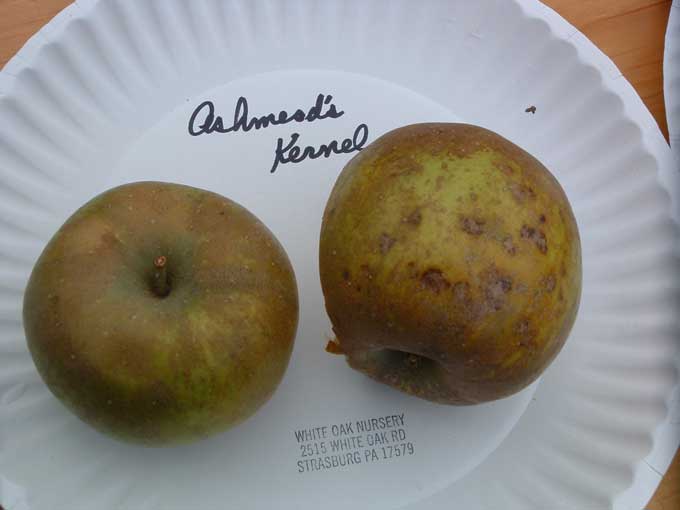
ashmead's kernel

is an old english russet apple "medium size, golden-brown skin with a crisp nutty snap. Fruit explodes with champagne-sherbet juice infused with a lingering scent of orange blossom. Flesh is dense, sugary and aromatic with intense flavor, characteristic of russets."* orangepippin.com (the comprehensive resource for apples and orchards) tells us that ashmead's kernel is a homely fruit (and how) but, with flavour like that, does it really matter? once available here but now, alas, sold out.


* for erudite and mildly snarky essays on garden catalogues and their often purple prose, see onward and upward in the garden, by katharine s. white (wife of e.b.)

Jun 16, 2009

moving and the internet

just moved, and in the process of painting miscellaneous things. i placed an order for verizon dsl and they have just shipped the modem. activation is scheduled for june 24 which is EIGHT DAYS AWAY. naturally, it is not possible to collect the modem in person at the verizon store in harvard square and still get it for free in this online-only offer they're having. i want the internet back now.

Jun 10, 2009

fusion tables and data interchange

google research introduces fusion tables, and it's neat and nifty, but it looks different from when it was first conceived (and when we started talking about it in earnest, during this trip). i guess that's what happens when you leave mid-way. more thoughts to come.

Jun 8, 2009

a new source of deliciousness

pomegranate molasses, lime juice, honey, and soda water, with mint. we could sell this at a beachside bar, with fried chickpeas rolled in cayenne pepper, cumin, and dried mint flakes, and make millions.

Jun 2, 2009

munich to zurich

[catching up #2; tenses are all over the place, as you might expect]


this first bit written on a quiet, fast, inexpensive train from munich to zurich*, with leonard cohen's the faith** playing on the ipod as we roll through the summer country towards switzerland. this is immeasurably better than flying.

the 3D display at the zurich hb was dark when i got there, so i passed it by and came directly to wollishofen where hk was waiting for me at the tram stop. i rehydrated extensively while she cooked, then we walked down to the lake when tom got back. after dinner, we allowed the food to settle for a decent period before venturing into the lake, which was clear and not as cold as it looked. i bumped into a duck while swimming to the jetty; it looked surprised, bobbed its head slowly up out of the water, then sent a long string of poop into the depths.

* is it really so hard to get this right? spend less money on highways and cars, stop subsidising gas and the auto industry, learn to eat food grown closer to home, tax cars and gas more, build common-gauge rail lines, and good transit systems almost inevitably become reality.
** apparently based on an old basque song. i first heard this at enrique martinez celaya's lecture at the ranch last summer.

munich

[catching up #1] an assortment of thoughts:

  1. there's quite a lot of art in munich (i cherrypicked and went to the glyptothek, the moderne*, and the brandhorst).
  2. the munich subway train stations have no faregates, only a ticket validator. this is quite nice and for sure reduces cost of enforcement. but such a fare system (essentially self-checking) only works when a few conditions coexist. rule-abiding, non-freeriding users are probably critical, but the incentive structures built into fares is also important. in munich, a single trip in the two central zones runs about EUR2; a 7 day unlimited pass for the same zones is EUR11.50; the fine for not having a valid ticket is EUR40. clearly, the only intelligent decision is to buy the long-term unlimited pass. this encourages high-volume usage and reduces the need for enforcement. the same thing, by the way, happens in zurich (on which more anon). if only we knew which were necessary and which were sufficient.
  3. shops close early. you can't buy a band-aid after 8, but you can be drinking beer and eating sausages til well past midnight. on balance, this is a good thing.
  4. and what beer and what sausages. holy crap. special mention: thanks to patrick, we made an excursion to the stunningly touristy andechser pub in the old city and had some draft andechser doppelbock. dark in the glass, crisp, surprisingly clean-tasting, very aromatic with citrus and malt.
  5. also, the grocery stores sell beer for less than the price of bottled water, less, in fact, than the price of PBR in cambridge, mass. this was a cause of joy in munich and now, as i write this in cambridge, a source of crushing despair. i thought of buying water for the grilling excursion, but the thought perished rapidly.
  6. the isar river runs through munich and is remarkably clean and cold. near thalkirchen, there is a gravel bank where enormous crowds gather to grill on myriad disposable grilling devices and drink beers cooled by immersion in the river. our grilling was almost thwarted by defective matches and failure to completely read the detailed instructions on the grilling device. competence prevailed, and we eventually succeeded in attaining perfectly caramelised bratwurst, herbed pork loin, and white asparagus (you know it is spargel-season when asparagus costs EUR4.60 for a half-kilogram and EUR5 for one kilogram), accompanied by copious quantities of toasted rye bread, cheese, and summer beverages of choice, which are
  7. either a radler (wheat beer or lager mixed with lemonade or lemon soda) or an apple-soda (exactly what you'd expect). both are quite civilized, much like
  8. quark. why have i never before encountered this remarkable dairy product? it is so versatile, delicate-tasting, and available in germany in a panoply of baked goods
  9. which include breads! you can buy them by weight, they are baked fresh every day, and they are strong, brown, and full of spices. the pretzels (or brez'n) are chewy, glossy, flecked with salt and, if you're lucky, still warm.
* what is a pinakothek? it is a mystery.