
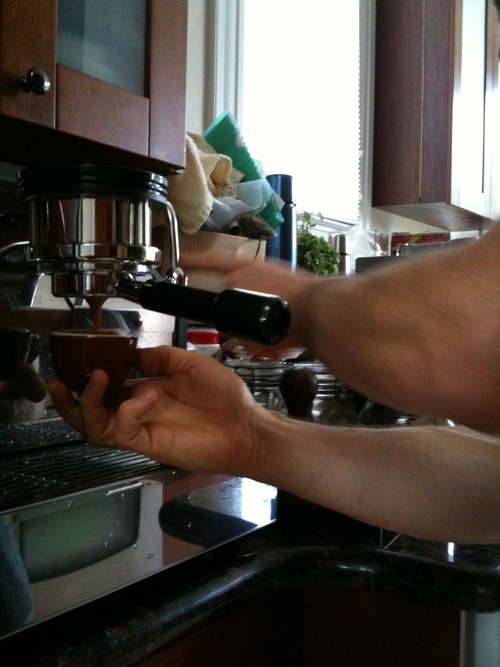
dan pulls a great shot of friendo blendo on a shiny new gs3 with a naked portafilter. in back, you see a versalab grinder, which is also very nice.
Oct 26, 2010
gs3


Oct 21, 2010
environmental sensing
the distributed cognition reading group forges on this week, into donald hoffman's visual intelligence
i liked the book when I first read it mostly because it presented a vast quantity of research in an almost patronisingly accessible fashion. the 34 (i think i'm close) rules of visual image processing were also stunning because i hadn't thought about this stuff prior to reading about it in hoffman and seeing his accompanying illustrations, each designed to highlight the particular rule being discussed. revisiting the book, my original impression of the care taken in writing it remains unchanged. it's science writing of rare quality. the power of the illustrations and the systematic presentation of the rules of visual image processing is diminished somewhat by greater familiarity with the subject matter, but not by much.
my quibbles this time around are with underlying assumptions. most of these are not, in the grand scheme, very important. the one which is worth mentioning is the question of where these rules of visual intelligence come from to start with. hoffman goes on a brief chomsky lovefest some way into the book, and argues that there is something innate about these rules. the argument for innateness (or hardwiring, or whatever) is that the rules are non-obvious, they emerge at a young age, and are almost universal. this argument seems incomplete. perhaps this is because i have, lets face it, no training in the cognitive sciences. but for counterargument's sake, here's another explanation.
a quick survey of the rules leads to the overwhelming conclusion that they are designed to be as parsimonious as possible in terms of cognitive processing. the constraint imposed by the laws of physics produces patterning and regularity in the behaviour of physical objects in the environment as perceived visually. we are pattern-seeking and pattern-identifying beings, and we find patterns in things especially quickly when the patterns are frequently repeated. the ubiquity of the rules of visual information processing therefore plausibly reflects the ubiquity of physical laws rather than innate hardwiring.
(this is not to say that thousands of years of evolution have not produced neural pathways optimized to process these particular types of regularities and patterns, but only to suggest that there may be an antecedent cause for this kind of hardwiring.)
hoffman's conclusion went unappreciated by me when i first read it but not this time around. he notes that the world we perceive is both the world we have interpreted through vision (the phenomenal world) and the world as it "really is" (the relational world). as long as the relational world is systematic in its behaviour, it is possible to interpret what we perceive of it. importantly, the relational world can be completely arbitrary, as long as it is systematic. this is deep stuff, at least to me, for what it contributes to sociological understanding: it goes some way to providing a theoretical basis for understanding why practices that seem totally alien to me can be accepted as norms by someone else in a society where those practices are normal.
clay shirky gave a talk to a small number of people at HBS a few weeks ago about his new book. during the talk, he made much about cultural values and norms, but never defined culture. i brought that up in the Q&A and he instantly gave one of the crispest and best definitions of culture i've heard yet: "culture is the set of habits that allow a group of people to cooperate by assumption rather than by negotiation." i would extend and improve on it and say culture is the set of habits that allow a collectivity to coordinate by assumption rather than by negotiation."
the fact is that we are environment-sensing entities. when we see that the environment is chaotic, our instinct is to keep paying as much attention to it as we can, in as fine-grained as manner as we can, until we can detect a pattern. we are also economical (lazy, if you prefer) so that, if that pattern holds and is detectably stable, we then identify the rule producing the pattern, and use it to reduce attention on that phenomenon to an algorithm and devote our freed-up attention capacity to something else. in doing this, we form habits: sets of rules of cause and effect, sequences of things we do because doing them in the past produced a result that we wanted to recur.
when we act in the world, we combine both the phenomenal world (our perception of the world) and the relational world (the "real" world that responds to our actions). we develop habits by understanding the relationship between action and the behaviour of the relational world in response to action, as mediated through perception. (this can be said, now i think of it, even for how we develop habits for things like scratching a scab. if you haven't tried this, know that it feels really good.) in other words, we develop habits when we identify patterns in how our phenomenal world changes as the relational world responds to the actions we perceive ourselves taking in the relational world.
under all this is the assumption that humans are experimental beings: much of how we act comes from learning how to act in a real world that we perceive as responding to our actions. this is what frustrates me about our continuing obsession with strategy (formal and rational rules) where the really interesting stuff seems to be happening in tactics (practical reason responding to an environment with the resources at hand).
where is the research program on practical reason?
Oct 13, 2010
Oct 10, 2010
three states of hors d'oeuvres
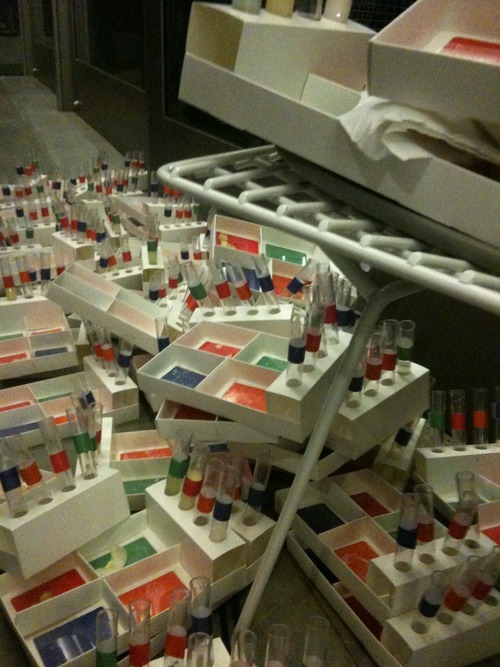
the project on spatial sciences was at the lab's re-launch. lots of fancypants people swarmed the northwest building to kick a soccerball around the basement (really) and eat a light repast upstairs. the idea: eat something solid, drink something liquid, while inhaling an aromatic vapour. in theory, intentional synaesthesia. in practice, the aroma of bonito flakes and sunkist orange juice permeating throughout. negative pressure in the vapour booths would probably help considerably. as would better flavourants and a disposal plan for the waste from the hors d'oeuvres (seen above forming large drifts piled up against the windows).
Oct 7, 2010
cooking with fire and clay

L-R top row: garden furniture, unidentifiable magazine, pot with stew, bolivian peasant wood stove, firewood, pot with beans, max's surfboard.
L-R bottom row: some rocks, bricks.
L-R bottom row: some rocks, bricks.
michael pollan is such hot shit, cooking mindblowingly delicious multicourse collabo meals over the span of more than a day with nothing more than an enormous wood-fired oven, a bevy of experienced baker-folk and chef-types*, apparently vast quantities of local seasonal produce and carefully raised meats, specialty equipment (including a real, live salamander, shown here to great advantage hovering above apricot and saffron gratin), and untrammeled access to a palatial country estate in napa, calif.
while pollan and his gang did that last weekend—and in fact completely unaware at the time that we were recreating his experience in microcosm—a few of us were doing something quite similar but on a scale befitting our stations in life.
caitlin's fieldwork brings her often to bolivia from whence she has, over the course of several visits, amassed a sizeable collection of clay pots and other cooking apparatus in which she now does most of her cooking. she returned from her latest excursion with a bolivian wood stove which is elegant in its absolute simplicity. this object, which you see in the photograph above, inspired chris and caitlin to convene us for a saturday afternoon exercise in atavism: to return to the humans that we all were in the dark backward and abysm of time by cooking a meal with fire and clay. i pointed out to chris that since we usually do most of our cooking over fire it wouldn't truly be atavistic without the clay.
our interdependent cooking configuration:
caitlin's fieldwork brings her often to bolivia from whence she has, over the course of several visits, amassed a sizeable collection of clay pots and other cooking apparatus in which she now does most of her cooking. she returned from her latest excursion with a bolivian wood stove which is elegant in its absolute simplicity. this object, which you see in the photograph above, inspired chris and caitlin to convene us for a saturday afternoon exercise in atavism: to return to the humans that we all were in the dark backward and abysm of time by cooking a meal with fire and clay. i pointed out to chris that since we usually do most of our cooking over fire it wouldn't truly be atavistic without the clay.
our interdependent cooking configuration:
- clay pots, wood stove, and mad cooking skillz from caitlin;
- more mad cooking skillz, lamb shoulder, plus general aura of cool from max (who makes music, works for the food project, and surfs);
- bricks, firewood, and knowing commentary from chris;
- big talk and giant scarlet runner beans from mexico by way of steve sando (by way of me).
to reduce to almost zero the risk of a runaway conflagration, chris and caitlin constructed a platform of bricks upon which the stove would sit. we were momentarily nonplussed by the firewood (clearly too long to fit completely in the stove) but decided to go for it anyway since we didn't have a saw to cut things up. max and chris started the fire with damp leaves from under the tree in the back yard while i scraped at a piece of firewood with a kitchen knife in an unsuccessful attempt to generate the tinder that we didn't have.
an open question: the stove was painted bright red to start and then turned black right after the fire got lit. will chris and max die tragically young, their promise unfulfilled because of toxic fumes inhaled while lighting a fire in a bolivian wood stove? only time will tell. but before describing what went down in each of the pots, let's backtrack an hour or so before the lighting of the fire, to when we cheated slightly by using the gas stove to boil gallons of water, brown many pieces of lamb in a cast iron skillet, fry up onions for the beans, and set off the smoke detectors for the entire building. to caitlin's landlady and her numerous neighbours, we say "sorry!"
an open question: the stove was painted bright red to start and then turned black right after the fire got lit. will chris and max die tragically young, their promise unfulfilled because of toxic fumes inhaled while lighting a fire in a bolivian wood stove? only time will tell. but before describing what went down in each of the pots, let's backtrack an hour or so before the lighting of the fire, to when we cheated slightly by using the gas stove to boil gallons of water, brown many pieces of lamb in a cast iron skillet, fry up onions for the beans, and set off the smoke detectors for the entire building. to caitlin's landlady and her numerous neighbours, we say "sorry!"
in the big pot: a lamb stew traditional (read: unbelievably labour-intensive) bolivian style. the lamb was large chunks of shoulder from animals raised by max's dad, which max first browned slowly in a large cast iron skillet. i only infrequently have the patience to brown meat thoroughly, so it was a pleasure to watch someone else do it right and apparently effortlessly. after we shut off all the smoke detectors, the browned pieces of meat went into the clay pot with their deglazed pan juices and enough water to cover, and we set them to boil hard on the wood stove. meanwhile caitlin put on her special cooking hat and started to make the chili paste. this incredibly laborious process begins with toasting a large quantity of aji amarillos in a dry skillet, then simmering them with some water, then seeding them and blending them with some onions, garlic, and parsley stems. midway, ask your toiling lascars to dice some yellow onion finely and brown those in oil before adding them to the blender. the result is a brightish yellow paste with a hint of smoke, which you fry in oil until it darkens considerably. she stirred many large spoonfuls of this paste into the stew for the final 90 minutes of cooking, during which we micro-managed the fire so that the stew stayed at a gentle simmer. the stew took 3 hours on the fire, by the end of which time all the collagen had fully hydrolysed, leaving the lamb spoon-tender.
in the small pot: rancho gordo scarlet runner beans cooked with onions, cayenne, cumin, and a bay leaf for 4 hours on a gentle simmer with water to cover. a load of finely chopped garlic went in for the last 30 minutes, followed by bunch of bitter, sugarless bolivian chocolate. cooking these beans is a walk in the park by any standard, but especially so when compared to a traditional bolivian lamb stew (see above). i futzed with them too much, but you cannot screw beans up.
some observations about clay (old hat for caitlin who cooks in nothing but clay):
- once properly seasoned and cured, you cook with clay pots just like you would with metal ones.
- conductivity in clay is much lower than in metal, so a variable heat source is much less problematic than you think. clay and wood are built for each other.
- food cooked in clay tastes earthy, in a good way. earthy food is both not new and also quite new.
- no clue about comparative heat capacity and thermal mass.
- heat control on this little stove thing (accomplished by pushing in or pulling out flaming pieces of wood) is surprisingly good.
having started cooking just after noon, we got down to eating at 5pm. beans with a dusting of chopped cilantro and onion, and lamb stew with a squeeze of lime and a salad-y garnish of halved cherry tomatoes, chopped parsley, and olive oil. i normally use a single aji amarillo as a flavour note in a large pot of beans or rice, so the large quantity of chili paste in the stew came as a surprise. the toasting and slow cooking made the chili mildly smokey and much sweeter than i usually experience it. good eats are often about an interplay of textures and temperatures: lamb shoulder soft enough to fall apart at the touch of a spoon but not mushy, a rich and distinct aroma of lamb, smoke, and sweet chilies, the herby crunch of parsley and cilantro, sugar and acid from the limes and tomatoes, beans with a texture almost meatier than the lamb and with some bite from the chocolate. a killer lunch.
here's how we stacked up against team pollan:
- they took 36 hours to cook their meal; we took 5.
- they were in napa, calif.; we were in somerville, mass.
- they used a custom-built wood-fired oven; we used a bolivian peasant woodstove.
- they made a massively multicourse meal featuring many brightly coloured food items; we made beans and a lamb stew, both of which were brown with brown highlights, though the garnishes did feature green and red bits.
- they cooked meat raised with care; we cooked meat raised with care by someone we know.
- "never once [did they have] to run out to the store for a missing ingredient"; we did two separate runs for garlic, dried aji amarillos, onions, tea, sugar, limes, and a taco for max.
reflecting on the meal beyond the food is now mandatory in any writing about food but i usually find it deeply tiresome. fortunately, one of michael pollan's numerous gifts is the ability to reflect incessantly on the meal beyond the food without ever seeming to weary of the task. i leave you with his conclusion from his 36-hour wood-fired goat-cooking odyssey, which conveniently is applicable also to our humble experiment on this other, colder coast:
I realize I’ve gotten at least as much pleasure from working together to create these meals as I have from eating them. Sometimes producing things is more gratifying—and more conducive to building community—than consuming them, I decide. ... there’s something special about the camaraderie of the kitchen crew.
* including chad robertson, who is half of the team behind tartine, a bakery in san francisco i lived regrettably close to. their croissants have a special place in my heart and on the walls of my arteries.
Oct 5, 2010
dishwasher x keyboard
verdict = clean and fully functional, after 6 days of air-drying. naysayers and debbie-downers = 0, the internets = 1. though tempting, this cleaning procedure is not recommended for notebook computers. some notes:
- remove as much of the casing as you can, and the usb cable too.
- top rack only.
- no rinse agent.
- take keyboard out periodically during cycle and flush keys with hot running water. a remarkable amount of crud builds up inside and under.
- remove before dry cycle begins.
- rinse thoroughly under hot running water to remove detergent traces.
- allow to dry under direct, hot sun for as long as you can bear it before reassembling.
Sep 28, 2010
flavour
"it has flavor, unlike anything that has been distilled six times. Now, this flavor is a strange, ancient one and might not immediately be to everyone's liking. But at least it's a taste that knows what it wants to be."
Sep 23, 2010
writing break
yamazaki 18
aberlour a'bunadhtalisker 10
ardbeg airigh nam beist
ardbeg corryvreckan
bookers bourbon
nano-lot piura (bag #3), sambirano, and hispaniola, from rogue
honeycrisp/gala unfiltered, unpasteurised cider
courtesy of the letters c, b, and e
Sep 16, 2010
Sep 13, 2010
journeyman
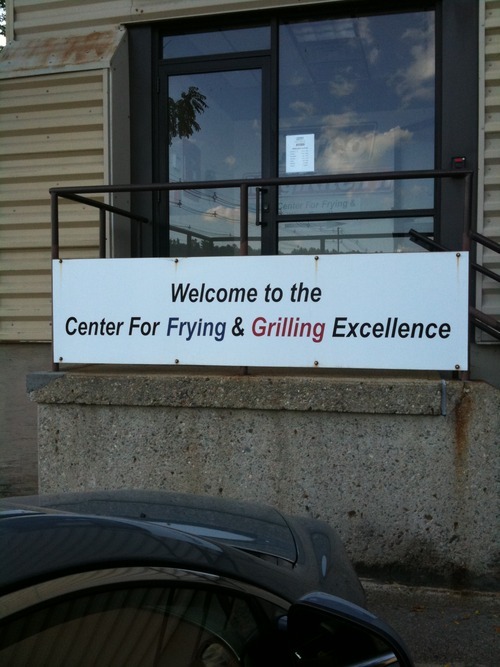
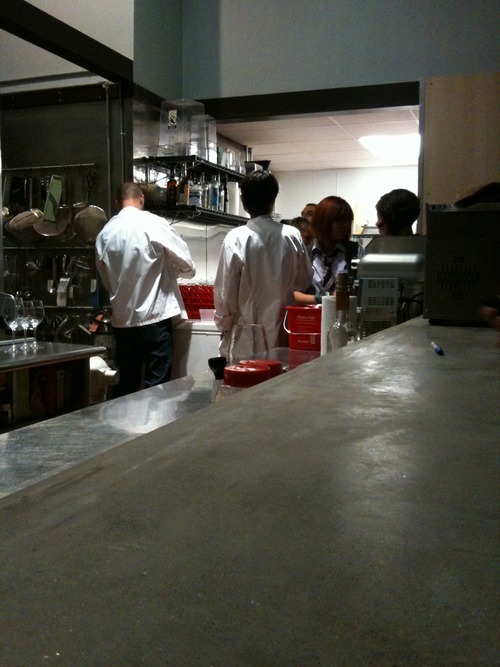
open at last! congratulations to journeyman: diana, tse wei, meg, dan, seth, and the rest of the team.
Sep 9, 2010
ceaseless practice
Ceaseless practice usually suffices to produce the precise look of subtle imperfection.
Sep 8, 2010
fugue state
the tertiary state of fatigue where the nerves and senses lie bared to direct contact with the world and there is no longer distance or matter between the vision and the absorption, where the mind races, recording, lucid but empty, and beauty can become ours through osmosis.
 (also titled
 also: seeing is forgetting the name of the thing one sees.
Sep 3, 2010
mowing
There was never a sound beside the wood but one,
And that was my long scythe whispering to the ground.
What was it it whispered? I knew not well myself;
Perhaps it was something about the heat of the sun,
Something, perhaps, about the lack of sound—
And that was why it whispered and did not speak.
It was no dream of the gift of idle hours,
Or easy gold at the hand of fay or elf:
Anything more than the truth would have seemed too weak
To the earnest love that laid the swale in rows,
Not without feeble-pointed spikes of flowers
(Pale orchises), and scared a bright green snake.
The fact is the sweetest dream that labor knows.
My long scythe whispered and left the hay to make.
robert frost, a boy's will, 1915
Aug 30, 2010
the future
"the future is useless without the insight that distinguishes fact from wish and exposes, beneath variable disguises, an unchanging self."
robert grudin, the grace of great things.
Aug 29, 2010
light
"Northern light is like light after it rains. I don't like fat, lazy, Mediterranean light."
richard serra (in calvin tomkins's lives of the artists)
Aug 27, 2010
big in japan
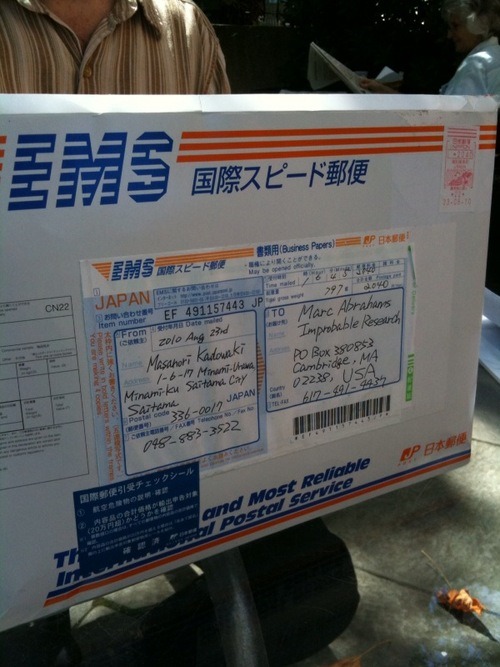
marc abrahams, chief instigator of the ignobel awards (for research that makes people laugh and then think), is the subject of a feature manga article in YOUNG JUMP, a japanese weekly with a circulation of almost a million copies. below, a record of this historic moment.
Aug 22, 2010
manifesto: the mad farmer liberation front
Love the quick profit, the annual raise,
vacation with pay. Want more
of everything ready-made. Be afraid
to know your neighbors and to die.
And you will have a window in your head.
Not even your future will be a mystery
any more. Your mind will be punched in a card
and shut away in a little drawer.
When they want you to buy something
they will call you. When they want you
to die for profit they will let you know.
So, friends, every day do something
that won't compute. Love the Lord.
Love the world. Work for nothing.
Take all that you have and be poor.
Love someone who does not deserve it.
Denounce the government and embrace
the flag. Hope to live in that free
republic for which it stands.
Give your approval to all you cannot
understand. Praise ignorance, for what man
has not encountered he has not destroyed.
Ask the questions that have no answers.
Invest in the millenium. Plant sequoias.
Say that your main crop is the forest
that you did not plant,
that you will not live to harvest.
Say that the leaves are harvested
when they have rotted into the mold.
Call that profit. Prophesy such returns.
Put your faith in the two inches of humus
that will build under the trees
every thousand years.
Listen to carrion—put your ear
close, and hear the faint chattering
of the songs that are to come.
Expect the end of the world. Laugh.
Laughter is immeasurable. Be joyful
though you have considered all the facts.
So long as women do not go cheap
for power, please women more than men.
Ask yourself: Will this satisfy
a woman satisfied to bear a child?
Will this disturb the sleep
of a woman near to giving birth?
Go with your love to the fields.
Lie down in the shade. Rest your head
in her lap. Swear allegiance
to what is nighest your thoughts.
As soon as the generals and the politicos
can predict the motions of your mind,
lose it. Leave it as a sign
to mark the false trail, the way
you didn't go.
Be like the fox
who makes more tracks than necessary,
some in the wrong direction.
Practice resurrection.
 , wendell berry, 1973
Aug 21, 2010
the tomato special
kevin and mimi are diabolical geniuses.
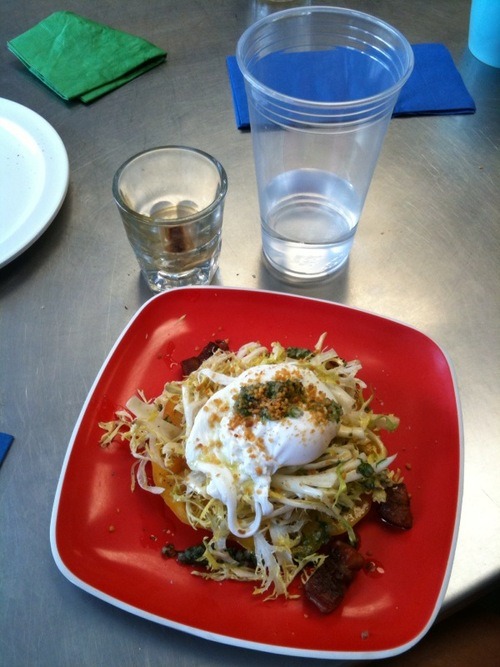
above you see a poached egg with chimichurri and fried garlic sand on frisee on a slab of heirloom tomato liberally furnished with cubes of slow-cooked bacon and lashings of bacon fat. this architectural dish is not suitable for those on vegan or low-tastiness diets.
since it is now saturday night, you will have to wait until next saturday to get the tomato special during brunch at toscanini's.
the life of the mind
We err when we stray too far from the life of the mind and the potato.
"contact," in the raw and the cooked, jim harrison, 1992.
It is a mistake to think you can solve any major problems just with potatoes.
douglas adams [thx pbarry].
Aug 14, 2010
the chemical sandwich
"every hour is banh mi hour, if the sandwich is eaten within five minutes of it being made. There is something close to alchemy when the baguette is still hot and has lent its warmth to the pâté and the sausage, while not wilting the cilantro or cucumber spears."
the new botany
"the new botany aligns the development of plants with their economic, not evolutionary, success."
amory and hunter lovins, a tale of two botanies
storm king
is neat, but doing dia beacon and storm king in the same day is like drinking two 750s of beer where just one is a sufficiency. maya lin's wave field was undergoing maintenance and was looking scruffy—not a word that usually applies to land art, but there were weedy plants growing all over it.
Aug 11, 2010
dia beacon
last weekend, we drove westward into upstate new york to visit dia beacon. the drive, google maps tells us, takes 3h 22m. on I-84, we saw a sign for "FREE SNAX" that aroused some interest. a few hundred feet later, another sign for "FREE DRINX." we took the next exit just as we saw the third sign: "NEXT EXIT." it turned out to be a troop of boy scouts with coffee and doughnuts from dunkin' donuts. from a distance, we inferred that they would give these items away but make meaningful motions towards the donation jar while doing so. we hit the road again.
dia beacon is on the eastern bank of the hudson river. if you seek the fabled alexis diner that is close to beacon, know this: google maps will lead you not to alexis but into the parking lot of a hotel and conference center nestled into the woods. here, you will discover that the diner you seek is in newburgh, 30 minutes away and on the opposite bank.
from the parking lot, dia beacon looks trivially small. an old box-printing factory skinned in dark brick, one storey tall, barely a city block wide. entering the gallery, it becomes obvious that dia beacon is actually quite a bit larger on the inside than it looks on the outside. when you notice the sub-level containing a series of huge serra steel sculptures hulking in the half-gloom, you realise that dia beacon is, in fact, enormous.
the main galleries have glazed concrete floors, ceilings of frosted glass panes angled at 45 degrees, and are painted a neutral white. on a sunny day, light pours in from the ceiling and the main galleries are full to overflowing with a soft but powerful light. doubtless one of the best installation spaces i've been in.
the best things there:
- silver meters and gold meters by walter de maria. two series of steel plates with increasing numbers of silver and gold discs embedded in them, where the total mass of precious metal is the same in each plate. serious bankroll art, though the fabrication was interestingly variable. the steel plates were drilled out, the discs placed, and then polished down. imagine the serenity and glacial perfection had each sheet been polished down as a whole rather than spot polished where the discs were placed. (they were not.)
- three torqued spirals and a torqued ellipse by richard serra. i saw the serra retrospective five years ago at moma, crowded in with hundreds of other people, and have been seeking his pieces out since. standing under a leaning plane of rusting steel, or inside the narrowing and widening spaces inside the torqued spirals, the overwhelming sensation is of being under a large looming mass, or between two massive bodies. it's the essence of cliff and valley. the beacon installation puts them in a dimly-lit but cavernous room where they seem even more massive.
- one little john chamberlain piece that had no title but was the smallest of all the pieces on long term view. blue with cream and chrome, it was happy and light and just right. the others were neat, this one was perfect.
- north, east, south, west, by michael heizer. these four large negative spaces lined with weathering steel seem infinitely deep and also infinitely massively empty. essence of void. they make me want to go see the original double negative out in nevada.
- a slew of fred sandback yarn installations. these were, in their own way, the most amazing of the pieces at beacon. where a serra creates a sense of mass with a massive, space-filling piece, the sandback pieces slice up space using nothing but pieces of coloured yarn that define the edges of planes. there is such economy in the understanding of how we perceive space and planes that words fail. you have to see it for yourself. i saw my first sandback installation in munich, a single pair of pink yarn verticals at the pinakothek der moderne and that was neat, but the beacon collection is bemusingly vast by comparison.
no photos. nothing i have does this space justice.
Aug 6, 2010
if there's something coherent here, i'm damned if i know what it is.
a long week, and one especially jarring from the contrast with maine last weekend (a weekend of nothing much but paddling around the bush compound in warm, dry, sunny weather, and getting mild sunburn). tuesday or wednesday it was so hot that the sheets felt warm to the touch. not pleasant. the humidity broke yesterday afternoon in a storm of tropical intensity and brevity, so today was hot but comparatively dry.
jim is in town for band camp so there has been more eating out than usual since he is one of the rare individuals willing to absorb high variance for a high mean in food. he also brings me latvian rye on request, which is a minor wonder of density.
i'm continually fascinated by how some people have carefully refined understandings of what seem to be impenetrable regional variation in food. jim, for instance, appears to know the inner grammar of many of the major streams of chinese cooking even though he cannot pronounce the name of his favourite chinese vegetable (丝瓜) to save his life. i do not have this knowledge of the terrain, probably because chinese food is all blended in the motherland (i had observed this previously but the ramifications, such as they are, were not evident then).
in any case, i was made aware yesterday that i'd never before eaten food that was identifiably shanghainese before, so we made our way today to what was rumoured to be an outstanding shanghainese restaurant. despite the hoop-la, it was not particularly good. in fact, some of it was actively egregious. (i ate a surprising amount of the inexplicable pancake made of corn kernels held together with lumps of cornstarch and drizzled with a spicy mayonnaise, but have since decided that it was just the surprise at work). the lions head meatballs were nice.
later, in watertown, we discovered a new, bigger, and (apparently) better middle eastern market (massis) in watertown that had hitherto eluded detection by being a block further up mount auburn street than sevan or arax. as usual, jim on faith and gut instinct alone bought enough exotic salads and pastries for a mid-size regiment. i was much more restrained and got away with some (mediocre, it turns out) cookies and a bunch of extraordinarily plump, golden-hued apricots. those were not so mediocre. then we went to sophia's and narrowly missed the last serving of frozen lemon yogurt made with their house yogurt (i got a spoonful and it leaves berryline in the dust) while downloading some local knowledge from a charmingly food-obsessed woman buying dodonis feta at the counter.
i stopped in at violette on the way home and got into a prolonged conversation with richard, the owner, who got a bit wild-eyed about the naturally made wines which he stocks almost exclusively and opined that we've been trained to not trust the taste of honest (for which read naturally made) wine. he rambled on for a bit about how natural wine is both a set of initial decisions about the processes that will and will not be used in winemaking as well as the totality of the processes and consequences that are a result of those decisions. implicit in the rambling excursus was the idea that somehow natural winemaking is the only way that wine can be made to be honest to the grape and to the drinker. this is what we grasp after when we search for authenticity. there were echoes of david pye everywhere. richard also pointed out that natural winemaking should not be confused with craft or artisanal winemaking. while this is certainly true, it is only true because of some slippage in the definition of craft. from his account (and the ongoing discussion at saignée), natural winemaking sounds like an instance of craft in the ideal-typical sense of the word.
artisanality (really, what does that mean other than small batch, laborious) has become inextricably connected with craftsmanship, and we've lost the sight of the ideal-typical conception of craftsmanship. which is, of course, the unglorified situation of making things that have to work well enough to be worth the time put into making them. the craftsman has to be understood not as an individual but as a member of a group that persists over time. and over the long evolution of crafts (like coopering or typography or boatmaking), craft processes and products gradually converge to a stable situation: they are generally neither overdone nor underdone, corners are usually not cut, the lily is not gilded as a matter of course.
put another way, the convergence of craft to a steady state is equivalent to saying that craft is a process of coming to understand, over the course of plenty of trial and error, the materials and processes available and the optimal manner in which they should be used. what doesn't work is selected out of the system. what's left is the ideal notion of craft: brutal honesty with process and material. in the real world, that can be a product of conscious refinement and cognition but often is just the consequence of selection pressure. (on this, the unknown craftsman
and when we experience an object of craft, something of that brutal honesty comes through. we become aware (whether consciously or not) that no shortcuts taken that shouldn't have been taken, there is nothing (or almost nothing) extraneous in the object. appreciating craft as process and outcome is a form of connoisseurship as much as the appreciation of art is, and perhaps is as much a natural inclination that has to be encouraged, nurtured
triangles and their centres
when i was growing up, one of our tv stations was dedicated to public access and education. it often ran informational videos including one on the virtues of rice. this video, about the various centres of triangles, is of about the right vintage.
i love informational videos.
Subscribe to:
Posts (Atom)